

103
7
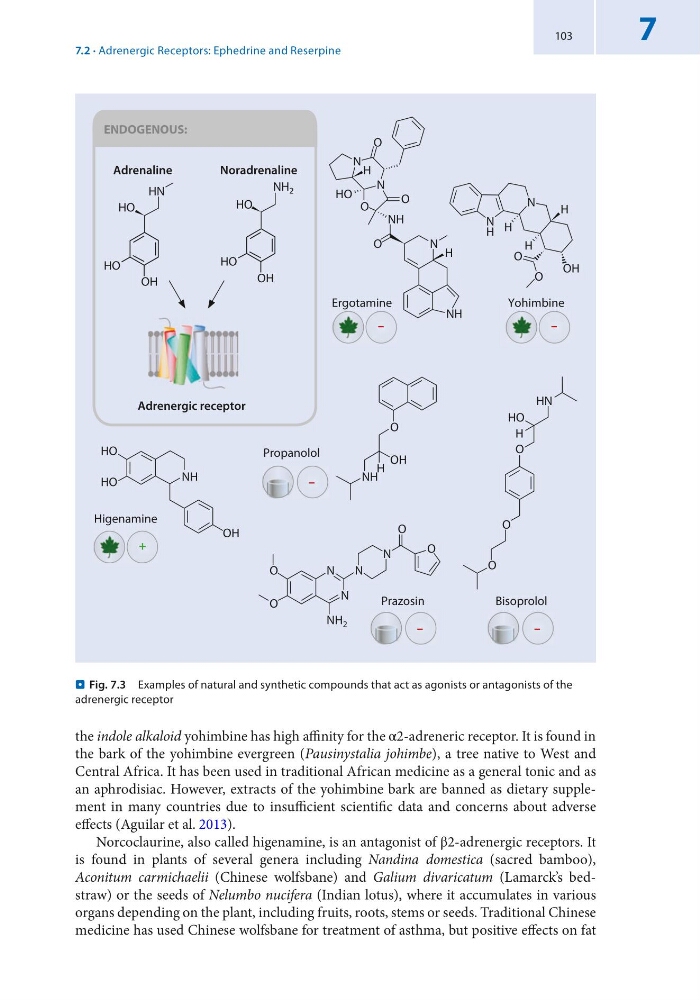
the indole alkaloid yohimbine has high affinity for the α2-adreneric receptor. It is found in
the bark of the yohimbine evergreen (Pausinystalia johimbe), a tree native to West and
Central Africa. It has been used in traditional African medicine as a general tonic and as
an aphrodisiac. However, extracts of the yohimbine bark are banned as dietary supplement in many countries due to insufficient scientific data and concerns about adverse
effects (Aguilar et al. 2013).
Norcoclaurine, also called higenamine, is an antagonist of β2-adrenergic receptors. It
is found in plants of several genera including Nandina domestica (sacred bamboo),
Aconitum carmichaelii (Chinese wolfsbane) and Galium divaricatum (Lamarck’s bedstraw) or the seeds of Nelumbo nucifera (Indian lotus), where it accumulates in various
organs depending on the plant, including fruits, roots, stems or seeds. Traditional Chinese
medicine has used Chinese wolfsbane for treatment of asthma, but positive effects on fat
Adrenergic receptor
Adrenaline
ENDOGENOUS:
Noradrenaline
Ergotamine
–
Prazosin
B isoprolol
Propanolol
–
Higenamine
Yohimbine
HO
HO
HO
O
O
O
O
NH 2
NH 2
N
N
N
H
OH
HO
HO
HO
H
O
O
O
O
O
O
O
N
N
N
N
HN
OH
OH
O
O
O
N
H
NH
NH
N
H
H
H
NH
NH
H
H
HO
HO
OH
OH
HN
–
–
+
–
–
. Fig. 7.3 Examples of natural and synthetic compounds that act as agonists or antagonists of the
adrenergic receptor
7.2 · Adrenergic Receptors: Ephedrine and Reserpine
7
the indole alkaloid yohimbine has high affinity for the α2-adreneric receptor. It is found in
the bark of the yohimbine evergreen (Pausinystalia johimbe), a tree native to West and
Central Africa. It has been used in traditional African medicine as a general tonic and as
an aphrodisiac. However, extracts of the yohimbine bark are banned as dietary supplement in many countries due to insufficient scientific data and concerns about adverse
effects (Aguilar et al. 2013).
Norcoclaurine, also called higenamine, is an antagonist of β2-adrenergic receptors. It
is found in plants of several genera including Nandina domestica (sacred bamboo),
Aconitum carmichaelii (Chinese wolfsbane) and Galium divaricatum (Lamarck’s bedstraw) or the seeds of Nelumbo nucifera (Indian lotus), where it accumulates in various
organs depending on the plant, including fruits, roots, stems or seeds. Traditional Chinese
medicine has used Chinese wolfsbane for treatment of asthma, but positive effects on fat
Adrenergic receptor
Adrenaline
ENDOGENOUS:
Noradrenaline
Ergotamine
–
Prazosin
B isoprolol
Propanolol
–
Higenamine
Yohimbine
HO
HO
HO
O
O
O
O
NH 2
NH 2
N
N
N
H
OH
HO
HO
HO
H
O
O
O
O
O
O
O
N
N
N
N
HN
OH
OH
O
O
O
N
H
NH
NH
N
H
H
H
NH
NH
H
H
HO
HO
OH
OH
HN
–
–
+
–
–
. Fig. 7.3 Examples of natural and synthetic compounds that act as agonists or antagonists of the
adrenergic receptor
7.2 · Adrenergic Receptors: Ephedrine and Reserpine