

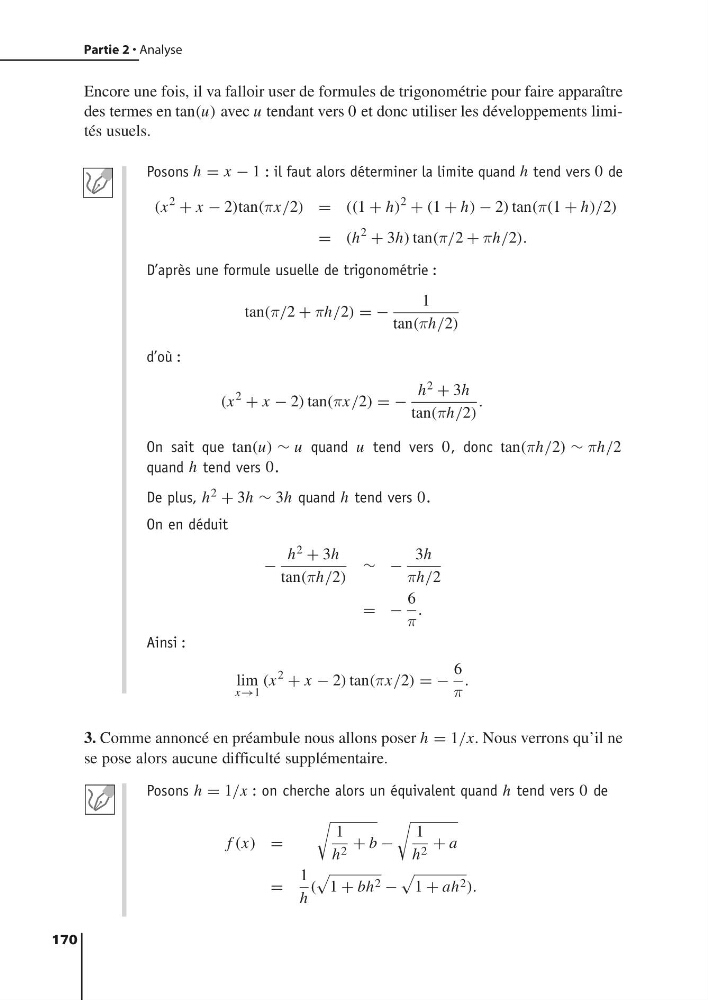
Encore une fois, il va falloir user de formules de trigonométrie pour faire apparaître
des termes en tan(u) avec u tendant vers 0 et donc utiliser les développements limités usuels.
Posons h = x − 1 : il faut alors déterminer la limite quand h tend vers 0 de
(x
2
+ x − 2)tan(πx/2) = ((1 + h)
2
+ (1 + h) − 2) tan(π(1 + h)/2)
= (h
2
+ 3h) tan(π/2 + πh/2).
D’après une formule usuelle de trigonométrie :
tan(π/2 + πh/2) = −
1
tan(πh/2)
d’où :
(x
2
+ x − 2) tan(πx/2) = −
h 2 + 3h
tan(πh/2)
.
On sait que tan(u) ∼ u quand u tend vers 0, donc tan(πh/2) ∼ πh/2
quand h tend vers 0.
De plus, h 2 + 3h ∼ 3h quand h tend vers 0.
On en déduit
−
h 2 + 3h
tan(πh/2)
∼ −
3h
πh/2
= −
6
π
.
Ainsi :
lim
x→1
(x
2
+ x − 2) tan(πx/2) = −
6
π
.
3. Comme annoncé en préambule nous allons poser h = 1/x. Nous verrons qu’il ne
se pose alors aucune difficulté supplémentaire.
Posons h = 1/x : on cherche alors un équivalent quand h tend vers 0 de
f (x) =
1
h 2 + b −
1
h 2 + a
=
1
h
(
1 + bh 2 −
1 + ah 2 ).
170
Partie 2 • Analyse
9782100547678-Fresl-C7.qxd 5/07/10 9:22 Page 170
des termes en tan(u) avec u tendant vers 0 et donc utiliser les développements limités usuels.
Posons h = x − 1 : il faut alors déterminer la limite quand h tend vers 0 de
(x
2
+ x − 2)tan(πx/2) = ((1 + h)
2
+ (1 + h) − 2) tan(π(1 + h)/2)
= (h
2
+ 3h) tan(π/2 + πh/2).
D’après une formule usuelle de trigonométrie :
tan(π/2 + πh/2) = −
1
tan(πh/2)
d’où :
(x
2
+ x − 2) tan(πx/2) = −
h 2 + 3h
tan(πh/2)
.
On sait que tan(u) ∼ u quand u tend vers 0, donc tan(πh/2) ∼ πh/2
quand h tend vers 0.
De plus, h 2 + 3h ∼ 3h quand h tend vers 0.
On en déduit
−
h 2 + 3h
tan(πh/2)
∼ −
3h
πh/2
= −
6
π
.
Ainsi :
lim
x→1
(x
2
+ x − 2) tan(πx/2) = −
6
π
.
3. Comme annoncé en préambule nous allons poser h = 1/x. Nous verrons qu’il ne
se pose alors aucune difficulté supplémentaire.
Posons h = 1/x : on cherche alors un équivalent quand h tend vers 0 de
f (x) =
1
h 2 + b −
1
h 2 + a
=
1
h
(
1 + bh 2 −
1 + ah 2 ).
170
Partie 2 • Analyse
9782100547678-Fresl-C7.qxd 5/07/10 9:22 Page 170