

be extracted with detergents without becoming unstable (bacterial outer membrane porins providing
some exceptions). Membrane biochemists, as a rule, spend months if not years trying to identify the
detergent and conditions that will endow their target protein with a modicum of stability, and,
nevertheless, insufficient stability is a recurrent source of limitations as to which experiments can be
carried out. To take two examples, crystallization attempts become very difficult if the target protein is
not stable for at least a few days, preferably weeks, in concentrated solutions kept at 4
C. Solution
NMR measurements are generally carried out at room temperature or above it, to increase the tumbling
rate of the MP/detergent complexes and improve the resolution of the spectra, and they also require
concentrated solutions. They therefore consume huge amounts of costly isotopically labeled material if
the samples must be discarded after only a few hours of measurements.
Many explanations have been proposed for the inactivating character of detergents. Some of
them involve the loss of the physical constraints applied to the protein by the membrane environment
(e.g. the gradient of lateral pressure; see Chap. 1, § 1.2). Whereas no experimental proof of this
proposal has been provided, molecular dynamics (MD) simulations do indicate that the dynamics of
MPs can increase slightly (typically by a factor 1.5Â) following transfer from a lipid to a detergent
environment (see e.g. Bond and Sansom 2003; Patargias et al. 2005; Perlmutter et al. 2014; Rouse and
Sansom 2015; for a dissenting view, see Frey et al. 2017 and, about the lesser ordering of amino acid
side chains exposed to a detergent rather than a lipid environment, Hite et al. 2008; see also Hong and
Bowie 2011). There are good reasons to think that faster conformational dynamics might indeed favor
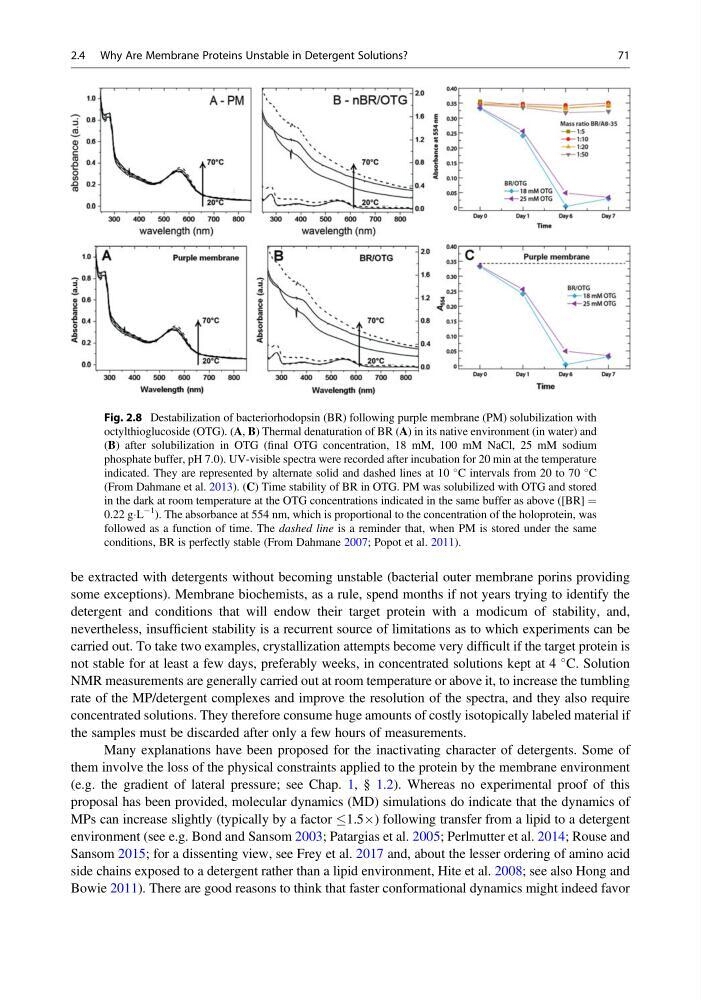
Fig. 2.8 Destabilization of bacteriorhodopsin (BR) following purple membrane (PM) solubilization with
octylthioglucoside (OTG). (A, B) Thermal denaturation of BR (A) in its native environment (in water) and
(B) after solubilization in OTG (final OTG concentration, 18 mM, 100 mM NaCl, 25 mM sodium
phosphate buffer, pH 7.0). UV-visible spectra were recorded after incubation for 20 min at the temperature
indicated. They are represented by alternate solid and dashed lines at 10
C intervals from 20 to 70
C
(From Dahmane et al. 2013). (C) Time stability of BR in OTG. PM was solubilized with OTG and stored
in the dark at room temperature at the OTG concentrations indicated in the same buffer as above ([BR] ¼
0.22 gÁL
À1
). The absorbance at 554 nm, which is proportional to the concentration of the holoprotein, was
followed as a function of time. The dashed line is a reminder that, when PM is stored under the same
conditions, BR is perfectly stable (From Dahmane 2007; Popot et al. 2011).
2.4 Why Are Membrane Proteins Unstable in Detergent Solutions?
71
some exceptions). Membrane biochemists, as a rule, spend months if not years trying to identify the
detergent and conditions that will endow their target protein with a modicum of stability, and,
nevertheless, insufficient stability is a recurrent source of limitations as to which experiments can be
carried out. To take two examples, crystallization attempts become very difficult if the target protein is
not stable for at least a few days, preferably weeks, in concentrated solutions kept at 4
C. Solution
NMR measurements are generally carried out at room temperature or above it, to increase the tumbling
rate of the MP/detergent complexes and improve the resolution of the spectra, and they also require
concentrated solutions. They therefore consume huge amounts of costly isotopically labeled material if
the samples must be discarded after only a few hours of measurements.
Many explanations have been proposed for the inactivating character of detergents. Some of
them involve the loss of the physical constraints applied to the protein by the membrane environment
(e.g. the gradient of lateral pressure; see Chap. 1, § 1.2). Whereas no experimental proof of this
proposal has been provided, molecular dynamics (MD) simulations do indicate that the dynamics of
MPs can increase slightly (typically by a factor 1.5Â) following transfer from a lipid to a detergent
environment (see e.g. Bond and Sansom 2003; Patargias et al. 2005; Perlmutter et al. 2014; Rouse and
Sansom 2015; for a dissenting view, see Frey et al. 2017 and, about the lesser ordering of amino acid
side chains exposed to a detergent rather than a lipid environment, Hite et al. 2008; see also Hong and
Bowie 2011). There are good reasons to think that faster conformational dynamics might indeed favor
Fig. 2.8 Destabilization of bacteriorhodopsin (BR) following purple membrane (PM) solubilization with
octylthioglucoside (OTG). (A, B) Thermal denaturation of BR (A) in its native environment (in water) and
(B) after solubilization in OTG (final OTG concentration, 18 mM, 100 mM NaCl, 25 mM sodium
phosphate buffer, pH 7.0). UV-visible spectra were recorded after incubation for 20 min at the temperature
indicated. They are represented by alternate solid and dashed lines at 10
C intervals from 20 to 70
C
(From Dahmane et al. 2013). (C) Time stability of BR in OTG. PM was solubilized with OTG and stored
in the dark at room temperature at the OTG concentrations indicated in the same buffer as above ([BR] ¼
0.22 gÁL
À1
). The absorbance at 554 nm, which is proportional to the concentration of the holoprotein, was
followed as a function of time. The dashed line is a reminder that, when PM is stored under the same
conditions, BR is perfectly stable (From Dahmane 2007; Popot et al. 2011).
2.4 Why Are Membrane Proteins Unstable in Detergent Solutions?
71