

denaturation and that one of the mechanisms by which APols stabilize MPs as compared to detergents
is to damp this dynamics (see Chap. 5, § 5.6). It is sometimes argued, without, to my knowledge, any
experimental demonstration having ever been brought, that fluctuations in the protein-adsorbed
detergent belt, by leading some regions of the TM surface of MPs to become transiently exposed to
water, would be destabilizing. It is somewhat hard to think of this as a cause of denaturation, because
the time scale on which detergent molecules exchange positions is very short (ns; see § 2.2.2 and Bond
et al. 2006), leaving no time for the protein to react to such events by more than transient side-chain
reorientations.
My personal prejudice, based on years of experience fighting MP instability, is that, whereas
some of these physical effects may well contribute to it, the major factor is probably the dissociating
character of detergents, namely their ability to compete with stabilizing protein/protein and protein/
lipid interactions (Gohon and Popot 2003; Popot 2010). I will illustrate this point with some
experiments carried out using the cytochrome b 6 f complex as a model system. As a workhorse for
developing stabilizing methods, the b 6 f complex is an excellent if somewhat frustrating MP to work
with, because of its extreme sensitivity to detergents.
2.4.2
A Field Case: Inactivation of the Cytochrome b 6 f Complex by Detergents
Cytochrome b 6 f is a complex from the photosynthetic membrane of plants, green algae, and
cyanobacteria. It transfers electrons from the two-electron, lipid-soluble donor plastoquinol (PQH 2 ),
which has been reduced by photosystem II, to the one-electron, water-soluble acceptor plastocyanin,
which will deliver them to photosystem I (for a recent review, see e.g. Saif Hasan et al. 2013). In so
doing, cytochrome b 6 f contributes to building up the proton electrochemical potential that powers the
synthesis of ATP by the F 1 F O -ATPase.
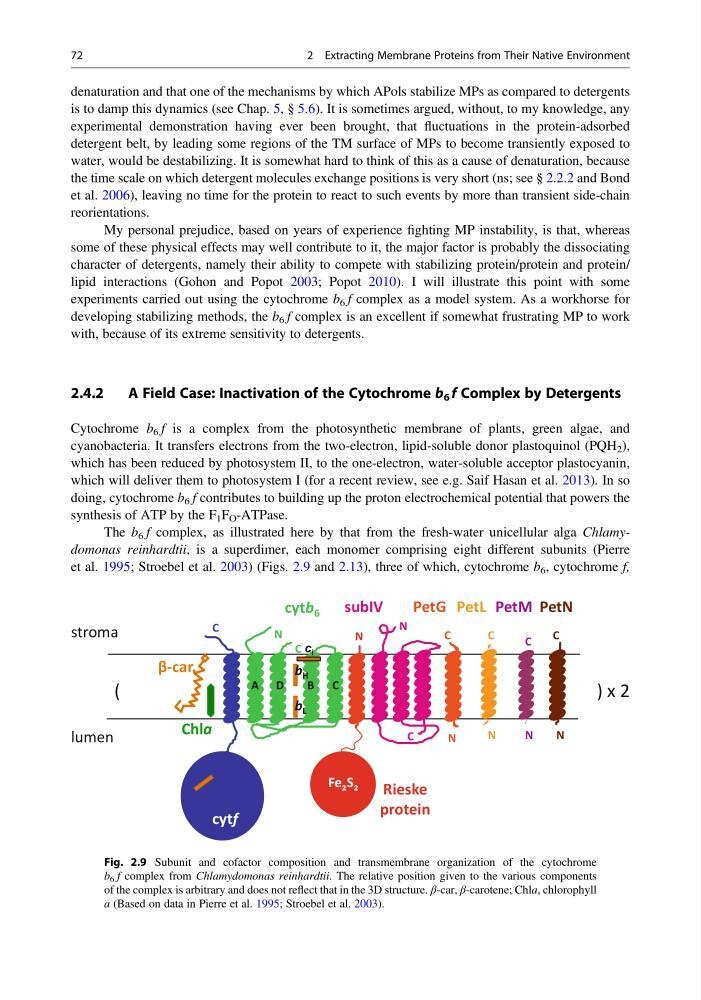
The b 6 f complex, as illustrated here by that from the fresh-water unicellular alga Chlamydomonas reinhardtii, is a superdimer, each monomer comprising eight different subunits (Pierre
et al. 1995; Stroebel et al. 2003) (Figs. 2.9 and 2.13), three of which, cytochrome b 6 , cytochrome f,
stroma
lumen
subIV
C
Rieske
protein
C
N
PetG PetL PetM
C
C
C
N
N
N
N
cytb 6
C
N
PetN
C
N
β-car.
Chla
b L
b H
A
B C
D
Fe 2 S 2
cytf
) x 2
(
c i
Fig. 2.9 Subunit and cofactor composition and transmembrane organization of the cytochrome
b 6 f complex from Chlamydomonas reinhardtii. The relative position given to the various components
of the complex is arbitrary and does not reflect that in the 3D structure. β-car, β-carotene; Chla, chlorophyll
a (Based on data in Pierre et al. 1995; Stroebel et al. 2003).
72
2 Extracting Membrane Proteins from Their Native Environment
is to damp this dynamics (see Chap. 5, § 5.6). It is sometimes argued, without, to my knowledge, any
experimental demonstration having ever been brought, that fluctuations in the protein-adsorbed
detergent belt, by leading some regions of the TM surface of MPs to become transiently exposed to
water, would be destabilizing. It is somewhat hard to think of this as a cause of denaturation, because
the time scale on which detergent molecules exchange positions is very short (ns; see § 2.2.2 and Bond
et al. 2006), leaving no time for the protein to react to such events by more than transient side-chain
reorientations.
My personal prejudice, based on years of experience fighting MP instability, is that, whereas
some of these physical effects may well contribute to it, the major factor is probably the dissociating
character of detergents, namely their ability to compete with stabilizing protein/protein and protein/
lipid interactions (Gohon and Popot 2003; Popot 2010). I will illustrate this point with some
experiments carried out using the cytochrome b 6 f complex as a model system. As a workhorse for
developing stabilizing methods, the b 6 f complex is an excellent if somewhat frustrating MP to work
with, because of its extreme sensitivity to detergents.
2.4.2
A Field Case: Inactivation of the Cytochrome b 6 f Complex by Detergents
Cytochrome b 6 f is a complex from the photosynthetic membrane of plants, green algae, and
cyanobacteria. It transfers electrons from the two-electron, lipid-soluble donor plastoquinol (PQH 2 ),
which has been reduced by photosystem II, to the one-electron, water-soluble acceptor plastocyanin,
which will deliver them to photosystem I (for a recent review, see e.g. Saif Hasan et al. 2013). In so
doing, cytochrome b 6 f contributes to building up the proton electrochemical potential that powers the
synthesis of ATP by the F 1 F O -ATPase.
The b 6 f complex, as illustrated here by that from the fresh-water unicellular alga Chlamydomonas reinhardtii, is a superdimer, each monomer comprising eight different subunits (Pierre
et al. 1995; Stroebel et al. 2003) (Figs. 2.9 and 2.13), three of which, cytochrome b 6 , cytochrome f,
stroma
lumen
subIV
C
Rieske
protein
C
N
PetG PetL PetM
C
C
C
N
N
N
N
cytb 6
C
N
PetN
C
N
β-car.
Chla
b L
b H
A
B C
D
Fe 2 S 2
cytf
) x 2
(
c i
Fig. 2.9 Subunit and cofactor composition and transmembrane organization of the cytochrome
b 6 f complex from Chlamydomonas reinhardtii. The relative position given to the various components
of the complex is arbitrary and does not reflect that in the 3D structure. β-car, β-carotene; Chla, chlorophyll
a (Based on data in Pierre et al. 1995; Stroebel et al. 2003).
72
2 Extracting Membrane Proteins from Their Native Environment