

• Third, they are in a highly dynamic state: individual molecules deform on the 10–100 ps
timescale, and they exchange their positions on the ns one (see e.g. Bogusz et al. 2001).
• Fourth, they are not of uniform size but distribute around an average one (see Tanford 1980).
• Fifth, they are in permanent exchange with the free monomers in the solution. In an OG
micelle, for instance, the residency time of individual molecules is ~7 ns (Frindi et al. 1992).
Given that the average micelle comprises ~92 molecules, this means that each ns more than
10 molecules leave the micelle, and, as the system is at equilibrium, as many enter it from the
solution. The rate of exchange being essentially determined by the free energy cost of
extracting the hydrophobic tail from the micelle core and exposing it to water, it drops by
ca. one order of magnitude for each couple of methylene groups added to the tail. For DDM,
one can therefore expect the residency time to be in the μs range (see Frindi et al. 1992).
A DDM micelle, which comprises 110–140 molecules (le Maire et al. 2000), takes up and
releases one every 10 ns or so.
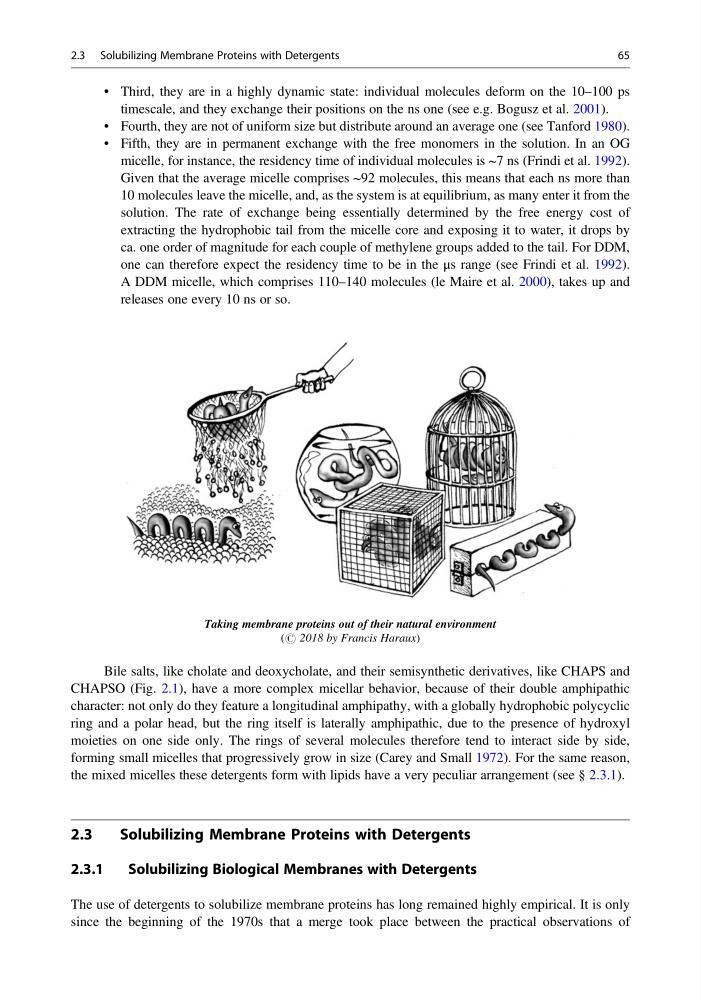
Taking membrane proteins out of their natural environment
(# 2018 by Francis Haraux)
Bile salts, like cholate and deoxycholate, and their semisynthetic derivatives, like CHAPS and
CHAPSO (Fig. 2.1), have a more complex micellar behavior, because of their double amphipathic
character: not only do they feature a longitudinal amphipathy, with a globally hydrophobic polycyclic
ring and a polar head, but the ring itself is laterally amphipathic, due to the presence of hydroxyl
moieties on one side only. The rings of several molecules therefore tend to interact side by side,
forming small micelles that progressively grow in size (Carey and Small 1972). For the same reason,
the mixed micelles these detergents form with lipids have a very peculiar arrangement (see § 2.3.1).
2.3
Solubilizing Membrane Proteins with Detergents
2.3.1
Solubilizing Biological Membranes with Detergents
The use of detergents to solubilize membrane proteins has long remained highly empirical. It is only
since the beginning of the 1970s that a merge took place between the practical observations of
2.3 Solubilizing Membrane Proteins with Detergents
65
timescale, and they exchange their positions on the ns one (see e.g. Bogusz et al. 2001).
• Fourth, they are not of uniform size but distribute around an average one (see Tanford 1980).
• Fifth, they are in permanent exchange with the free monomers in the solution. In an OG
micelle, for instance, the residency time of individual molecules is ~7 ns (Frindi et al. 1992).
Given that the average micelle comprises ~92 molecules, this means that each ns more than
10 molecules leave the micelle, and, as the system is at equilibrium, as many enter it from the
solution. The rate of exchange being essentially determined by the free energy cost of
extracting the hydrophobic tail from the micelle core and exposing it to water, it drops by
ca. one order of magnitude for each couple of methylene groups added to the tail. For DDM,
one can therefore expect the residency time to be in the μs range (see Frindi et al. 1992).
A DDM micelle, which comprises 110–140 molecules (le Maire et al. 2000), takes up and
releases one every 10 ns or so.
Taking membrane proteins out of their natural environment
(# 2018 by Francis Haraux)
Bile salts, like cholate and deoxycholate, and their semisynthetic derivatives, like CHAPS and
CHAPSO (Fig. 2.1), have a more complex micellar behavior, because of their double amphipathic
character: not only do they feature a longitudinal amphipathy, with a globally hydrophobic polycyclic
ring and a polar head, but the ring itself is laterally amphipathic, due to the presence of hydroxyl
moieties on one side only. The rings of several molecules therefore tend to interact side by side,
forming small micelles that progressively grow in size (Carey and Small 1972). For the same reason,
the mixed micelles these detergents form with lipids have a very peculiar arrangement (see § 2.3.1).
2.3
Solubilizing Membrane Proteins with Detergents
2.3.1
Solubilizing Biological Membranes with Detergents
The use of detergents to solubilize membrane proteins has long remained highly empirical. It is only
since the beginning of the 1970s that a merge took place between the practical observations of
2.3 Solubilizing Membrane Proteins with Detergents
65