

occurs at a relatively low temperature, as for the Triton X-100 analog Triton X-114 (22
C), this
property can be used as a separation method, MPs accumulating in the detergent-rich phase. When
working close to the CMC (see § 2.4.2, why one may want to do so), one should remain aware that
changes in ionic strength and temperature can affect the CMC of even nonionic detergents (see
e.g. Miyagishi et al. 2001; Molina-Bolívar et al. 2013, and references therein) and place one in the
unpleasant situation of trying to work, unknowingly, at submicellar concentrations, with catastrophic
results (the protein aggregates and, as a rule, precipitates).
When the polar heads carry charges, their electrostatic repulsion in micelles increases the CMC.
This effect is already present for zwitterionic detergents, even though they carry no net charge:
lauryldimethylamine oxide (LDAO), for instance, which carries the same alkyl chain as DDM but
whose polar head bears partial charges (Fig. 2.1), has a CMC of 1–2 mM in water, 5–10Â higher than
that of DDM. The effect is much more pronounced for detergents carrying a net charge, like sodium
dodecylsulfate (SDS). In pure water, the CMC of SDS is ~7–10 mM, almost two orders of magnitude
above that of DDM, despite their bearing the same alkyl chain. As can be expected, the CMC of
detergents with a charged polar head is very sensitive to the ionic strength: in 100–200 mM NaCl, the
CMC of SDS drops to 1–2 mM (CMC data are from Neugebauer 1988, 1990; Király et al. 1997).
Micelles are not the nice well-ordered spherical assemblies shown in most cartoons:
• First, they are not always spherical. Depending on the shape of the molecule, they can be
roughly spherical, ellipsoid – either prolate or oblate – or cylindrical, the relative size or
apparent size (think e.g. of the modulation of the latter by the temperature or ionic strength) of
the polar head and hydrophobic tail playing a major role in determining the average form
(cf. Chap. 1, Table 1.1, rows 1 and 2). Apparently minor details of chemical structure, such as
the head/tail orientation in the α vs. β anomers of DDM (Fig. 2.1), can have important effects
on the size and shape of the micelles (Abel et al. 2011).
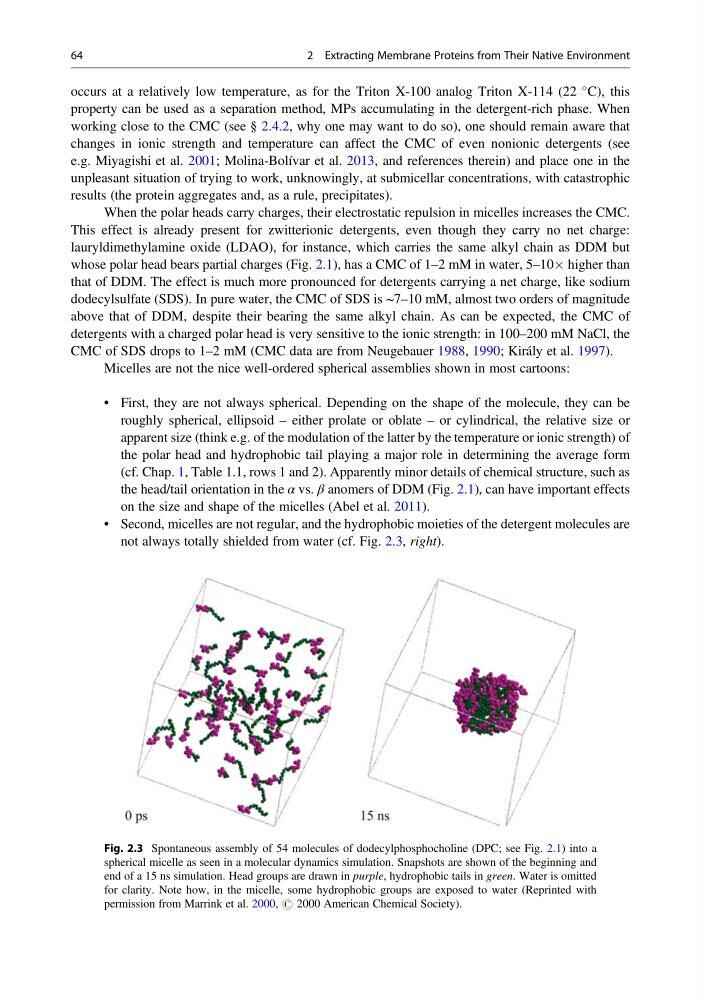
• Second, micelles are not regular, and the hydrophobic moieties of the detergent molecules are
not always totally shielded from water (cf. Fig. 2.3, right).
Fig. 2.3 Spontaneous assembly of 54 molecules of dodecylphosphocholine (DPC; see Fig. 2.1) into a
spherical micelle as seen in a molecular dynamics simulation. Snapshots are shown of the beginning and
end of a 15 ns simulation. Head groups are drawn in purple, hydrophobic tails in green. Water is omitted
for clarity. Note how, in the micelle, some hydrophobic groups are exposed to water (Reprinted with
permission from Marrink et al. 2000, # 2000 American Chemical Society).
64
2 Extracting Membrane Proteins from Their Native Environment
C), this
property can be used as a separation method, MPs accumulating in the detergent-rich phase. When
working close to the CMC (see § 2.4.2, why one may want to do so), one should remain aware that
changes in ionic strength and temperature can affect the CMC of even nonionic detergents (see
e.g. Miyagishi et al. 2001; Molina-Bolívar et al. 2013, and references therein) and place one in the
unpleasant situation of trying to work, unknowingly, at submicellar concentrations, with catastrophic
results (the protein aggregates and, as a rule, precipitates).
When the polar heads carry charges, their electrostatic repulsion in micelles increases the CMC.
This effect is already present for zwitterionic detergents, even though they carry no net charge:
lauryldimethylamine oxide (LDAO), for instance, which carries the same alkyl chain as DDM but
whose polar head bears partial charges (Fig. 2.1), has a CMC of 1–2 mM in water, 5–10Â higher than
that of DDM. The effect is much more pronounced for detergents carrying a net charge, like sodium
dodecylsulfate (SDS). In pure water, the CMC of SDS is ~7–10 mM, almost two orders of magnitude
above that of DDM, despite their bearing the same alkyl chain. As can be expected, the CMC of
detergents with a charged polar head is very sensitive to the ionic strength: in 100–200 mM NaCl, the
CMC of SDS drops to 1–2 mM (CMC data are from Neugebauer 1988, 1990; Király et al. 1997).
Micelles are not the nice well-ordered spherical assemblies shown in most cartoons:
• First, they are not always spherical. Depending on the shape of the molecule, they can be
roughly spherical, ellipsoid – either prolate or oblate – or cylindrical, the relative size or
apparent size (think e.g. of the modulation of the latter by the temperature or ionic strength) of
the polar head and hydrophobic tail playing a major role in determining the average form
(cf. Chap. 1, Table 1.1, rows 1 and 2). Apparently minor details of chemical structure, such as
the head/tail orientation in the α vs. β anomers of DDM (Fig. 2.1), can have important effects
on the size and shape of the micelles (Abel et al. 2011).
• Second, micelles are not regular, and the hydrophobic moieties of the detergent molecules are
not always totally shielded from water (cf. Fig. 2.3, right).
Fig. 2.3 Spontaneous assembly of 54 molecules of dodecylphosphocholine (DPC; see Fig. 2.1) into a
spherical micelle as seen in a molecular dynamics simulation. Snapshots are shown of the beginning and
end of a 15 ns simulation. Head groups are drawn in purple, hydrophobic tails in green. Water is omitted
for clarity. Note how, in the micelle, some hydrophobic groups are exposed to water (Reprinted with
permission from Marrink et al. 2000, # 2000 American Chemical Society).
64
2 Extracting Membrane Proteins from Their Native Environment