

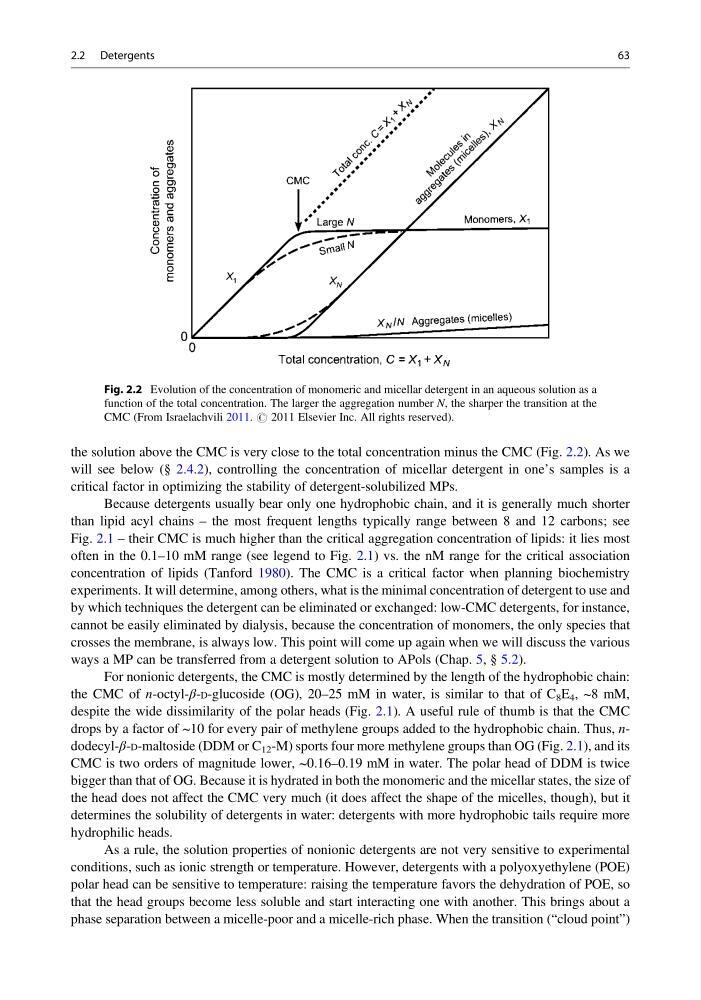
the solution above the CMC is very close to the total concentration minus the CMC (Fig. 2.2). As we
will see below (§ 2.4.2), controlling the concentration of micellar detergent in one’s samples is a
critical factor in optimizing the stability of detergent-solubilized MPs.
Because detergents usually bear only one hydrophobic chain, and it is generally much shorter
than lipid acyl chains – the most frequent lengths typically range between 8 and 12 carbons; see
Fig. 2.1 – their CMC is much higher than the critical aggregation concentration of lipids: it lies most
often in the 0.1–10 mM range (see legend to Fig. 2.1) vs. the nM range for the critical association
concentration of lipids (Tanford 1980). The CMC is a critical factor when planning biochemistry
experiments. It will determine, among others, what is the minimal concentration of detergent to use and
by which techniques the detergent can be eliminated or exchanged: low-CMC detergents, for instance,
cannot be easily eliminated by dialysis, because the concentration of monomers, the only species that
crosses the membrane, is always low. This point will come up again when we will discuss the various
ways a MP can be transferred from a detergent solution to APols (Chap. 5, § 5.2).
For nonionic detergents, the CMC is mostly determined by the length of the hydrophobic chain:
the CMC of n-octyl-β-D-glucoside (OG), 20–25 mM in water, is similar to that of C 8 E 4 , ~8 mM,
despite the wide dissimilarity of the polar heads (Fig. 2.1). A useful rule of thumb is that the CMC
drops by a factor of ~10 for every pair of methylene groups added to the hydrophobic chain. Thus, ndodecyl-β-D-maltoside (DDM or C 12 -M) sports four more methylene groups than OG (Fig. 2.1), and its
CMC is two orders of magnitude lower, ~0.16–0.19 mM in water. The polar head of DDM is twice
bigger than that of OG. Because it is hydrated in both the monomeric and the micellar states, the size of
the head does not affect the CMC very much (it does affect the shape of the micelles, though), but it
determines the solubility of detergents in water: detergents with more hydrophobic tails require more
hydrophilic heads.
As a rule, the solution properties of nonionic detergents are not very sensitive to experimental
conditions, such as ionic strength or temperature. However, detergents with a polyoxyethylene (POE)
polar head can be sensitive to temperature: raising the temperature favors the dehydration of POE, so
that the head groups become less soluble and start interacting one with another. This brings about a
phase separation between a micelle-poor and a micelle-rich phase. When the transition (“cloud point”)
Fig. 2.2 Evolution of the concentration of monomeric and micellar detergent in an aqueous solution as a
function of the total concentration. The larger the aggregation number N, the sharper the transition at the
CMC (From Israelachvili 2011. # 2011 Elsevier Inc. All rights reserved).
2.2 Detergents
63
will see below (§ 2.4.2), controlling the concentration of micellar detergent in one’s samples is a
critical factor in optimizing the stability of detergent-solubilized MPs.
Because detergents usually bear only one hydrophobic chain, and it is generally much shorter
than lipid acyl chains – the most frequent lengths typically range between 8 and 12 carbons; see
Fig. 2.1 – their CMC is much higher than the critical aggregation concentration of lipids: it lies most
often in the 0.1–10 mM range (see legend to Fig. 2.1) vs. the nM range for the critical association
concentration of lipids (Tanford 1980). The CMC is a critical factor when planning biochemistry
experiments. It will determine, among others, what is the minimal concentration of detergent to use and
by which techniques the detergent can be eliminated or exchanged: low-CMC detergents, for instance,
cannot be easily eliminated by dialysis, because the concentration of monomers, the only species that
crosses the membrane, is always low. This point will come up again when we will discuss the various
ways a MP can be transferred from a detergent solution to APols (Chap. 5, § 5.2).
For nonionic detergents, the CMC is mostly determined by the length of the hydrophobic chain:
the CMC of n-octyl-β-D-glucoside (OG), 20–25 mM in water, is similar to that of C 8 E 4 , ~8 mM,
despite the wide dissimilarity of the polar heads (Fig. 2.1). A useful rule of thumb is that the CMC
drops by a factor of ~10 for every pair of methylene groups added to the hydrophobic chain. Thus, ndodecyl-β-D-maltoside (DDM or C 12 -M) sports four more methylene groups than OG (Fig. 2.1), and its
CMC is two orders of magnitude lower, ~0.16–0.19 mM in water. The polar head of DDM is twice
bigger than that of OG. Because it is hydrated in both the monomeric and the micellar states, the size of
the head does not affect the CMC very much (it does affect the shape of the micelles, though), but it
determines the solubility of detergents in water: detergents with more hydrophobic tails require more
hydrophilic heads.
As a rule, the solution properties of nonionic detergents are not very sensitive to experimental
conditions, such as ionic strength or temperature. However, detergents with a polyoxyethylene (POE)
polar head can be sensitive to temperature: raising the temperature favors the dehydration of POE, so
that the head groups become less soluble and start interacting one with another. This brings about a
phase separation between a micelle-poor and a micelle-rich phase. When the transition (“cloud point”)
Fig. 2.2 Evolution of the concentration of monomeric and micellar detergent in an aqueous solution as a
function of the total concentration. The larger the aggregation number N, the sharper the transition at the
CMC (From Israelachvili 2011. # 2011 Elsevier Inc. All rights reserved).
2.2 Detergents
63