

corresponding distribution of free rhodamine, which served as a control. This confirmed that the
observed persistent signals do correspond to FAPol rhod , given that the signal of the free dye (even
though it was ~100Â more concentrated than the label carried by FAPol rhod ) reaches a peak around 1 h
and then rapidly vanishes.
In summary, the systematic evaluation of three of the major administration routes (IV, IP, SC)
carried out in Study 15.5 revealed that following IV or IP injection, APol A8-35 exhibits a long-lasting
distribution in the whole body circulation up to 10–20 days. Such would also presumably be the case
for MP/A8-35 complexes. It also showed that fat pads can trap APols, which are subsequently slowly
released over time. The hepatic signal seen 10 min postinjection is consistent with the detoxification
function of this organ. The fluorescent signals in the liver parenchyma were confirmed when imaging
dissected organs, whereas most of the other organs were not fluorescent. This suggests that the
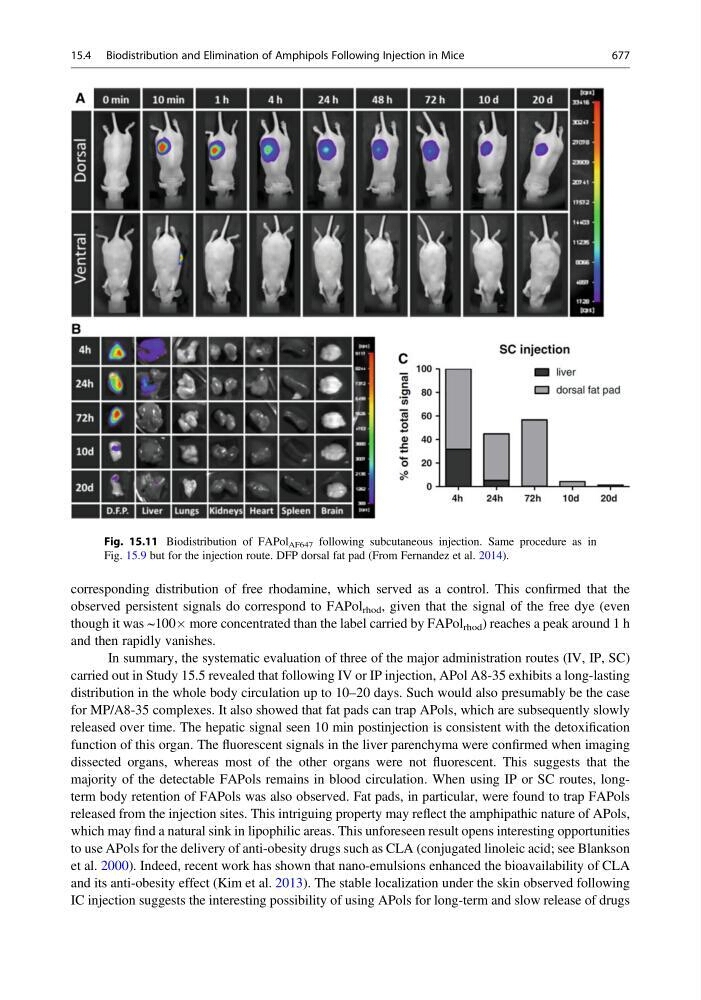
majority of the detectable FAPols remains in blood circulation. When using IP or SC routes, longterm body retention of FAPols was also observed. Fat pads, in particular, were found to trap FAPols
released from the injection sites. This intriguing property may reflect the amphipathic nature of APols,
which may find a natural sink in lipophilic areas. This unforeseen result opens interesting opportunities
to use APols for the delivery of anti-obesity drugs such as CLA (conjugated linoleic acid; see Blankson
et al. 2000). Indeed, recent work has shown that nano-emulsions enhanced the bioavailability of CLA
and its anti-obesity effect (Kim et al. 2013). The stable localization under the skin observed following
IC injection suggests the interesting possibility of using APols for long-term and slow release of drugs
Fig. 15.11 Biodistribution of FAPol AF647 following subcutaneous injection. Same procedure as in
Fig. 15.9 but for the injection route. DFP dorsal fat pad (From Fernandez et al. 2014).
15.4 Biodistribution and Elimination of Amphipols Following Injection in Mice
677