

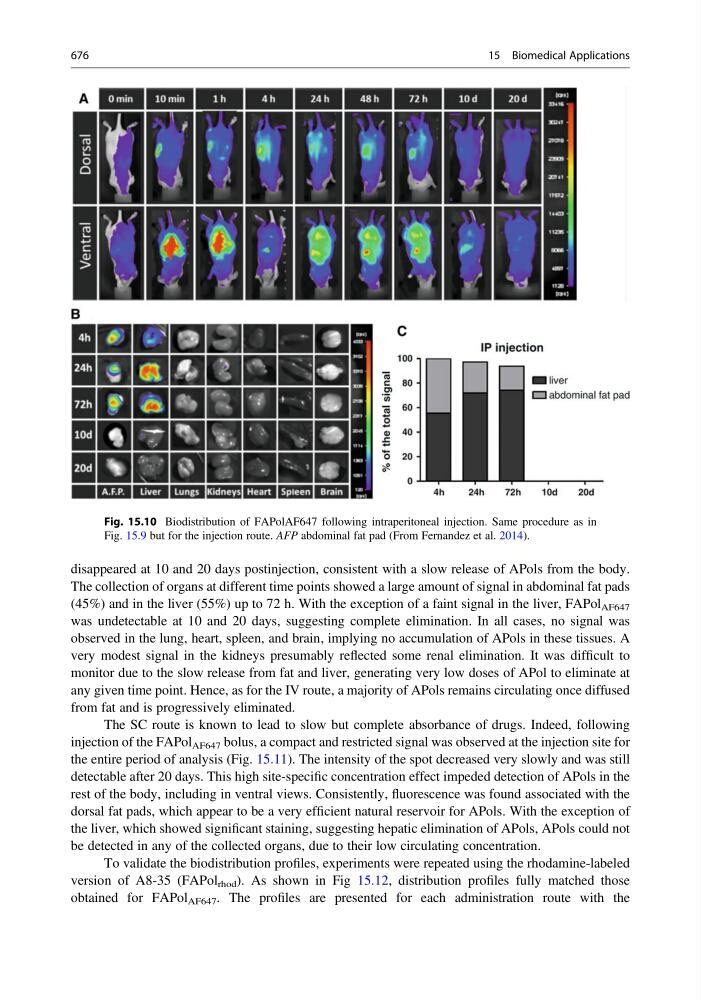
disappeared at 10 and 20 days postinjection, consistent with a slow release of APols from the body.
The collection of organs at different time points showed a large amount of signal in abdominal fat pads
(45%) and in the liver (55%) up to 72 h. With the exception of a faint signal in the liver, FAPol AF647
was undetectable at 10 and 20 days, suggesting complete elimination. In all cases, no signal was
observed in the lung, heart, spleen, and brain, implying no accumulation of APols in these tissues. A
very modest signal in the kidneys presumably reflected some renal elimination. It was difficult to
monitor due to the slow release from fat and liver, generating very low doses of APol to eliminate at
any given time point. Hence, as for the IV route, a majority of APols remains circulating once diffused
from fat and is progressively eliminated.
The SC route is known to lead to slow but complete absorbance of drugs. Indeed, following
injection of the FAPol AF647 bolus, a compact and restricted signal was observed at the injection site for
the entire period of analysis (Fig. 15.11). The intensity of the spot decreased very slowly and was still
detectable after 20 days. This high site-specific concentration effect impeded detection of APols in the
rest of the body, including in ventral views. Consistently, fluorescence was found associated with the
dorsal fat pads, which appear to be a very efficient natural reservoir for APols. With the exception of
the liver, which showed significant staining, suggesting hepatic elimination of APols, APols could not
be detected in any of the collected organs, due to their low circulating concentration.
To validate the biodistribution profiles, experiments were repeated using the rhodamine-labeled
version of A8-35 (FAPol rhod ). As shown in Fig 15.12, distribution profiles fully matched those
obtained for FAPol AF647 . The profiles are presented for each administration route with the
Fig. 15.10 Biodistribution of FAPolAF647 following intraperitoneal injection. Same procedure as in
Fig. 15.9 but for the injection route. AFP abdominal fat pad (From Fernandez et al. 2014).
676
15 Biomedical Applications