

and immunogens. This is of great interest for vaccination, and it also opens the possibility to use APols
for the delivery of hydrophobic drugs in the context of chronic diseases requiring long-term delivery of
drugs, such as chronic pain, psychiatric disorders, hypertensive diseases, AIDS, or cancer.
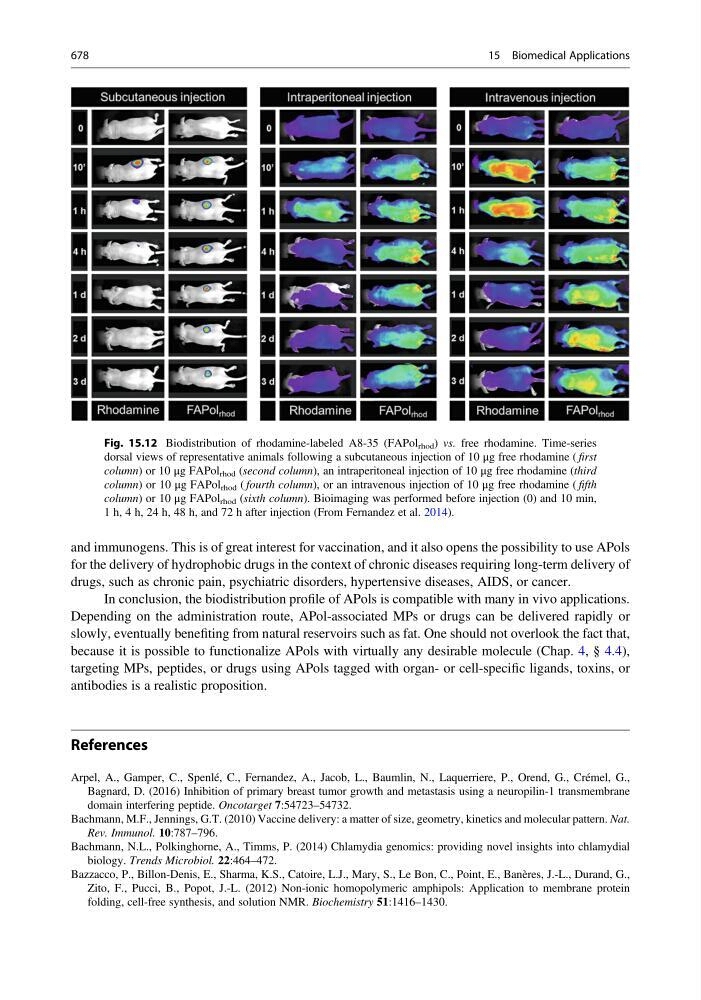
In conclusion, the biodistribution profile of APols is compatible with many in vivo applications.
Depending on the administration route, APol-associated MPs or drugs can be delivered rapidly or
slowly, eventually benefiting from natural reservoirs such as fat. One should not overlook the fact that,
because it is possible to functionalize APols with virtually any desirable molecule (Chap. 4, § 4.4),
targeting MPs, peptides, or drugs using APols tagged with organ- or cell-specific ligands, toxins, or
antibodies is a realistic proposition.
References
Arpel, A., Gamper, C., Spenlé, C., Fernandez, A., Jacob, L., Baumlin, N., Laquerriere, P., Orend, G., Crémel, G.,
Bagnard, D. (2016) Inhibition of primary breast tumor growth and metastasis using a neuropilin-1 transmembrane
domain interfering peptide. Oncotarget 7:54723–54732.
Bachmann, M.F., Jennings, G.T. (2010) Vaccine delivery: a matter of size, geometry, kinetics and molecular pattern. Nat.
Rev. Immunol. 10:787–796.
Bachmann, N.L., Polkinghorne, A., Timms, P. (2014) Chlamydia genomics: providing novel insights into chlamydial
biology. Trends Microbiol. 22:464–472.
Bazzacco, P., Billon-Denis, E., Sharma, K.S., Catoire, L.J., Mary, S., Le Bon, C., Point, E., Banères, J.-L., Durand, G.,
Zito, F., Pucci, B., Popot, J.-L. (2012) Non-ionic homopolymeric amphipols: Application to membrane protein
folding, cell-free synthesis, and solution NMR. Biochemistry 51:1416–1430.
Fig. 15.12 Biodistribution of rhodamine-labeled A8-35 (FAPol rhod ) vs. free rhodamine. Time-series
dorsal views of representative animals following a subcutaneous injection of 10 μg free rhodamine ( first
column) or 10 μg FAPol rhod (second column), an intraperitoneal injection of 10 μg free rhodamine (third
column) or 10 μg FAPol rhod ( fourth column), or an intravenous injection of 10 μg free rhodamine ( fifth
column) or 10 μg FAPol rhod (sixth column). Bioimaging was performed before injection (0) and 10 min,
1 h, 4 h, 24 h, 48 h, and 72 h after injection (From Fernandez et al. 2014).
678
15 Biomedical Applications