

Mice were vaccinated with nMOMP or rMOMP by the intramuscular (i.m.; 7 μg protein/mouse/
immunization) and the subcutaneous (s.c.; 3 μg protein/mouse/immunization) routes. CpG-1826
(10 μg/mouse/dose; 5
0 -TCCATGACGTTCCTGACGTT-3
0 ) and Montanide ISA 720 at a 30:70
volume ratio of MOMP + CpG to Montanide were used as adjuvants (Sun et al. 2009). The mice
were boosted two times at 2-week intervals with the same vaccine formulation. A negative control
group of mice was inoculated intranasally (i.n.) with buffer (MEM-0). Positive control mice were
immunized i.n. once with 1 Â 10
4 inclusion forming units (IFU) of C. muridarum (Sun et al. 2009).
Following an intranasal challenge of mice with live bacteria, the protection against infection afforded
by nMOMP/A8-35 was more robust than that achieved with nMOMP/Z3-14, as assessed by various
criteria including the loss of body weight (Fig. 15.4A) or the number of IFUs of C. trachomatis
recovered in the lungs (Fig. 15.4B). The protection observed was almost as high as that of mice that
had recovered from a previous infection with C. muridarum (noted CT MoPn in Fig. 15.4). It was
higher with nMOMP than with a misfolded, monomeric recombinant preparation of MOMP (rMOMP)
purified from inclusion bodies, consistent with the view that the native state of the protein is an
important factor in determining the level of protection achieved. Interestingly, no difference in
protection was observed between rMOMP preparations formulated with either detergent or APol.
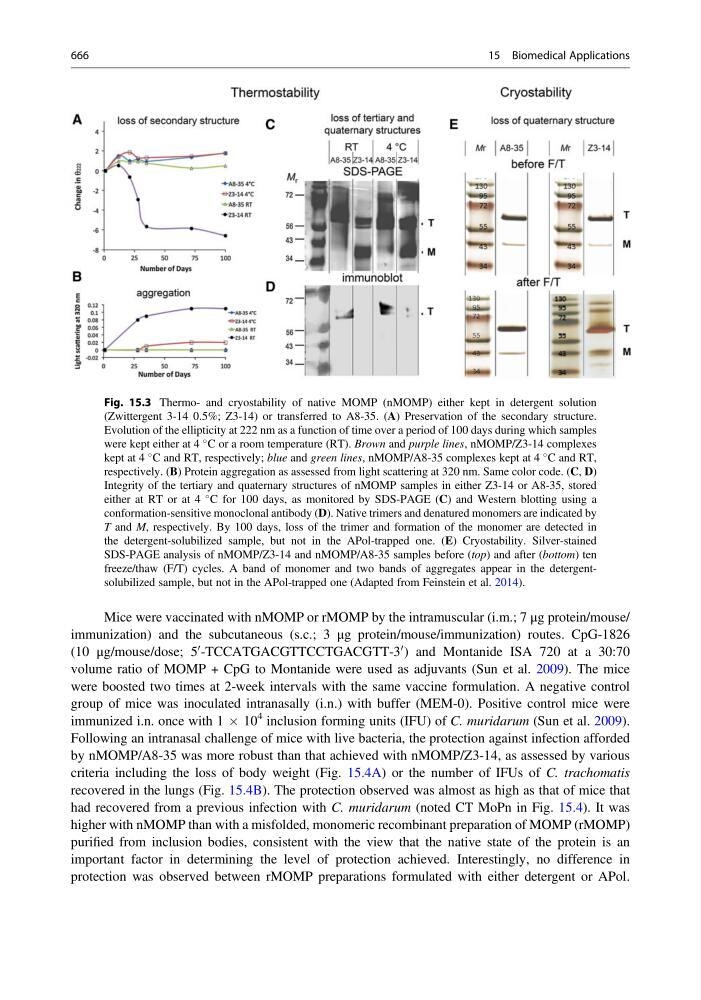
Fig. 15.3 Thermo- and cryostability of native MOMP (nMOMP) either kept in detergent solution
(Zwittergent 3-14 0.5%; Z3-14) or transferred to A8-35. (A) Preservation of the secondary structure.
Evolution of the ellipticity at 222 nm as a function of time over a period of 100 days during which samples
were kept either at 4
C or a room temperature (RT). Brown and purple lines, nMOMP/Z3-14 complexes
kept at 4
C and RT, respectively; blue and green lines, nMOMP/A8-35 complexes kept at 4
C and RT,
respectively. (B) Protein aggregation as assessed from light scattering at 320 nm. Same color code. (C, D)
Integrity of the tertiary and quaternary structures of nMOMP samples in either Z3-14 or A8-35, stored
either at RT or at 4
C for 100 days, as monitored by SDS-PAGE (C) and Western blotting using a
conformation-sensitive monoclonal antibody (D). Native trimers and denatured monomers are indicated by
T and M, respectively. By 100 days, loss of the trimer and formation of the monomer are detected in
the detergent-solubilized sample, but not in the APol-trapped one. (E) Cryostability. Silver-stained
SDS-PAGE analysis of nMOMP/Z3-14 and nMOMP/A8-35 samples before (top) and after (bottom) ten
freeze/thaw (F/T) cycles. A band of monomer and two bands of aggregates appear in the detergentsolubilized sample, but not in the APol-trapped one (Adapted from Feinstein et al. 2014).
666
15 Biomedical Applications