

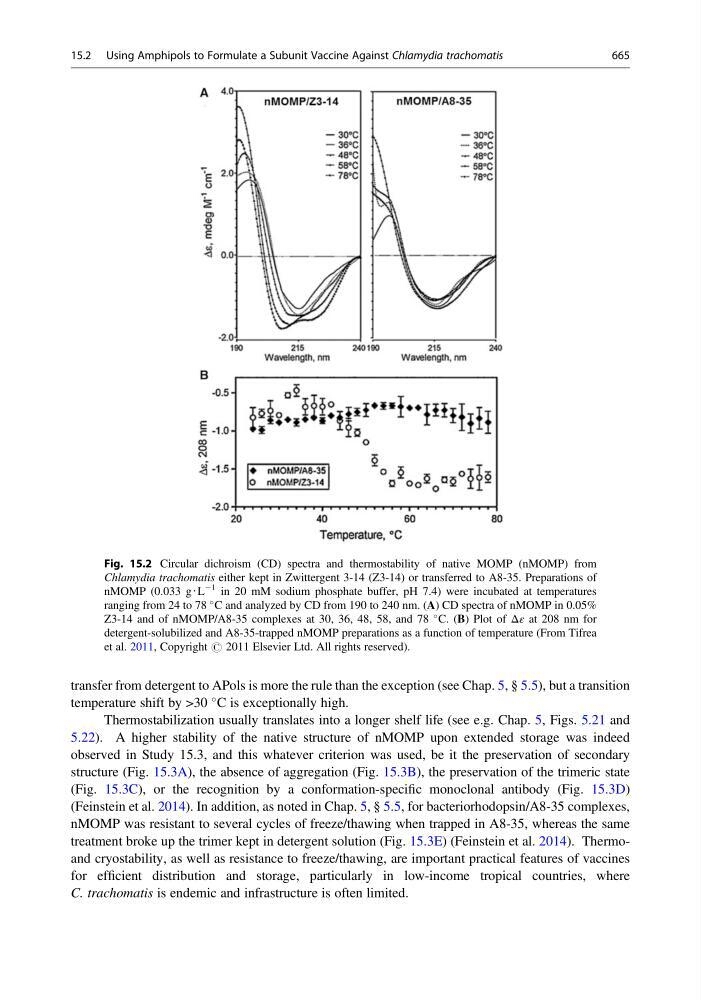
transfer from detergent to APols is more the rule than the exception (see Chap. 5, § 5.5), but a transition
temperature shift by >30
C is exceptionally high.
Thermostabilization usually translates into a longer shelf life (see e.g. Chap. 5, Figs. 5.21 and
5.22). A higher stability of the native structure of nMOMP upon extended storage was indeed
observed in Study 15.3, and this whatever criterion was used, be it the preservation of secondary
structure (Fig. 15.3A), the absence of aggregation (Fig. 15.3B), the preservation of the trimeric state
(Fig. 15.3C), or the recognition by a conformation-specific monoclonal antibody (Fig. 15.3D)
(Feinstein et al. 2014). In addition, as noted in Chap. 5, § 5.5, for bacteriorhodopsin/A8-35 complexes,
nMOMP was resistant to several cycles of freeze/thawing when trapped in A8-35, whereas the same
treatment broke up the trimer kept in detergent solution (Fig. 15.3E) (Feinstein et al. 2014). Thermoand cryostability, as well as resistance to freeze/thawing, are important practical features of vaccines
for efficient distribution and storage, particularly in low-income tropical countries, where
C. trachomatis is endemic and infrastructure is often limited.
Fig. 15.2 Circular dichroism (CD) spectra and thermostability of native MOMP (nMOMP) from
Chlamydia trachomatis either kept in Zwittergent 3-14 (Z3-14) or transferred to A8-35. Preparations of
nMOMP (0.033 g‧L
À1 in 20 mM sodium phosphate buffer, pH 7.4) were incubated at temperatures
ranging from 24 to 78
C and analyzed by CD from 190 to 240 nm. (A) CD spectra of nMOMP in 0.05%
Z3-14 and of nMOMP/A8-35 complexes at 30, 36, 48, 58, and 78
C. (B) Plot of Δε at 208 nm for
detergent-solubilized and A8-35-trapped nMOMP preparations as a function of temperature (From Tifrea
et al. 2011, Copyright # 2011 Elsevier Ltd. All rights reserved).
15.2 Using Amphipols to Formulate a Subunit Vaccine Against Chlamydia trachomatis
665