

A8-35 was used instead of detergents and chaotropes to extract and keep proteins soluble up to and
during the proteolysis step. It was then separated from the tryptic peptides before ESI-MS/MS analysis
by the simple device of acidifying the solution and removing the APol precipitate by table-top
centrifugation. Compared to classical protocols, the use of APols eliminates the need for protein
precipitation or ultrafiltration and sample desalting prior to and after proteolysis (Fig. 14.15A, left),
greatly simplifying and speeding up the procedure (Fig. 14.15A, right). Furthermore, this strategy
reduces sample loss compared with conventional approaches (Fig. 14.15B).
The efficiency of A8-35 at solubilizing MPs from whole cells observed in Study 14.5 contrasts
with the poor detergency reported in early works (see e.g. Champeil et al. 2000). This issue deserves
further investigation. However, two likely factors can be noted. For one thing, early solubilization
experiments, using principally A8-35, happened to be carried out on membranes densely packed with
proteins, such as the sarcoplasmic reticulum, thylakoids, or the purple membrane from H. salinarum.
In other cases (bacterial and animal plasma membrane), direct extraction of MPs by A8-35 has been
observed (see Chap. 5, § 5.2.2.2, Box 5.1). In the case of styrene-maleic acid copolymers (SMAs), it
has been noted that rigid and protein-rich membranes, such as bacterial outer membranes, resist
solubilization (Dörr et al. 2016) (Chap. 5, § 5.2.2.1). The choice of test membranes may thus have
led to underestimating the detergency of APols. For another thing, an important difference between
Study 14.5 and earlier solubilization attempts is the use of sonication. Sonication not only breaks up
the target membranes into smaller fragments, but it also gives APol molecules access to the two faces
of the membrane, which, in the case of detergent, is considered a critical step that determines the rate of
solubilization (for a discussion, see le Maire et al. 2000). It may well be that sonication considerably
accelerates the process of solubilization by A8-35 and that the higher detergency observed in Study
14.5 as compared to earlier studies is at least partially due to faster kinetics.
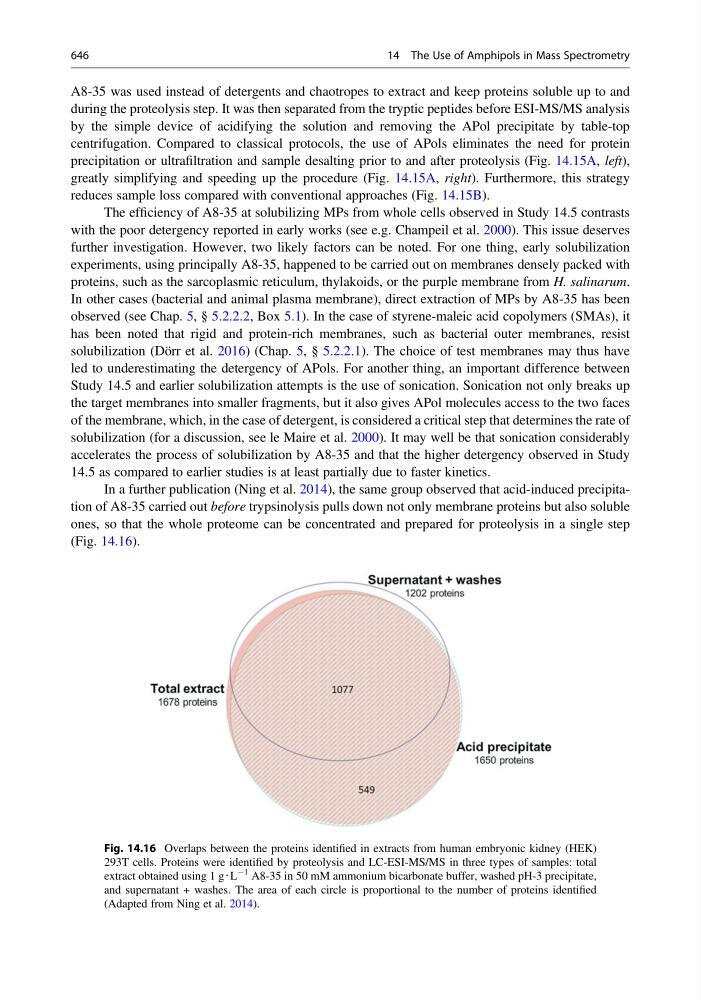
In a further publication (Ning et al. 2014), the same group observed that acid-induced precipitation of A8-35 carried out before trypsinolysis pulls down not only membrane proteins but also soluble
ones, so that the whole proteome can be concentrated and prepared for proteolysis in a single step
(Fig. 14.16).
Fig. 14.16 Overlaps between the proteins identified in extracts from human embryonic kidney (HEK)
293T cells. Proteins were identified by proteolysis and LC-ESI-MS/MS in three types of samples: total
extract obtained using 1 g‧L
À1 A8-35 in 50 mM ammonium bicarbonate buffer, washed pH-3 precipitate,
and supernatant + washes. The area of each circle is proportional to the number of proteins identified
(Adapted from Ning et al. 2014).
646
14 The Use of Amphipols in Mass Spectrometry