

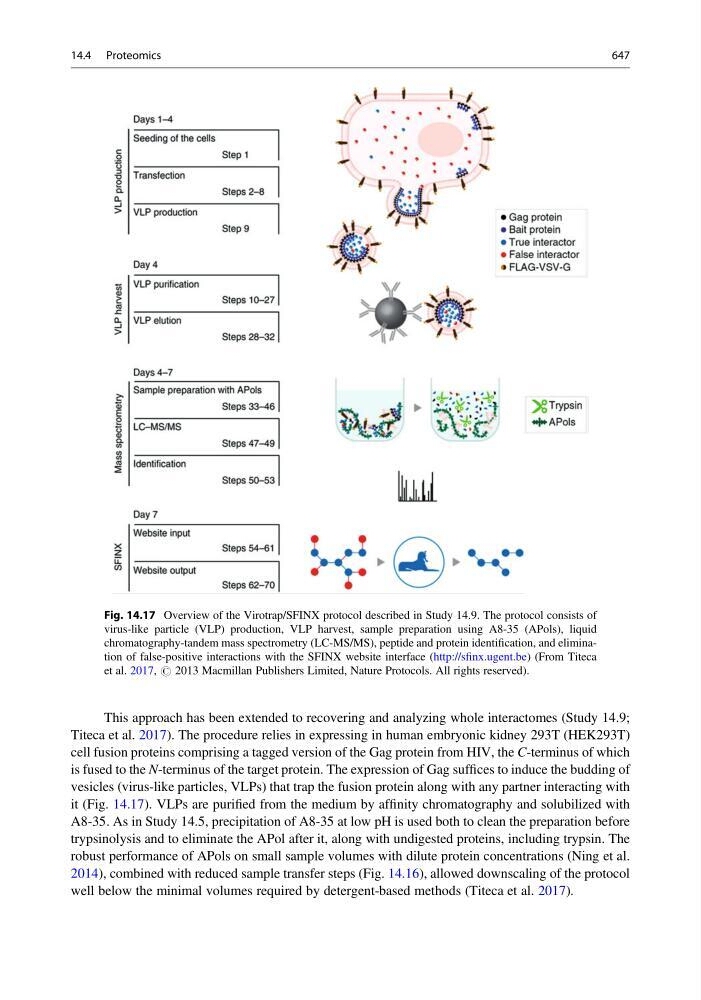
This approach has been extended to recovering and analyzing whole interactomes (Study 14.9;
Titeca et al. 2017). The procedure relies in expressing in human embryonic kidney 293T (HEK293T)
cell fusion proteins comprising a tagged version of the Gag protein from HIV, the C-terminus of which
is fused to the N-terminus of the target protein. The expression of Gag suffices to induce the budding of
vesicles (virus-like particles, VLPs) that trap the fusion protein along with any partner interacting with
it (Fig. 14.17). VLPs are purified from the medium by affinity chromatography and solubilized with
A8-35. As in Study 14.5, precipitation of A8-35 at low pH is used both to clean the preparation before
trypsinolysis and to eliminate the APol after it, along with undigested proteins, including trypsin. The
robust performance of APols on small sample volumes with dilute protein concentrations (Ning et al.
2014), combined with reduced sample transfer steps (Fig. 14.16), allowed downscaling of the protocol
well below the minimal volumes required by detergent-based methods (Titeca et al. 2017).
Fig. 14.17 Overview of the Virotrap/SFINX protocol described in Study 14.9. The protocol consists of
virus-like particle (VLP) production, VLP harvest, sample preparation using A8-35 (APols), liquid
chromatography-tandem mass spectrometry (LC-MS/MS), peptide and protein identification, and elimination of false-positive interactions with the SFINX website interface (http://sfinx.ugent.be) (From Titeca
et al. 2017, # 2013 Macmillan Publishers Limited, Nature Protocols. All rights reserved).
14.4 Proteomics
647