

14.2 MALDI-TOF Studies
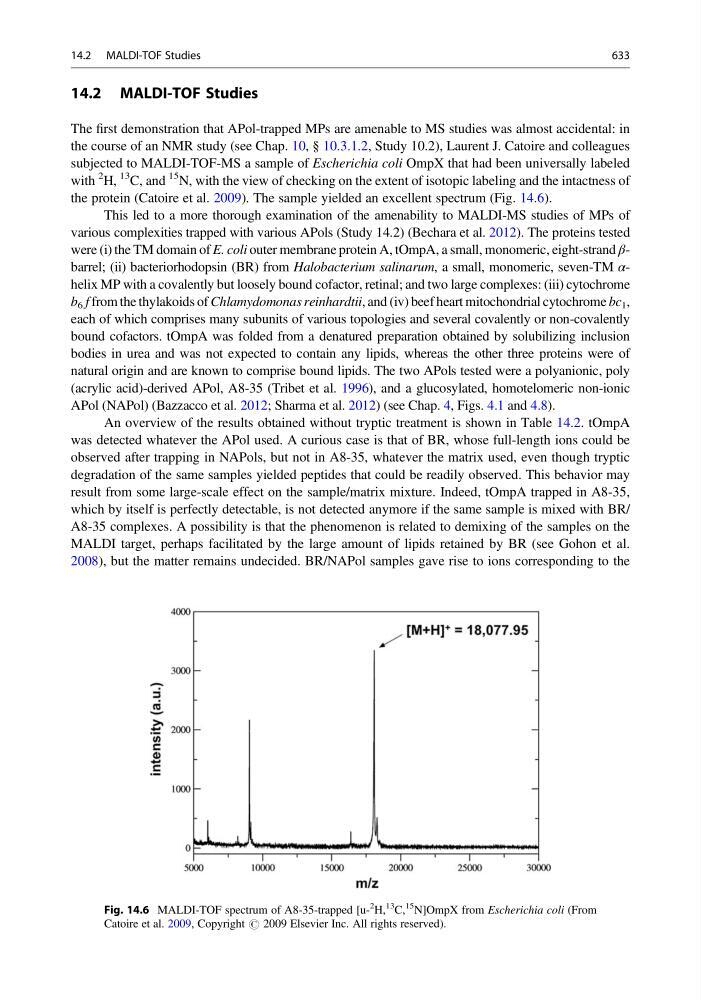
The first demonstration that APol-trapped MPs are amenable to MS studies was almost accidental: in
the course of an NMR study (see Chap. 10, § 10.3.1.2, Study 10.2), Laurent J. Catoire and colleagues
subjected to MALDI-TOF-MS a sample of Escherichia coli OmpX that had been universally labeled
with
2 H,
13 C, and
15 N, with the view of checking on the extent of isotopic labeling and the intactness of
the protein (Catoire et al. 2009). The sample yielded an excellent spectrum (Fig. 14.6).
This led to a more thorough examination of the amenability to MALDI-MS studies of MPs of
various complexities trapped with various APols (Study 14.2) (Bechara et al. 2012). The proteins tested
were (i) the TM domain of E. coli outer membrane protein A, tOmpA, a small, monomeric, eight-strand βbarrel; (ii) bacteriorhodopsin (BR) from Halobacterium salinarum, a small, monomeric, seven-TM αhelix MP with a covalently but loosely bound cofactor, retinal; and two large complexes: (iii) cytochrome
b 6 f from the thylakoids of Chlamydomonas reinhardtii, and (iv) beef heart mitochondrial cytochrome bc 1 ,
each of which comprises many subunits of various topologies and several covalently or non-covalently
bound cofactors. tOmpA was folded from a denatured preparation obtained by solubilizing inclusion
bodies in urea and was not expected to contain any lipids, whereas the other three proteins were of
natural origin and are known to comprise bound lipids. The two APols tested were a polyanionic, poly
(acrylic acid)-derived APol, A8-35 (Tribet et al. 1996), and a glucosylated, homotelomeric non-ionic
APol (NAPol) (Bazzacco et al. 2012; Sharma et al. 2012) (see Chap. 4, Figs. 4.1 and 4.8).
An overview of the results obtained without tryptic treatment is shown in Table 14.2. tOmpA
was detected whatever the APol used. A curious case is that of BR, whose full-length ions could be
observed after trapping in NAPols, but not in A8-35, whatever the matrix used, even though tryptic
degradation of the same samples yielded peptides that could be readily observed. This behavior may
result from some large-scale effect on the sample/matrix mixture. Indeed, tOmpA trapped in A8-35,
which by itself is perfectly detectable, is not detected anymore if the same sample is mixed with BR/
A8-35 complexes. A possibility is that the phenomenon is related to demixing of the samples on the
MALDI target, perhaps facilitated by the large amount of lipids retained by BR (see Gohon et al.
2008), but the matter remains undecided. BR/NAPol samples gave rise to ions corresponding to the
Fig. 14.6 MALDI-TOF spectrum of A8-35-trapped [u2
H,
13
C,
15
N]OmpX from Escherichia coli (From
Catoire et al. 2009, Copyright # 2009 Elsevier Inc. All rights reserved).
14.2 MALDI-TOF Studies
633