

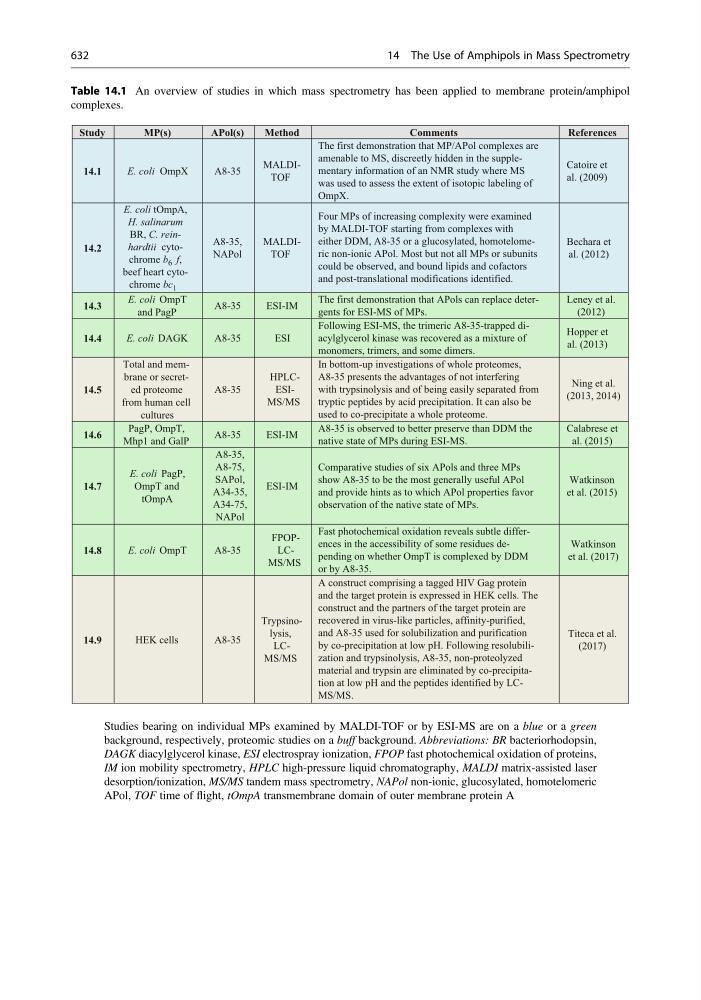
Table 14.1 An overview of studies in which mass spectrometry has been applied to membrane protein/amphipol
complexes.
Study
MP(s)
APol(s)
Method
Comments
References
14.1
E. coli OmpX
A8-35
MALDITOF
The first demonstration that MP/APol complexes are
amenable to MS, discreetly hidden in the supplementary information of an NMR study where MS
was used to assess the extent of isotopic labeling of
OmpX.
Catoire et
al. (2009)
14.2
E. coli tOmpA,
H. salinarum
BR, C. reinhardtii cytochrome b 6 f,
beef heart cytochrome bc 1
A8-35,
NAPol
MALDITOF
Four MPs of increasing complexity were examined
by MALDI-TOF starting from complexes with
either DDM, A8-35 or a glucosylated, homotelomeric non-ionic APol. Most but not all MPs or subunits
could be observed, and bound lipids and cofactors
and post-translational modifications identified.
Bechara et
al. (2012)
14.3
E. coli OmpT
and PagP
A8-35
ESI-IM
The first demonstration that APols can replace detergents for ESI-MS of MPs.
Leney et al.
(2012)
14.4
E. coli DAGK
A8-35
ESI
Following ESI-MS, the trimeric A8-35-trapped diacylglycerol kinase was recovered as a mixture of
monomers, trimers, and some dimers.
Hopper et
al. (2013)
14.5
Total and membrane or secreted proteome
from human cell
cultures
A8-35
ESIMS/MS
In bottom-up investigations of whole proteomes,
A8-35 presents the advantages of not interfering
with trypsinolysis and of being easily separated from
tryptic peptides by acid precipitation. It can also be
used to co-precipitate a whole proteome.
Ning et al.
(2013, 2014)
14.6
PagP, OmpT,
Mhp1 and GalP
A8-35
ESI-IM
A8-35 is observed to better preserve than DDM the
native state of MPs during ESI-MS.
Calabrese et
al. (2015)
14.7
E. coli PagP,
OmpT and
tOmpA
A8-35,
A8-75,
SAPol,
A34-35,
A34-75,
NAPol
ESI-IM
Comparative studies of six APols and three MPs
show A8-35 to be the most generally useful APol
and provide hints as to which APol properties favor
observation of the native state of MPs.
Watkinson
et al. (2015)
14.8
E. coli OmpT
A8-35
LCMS/MS
Fast photochemical oxidation reveals subtle differences in the accessibility of some residues depending on whether OmpT is complexed by DDM
or by A8-35.
Watkinson
et al. (2017)
14.9
HEK cells
A8-35
Trypsinolysis,
LCMS/MS
A construct comprising a tagged HIV Gag protein
and the target protein is expressed in HEK cells. The
construct and the partners of the target protein are
recovered in virus-like particles, affinity-purified,
and A8-35 used for solubilization and purification
by co-precipitation at low pH. Following resolubilization and trypsinolysis, A8-35, non-proteolyzed
material and trypsin are eliminated by co-precipitation at low pH and the peptides identified by LCMS/MS.
Titeca et al.
(2017)
Studies bearing on individual MPs examined by MALDI-TOF or by ESI-MS are on a blue or a green
background, respectively, proteomic studies on a buff background. Abbreviations: BR bacteriorhodopsin,
DAGK diacylglycerol kinase, ESI electrospray ionization, FPOP fast photochemical oxidation of proteins,
IM ion mobility spectrometry, HPLC high-pressure liquid chromatography, MALDI matrix-assisted laser
desorption/ionization, MS/MS tandem mass spectrometry, NAPol non-ionic, glucosylated, homotelomeric
APol, TOF time of flight, tOmpA transmembrane domain of outer membrane protein A
632
14 The Use of Amphipols in Mass Spectrometry