

photochemical oxidation; see below, § 14.3.3). These procedures provide information about the threedimensional organization of the target, its interactions with surfactants, its dynamics, and how it can
vary during the functional cycle.
MS can therefore be used for a vast variety of analyses, from ligand binding to exploring the
assembly and stoichiometry of protein complexes, detecting conformational changes, and determining
the sequence of individual proteins and posttranslational modifications. However, the target molecules
must initially be kept soluble, either before mixing with the MALDI matrix and drying or before
extrusion during ESI. In the case of MPs, this implies resorting to surfactants, typically detergents.
Detergents complicate MS experiments because, on the one hand, they migrate themselves, as
individual molecules or in clusters, contributing a heavy background that can compromise
experiments, and, on the other hand, a variable number of them tend to stick to the target protein,
creating a family of ions with different masses. If too many of them remain associated to the protein,
the MS spectra become unpredictable (for a discussion, see Barrera and Robinson 2011). Only a
limited number of detergents are compatible with MALDI, which may or not be well tolerated by the
target proteins (see e.g. Cadene and Chait 2000 and references therein). In the case of ESI, a decisive
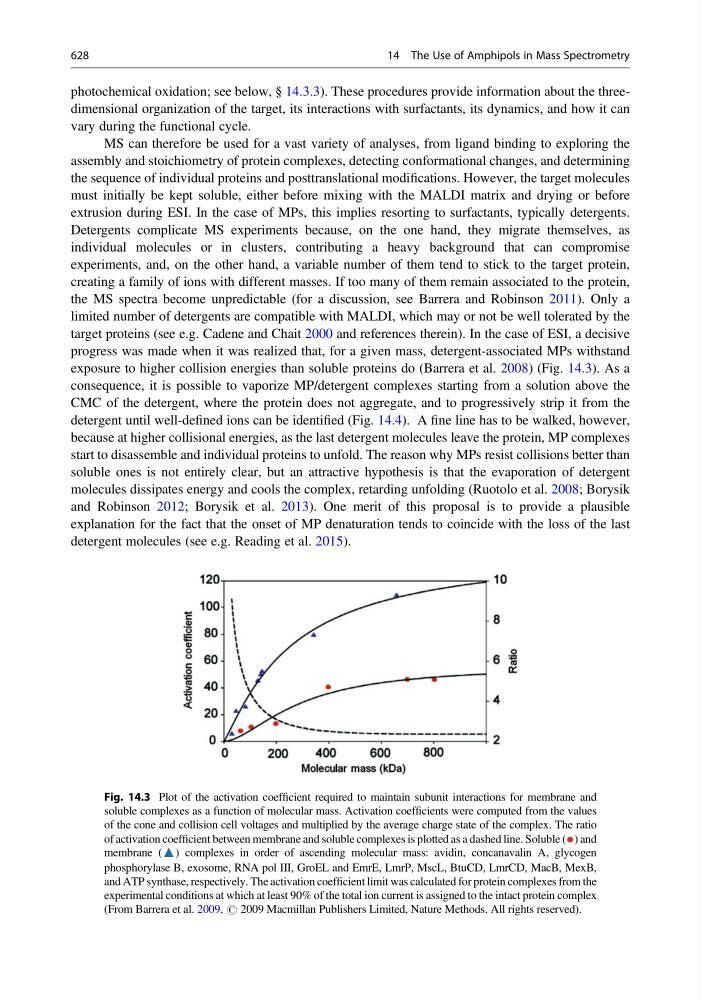
progress was made when it was realized that, for a given mass, detergent-associated MPs withstand
exposure to higher collision energies than soluble proteins do (Barrera et al. 2008) (Fig. 14.3). As a
consequence, it is possible to vaporize MP/detergent complexes starting from a solution above the
CMC of the detergent, where the protein does not aggregate, and to progressively strip it from the
detergent until well-defined ions can be identified (Fig. 14.4). A fine line has to be walked, however,
because at higher collisional energies, as the last detergent molecules leave the protein, MP complexes
start to disassemble and individual proteins to unfold. The reason why MPs resist collisions better than
soluble ones is not entirely clear, but an attractive hypothesis is that the evaporation of detergent
molecules dissipates energy and cools the complex, retarding unfolding (Ruotolo et al. 2008; Borysik
and Robinson 2012; Borysik et al. 2013). One merit of this proposal is to provide a plausible
explanation for the fact that the onset of MP denaturation tends to coincide with the loss of the last
detergent molecules (see e.g. Reading et al. 2015).
Fig. 14.3 Plot of the activation coefficient required to maintain subunit interactions for membrane and
soluble complexes as a function of molecular mass. Activation coefficients were computed from the values
of the cone and collision cell voltages and multiplied by the average charge state of the complex. The ratio
of activation coefficient between membrane and soluble complexes is plotted as a dashed line. Soluble (●) and
membrane (▲) complexes in order of ascending molecular mass: avidin, concanavalin A, glycogen
phosphorylase B, exosome, RNA pol III, GroEL and EmrE, LmrP, MscL, BtuCD, LmrCD, MacB, MexB,
and ATP synthase, respectively. The activation coefficient limit was calculated for protein complexes from the
experimental conditions at which at least 90% of the total ion current is assigned to the intact protein complex
(From Barrera et al. 2009, # 2009 Macmillan Publishers Limited, Nature Methods. All rights reserved).
628
14 The Use of Amphipols in Mass Spectrometry