

In summary, Study 13.7 validates the use of APols derivatized with polyhistidine tags for
immobilizing specifically and reversibly untagged MPs onto solid supports carrying metal ions.
Compared to MPs carrying a single His-tag, the presence of at least four His 6 -tags per MP/HistAPol
complex, distributed around the transmembrane domain of the protein, increases the affinity of the
complexes for Ni:NTA-coated SPR chips, which results in a higher surface density of immobilized
MPs and a more stable interaction. HistAPol-mediated immobilization provides an attachment of MPs
to Ni:NTA surfaces almost as stable as that mediated by the biotin/avidin couple, with the major
advantage of the reusability of the SPR biosensing chips. Thereby, HistAPol widens the spectrum of
applications that require both a high stability of the target MPs and the reversibility of their
immobilization.
13.3.2 Imidazole-Tagged Amphipols
Synthesizing HistAPol is costly and work-intensive, particularly because it is not straightforward to
prepare the hexahistidine peptide in good yield (Giusti et al. 2015). HistAPol therefore is better adapted
to applications requiring small amounts of polymer, such as immobilizing MPs onto chips for the
purpose of ligand screening, than for uses that would require mass production. This led to investigating
the synthesis and properties of a version of A8-35 onto which single imidazole moieties would be
grafted at random (Study 13.8). The expectation was that, statistically, some pairs of imidazole groups
would come close enough to interact simultaneously with immobilized Ni
2+ or Co
2+ cations. Following a procedure described in Chap. 4 (§ 4.4.1, Fig. 4.30A), 1-(3-aminopropyl)imidazole moieties were
grafted onto A8-75 concomitantly with isopropylamine ones (Fig. 13.15). The level of grafting of the
resulting “ImidAPol” reached ~6 imidazole moieties per 100 acrylic acid units, or ~20 per 40 kDa
particle.
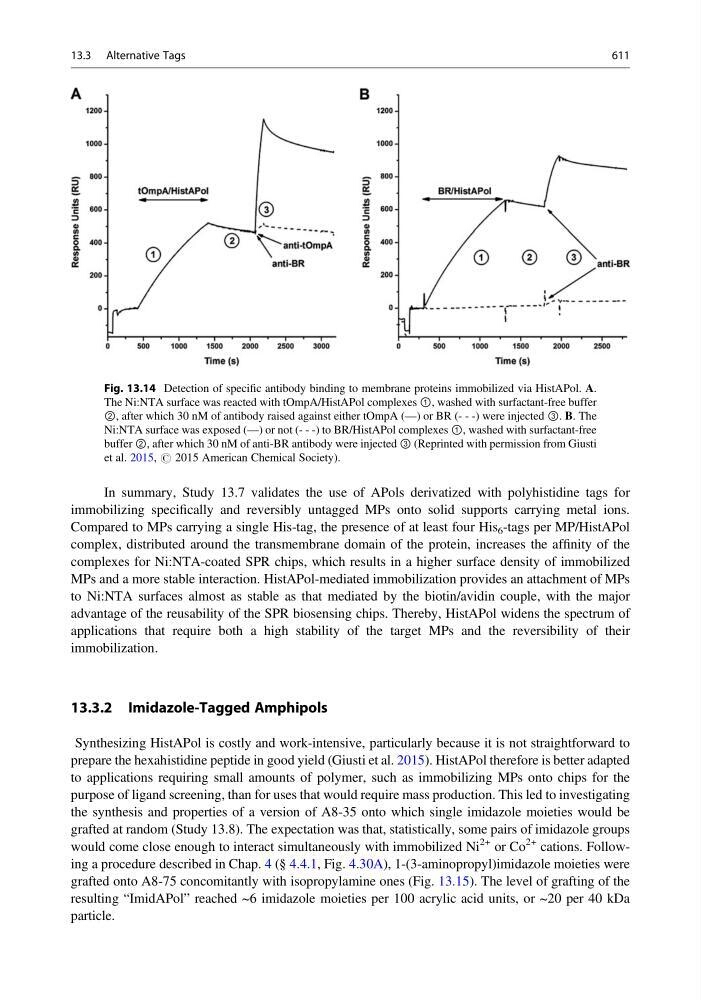
Fig. 13.14 Detection of specific antibody binding to membrane proteins immobilized via HistAPol. A.
The Ni:NTA surface was reacted with tOmpA/HistAPol complexes ①, washed with surfactant-free buffer
②, after which 30 nM of antibody raised against either tOmpA (—) or BR (- - -) were injected ③. B. The
Ni:NTA surface was exposed (—) or not (- - -) to BR/HistAPol complexes ①, washed with surfactant-free
buffer ②, after which 30 nM of anti-BR antibody were injected ③ (Reprinted with permission from Giusti
et al. 2015, # 2015 American Chemical Society).
13.3 Alternative Tags
611