

The solution properties of ImidAPols were characterized. It self-associates into particles similar
to those formed by A8-35. However, as already observed for HistAPol (Giusti et al. 2015; Chap. 4,
§ 4.4.2), ImidAPol does not precipitate efficiently at any low pH, because the protonation of both
carboxylate and imidazole moieties turns it from a polyanionic to, depending on the pH, a zwitterionic
or a cationic polymer. ImidAPol was as efficient as A8-35 at trapping MPs and keeping them soluble
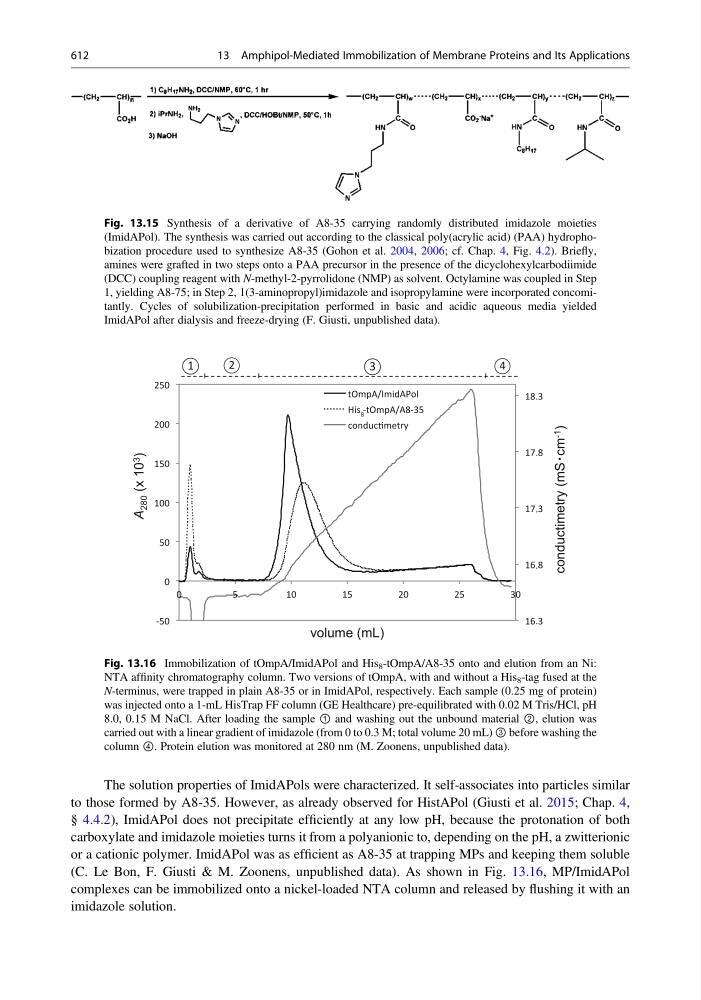
(C. Le Bon, F. Giusti & M. Zoonens, unpublished data). As shown in Fig. 13.16, MP/ImidAPol
complexes can be immobilized onto a nickel-loaded NTA column and released by flushing it with an
imidazole solution.
Fig. 13.15 Synthesis of a derivative of A8-35 carrying randomly distributed imidazole moieties
(ImidAPol). The synthesis was carried out according to the classical poly(acrylic acid) (PAA) hydrophobization procedure used to synthesize A8-35 (Gohon et al. 2004, 2006; cf. Chap. 4, Fig. 4.2). Briefly,
amines were grafted in two steps onto a PAA precursor in the presence of the dicyclohexylcarbodiimide
(DCC) coupling reagent with N-methyl-2-pyrrolidone (NMP) as solvent. Octylamine was coupled in Step
1, yielding A8-75; in Step 2, 1(3-aminopropyl)imidazole and isopropylamine were incorporated concomitantly. Cycles of solubilization-precipitation performed in basic and acidic aqueous media yielded
ImidAPol after dialysis and freeze-drying (F. Giusti, unpublished data).
.
.
.
.
A
280 (x 10 3
)
volume (mL)
conductimetry (mS͑cm -1
)
.
Fig. 13.16 Immobilization of tOmpA/ImidAPol and His 8 -tOmpA/A8-35 onto and elution from an Ni:
NTA affinity chromatography column. Two versions of tOmpA, with and without a His 8 -tag fused at the
N-terminus, were trapped in plain A8-35 or in ImidAPol, respectively. Each sample (0.25 mg of protein)
was injected onto a 1-mL HisTrap FF column (GE Healthcare) pre-equilibrated with 0.02 M Tris/HCl, pH
8.0, 0.15 M NaCl. After loading the sample ① and washing out the unbound material ②, elution was
carried out with a linear gradient of imidazole (from 0 to 0.3 M; total volume 20 mL) ③ before washing the
column ④. Protein elution was monitored at 280 nm (M. Zoonens, unpublished data).
612
13 Amphipol-Mediated Immobilization of Membrane Proteins and Its Applications