

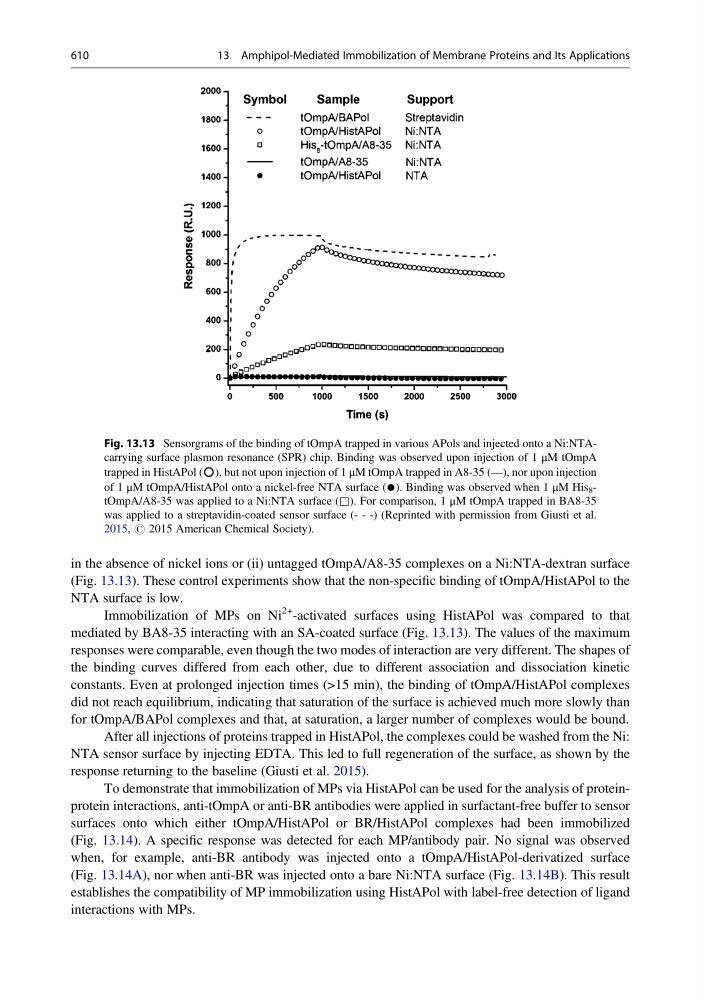
in the absence of nickel ions or (ii) untagged tOmpA/A8-35 complexes on a Ni:NTA-dextran surface
(Fig. 13.13). These control experiments show that the non-specific binding of tOmpA/HistAPol to the
NTA surface is low.
Immobilization of MPs on Ni
2+ -activated surfaces using HistAPol was compared to that
mediated by BA8-35 interacting with an SA-coated surface (Fig. 13.13). The values of the maximum
responses were comparable, even though the two modes of interaction are very different. The shapes of
the binding curves differed from each other, due to different association and dissociation kinetic
constants. Even at prolonged injection times (>15 min), the binding of tOmpA/HistAPol complexes
did not reach equilibrium, indicating that saturation of the surface is achieved much more slowly than
for tOmpA/BAPol complexes and that, at saturation, a larger number of complexes would be bound.
After all injections of proteins trapped in HistAPol, the complexes could be washed from the Ni:
NTA sensor surface by injecting EDTA. This led to full regeneration of the surface, as shown by the
response returning to the baseline (Giusti et al. 2015).
To demonstrate that immobilization of MPs via HistAPol can be used for the analysis of proteinprotein interactions, anti-tOmpA or anti-BR antibodies were applied in surfactant-free buffer to sensor
surfaces onto which either tOmpA/HistAPol or BR/HistAPol complexes had been immobilized
(Fig. 13.14). A specific response was detected for each MP/antibody pair. No signal was observed
when, for example, anti-BR antibody was injected onto a tOmpA/HistAPol-derivatized surface
(Fig. 13.14A), nor when anti-BR was injected onto a bare Ni:NTA surface (Fig. 13.14B). This result
establishes the compatibility of MP immobilization using HistAPol with label-free detection of ligand
interactions with MPs.
Fig. 13.13 Sensorgrams of the binding of tOmpA trapped in various APols and injected onto a Ni:NTAcarrying surface plasmon resonance (SPR) chip. Binding was observed upon injection of 1 μM tOmpA
trapped in HistAPol (), but not upon injection of 1 μM tOmpA trapped in A8-35 (—), nor upon injection
of 1 μM tOmpA/HistAPol onto a nickel-free NTA surface (●). Binding was observed when 1 μM His 8 -
tOmpA/A8-35 was applied to a Ni:NTA surface (⃞). For comparison, 1 μM tOmpA trapped in BA8-35
was applied to a streptavidin-coated sensor surface (- - -) (Reprinted with permission from Giusti et al.
2015, # 2015 American Chemical Society).
610
13 Amphipol-Mediated Immobilization of Membrane Proteins and Its Applications