

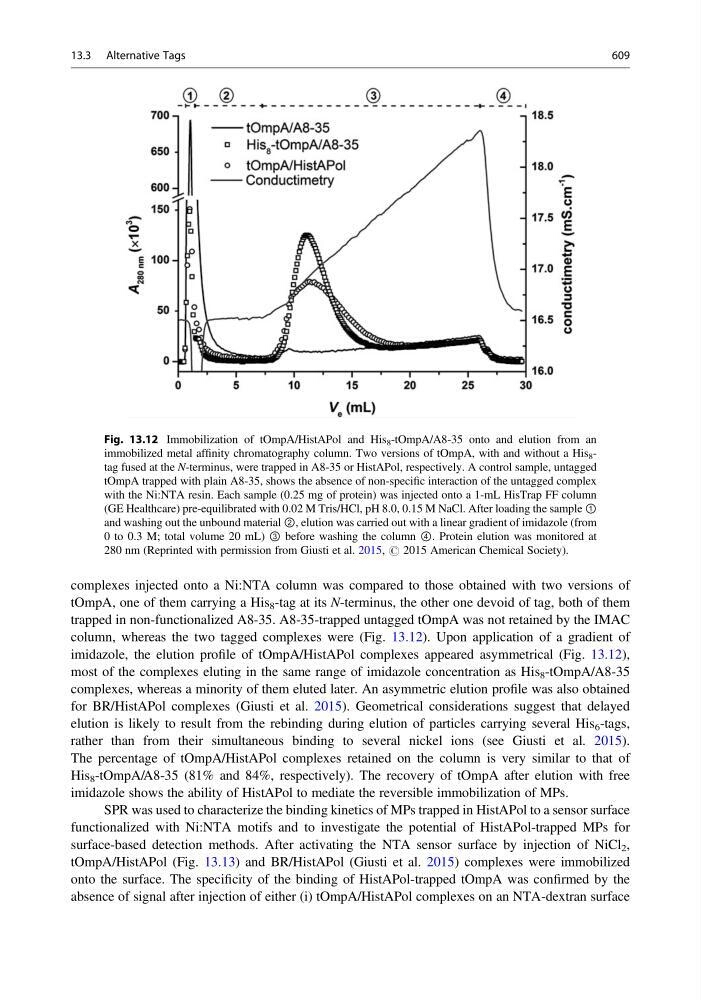
complexes injected onto a Ni:NTA column was compared to those obtained with two versions of
tOmpA, one of them carrying a His 8 -tag at its N-terminus, the other one devoid of tag, both of them
trapped in non-functionalized A8-35. A8-35-trapped untagged tOmpA was not retained by the IMAC
column, whereas the two tagged complexes were (Fig. 13.12). Upon application of a gradient of
imidazole, the elution profile of tOmpA/HistAPol complexes appeared asymmetrical (Fig. 13.12),
most of the complexes eluting in the same range of imidazole concentration as His 8 -tOmpA/A8-35
complexes, whereas a minority of them eluted later. An asymmetric elution profile was also obtained
for BR/HistAPol complexes (Giusti et al. 2015). Geometrical considerations suggest that delayed
elution is likely to result from the rebinding during elution of particles carrying several His 6 -tags,
rather than from their simultaneous binding to several nickel ions (see Giusti et al. 2015).
The percentage of tOmpA/HistAPol complexes retained on the column is very similar to that of
His 8 -tOmpA/A8-35 (81% and 84%, respectively). The recovery of tOmpA after elution with free
imidazole shows the ability of HistAPol to mediate the reversible immobilization of MPs.
SPR was used to characterize the binding kinetics of MPs trapped in HistAPol to a sensor surface
functionalized with Ni:NTA motifs and to investigate the potential of HistAPol-trapped MPs for
surface-based detection methods. After activating the NTA sensor surface by injection of NiCl 2 ,
tOmpA/HistAPol (Fig. 13.13) and BR/HistAPol (Giusti et al. 2015) complexes were immobilized
onto the surface. The specificity of the binding of HistAPol-trapped tOmpA was confirmed by the
absence of signal after injection of either (i) tOmpA/HistAPol complexes on an NTA-dextran surface
Fig. 13.12 Immobilization of tOmpA/HistAPol and His 8 -tOmpA/A8-35 onto and elution from an
immobilized metal affinity chromatography column. Two versions of tOmpA, with and without a His 8 -
tag fused at the N-terminus, were trapped in A8-35 or HistAPol, respectively. A control sample, untagged
tOmpA trapped with plain A8-35, shows the absence of non-specific interaction of the untagged complex
with the Ni:NTA resin. Each sample (0.25 mg of protein) was injected onto a 1-mL HisTrap FF column
(GE Healthcare) pre-equilibrated with 0.02 M Tris/HCl, pH 8.0, 0.15 M NaCl. After loading the sample ①
and washing out the unbound material ②, elution was carried out with a linear gradient of imidazole (from
0 to 0.3 M; total volume 20 mL) ③ before washing the column ④. Protein elution was monitored at
280 nm (Reprinted with permission from Giusti et al. 2015, # 2015 American Chemical Society).
13.3 Alternative Tags
609