

In the following sections, we review rapidly the most interesting characteristics of these new
tagged APols.
13.3.1 Polyhistidine-Tagged A8-35
One of the most widely used tags is a peptide comprised of six or more histidine residues (His 6 -tag,
His 8 -tag, etc.), which can specifically interact with Ni
2+ or Co
2+ ions bound to nitrilotriacetic acid
(NTA)-functionalized surfaces. The selectivity and reversibility of this mode of immobilization make
it very useful in biochemistry and biophysics for protein purification (Hochuli et al. 1987; Block et al.
2009) and protein immobilization onto chips (Nieba et al. 1997), nanoparticles (NPs) (Xu et al. 2004;
Patel et al. 2007), or other surfaces (Kang et al. 2007; Liu et al. 2010). Study 13.7 describes the
synthesis and validation of a derivative of A8-35, dubbed HistAPol, onto which His 6 -tags have been
bound via a short polyethylene glycol linker (Giusti et al. 2015; see Chap. 4, § 4.4). This modification
necessitated first the chemical synthesis of hexahistidine peptides, which is far from a trivial endeavor.
Chap. 4, § 4.4.2, also reports on the solution properties of HistAPol. The pH-dependence of the
solubility, in particular, is markedly different from that of plain A8-35, because at low pH the histidine
residues protonate, making the polymer zwitterionic and water-soluble, whereas, under the same
conditions, A8-35 and MP/A8-35 complexes become insoluble and precipitate (Chap. 4, § 4.3.1.2.5).
At pH 8, the SEC behavior of HistAPol particles, tOmpA/HistAPol and BR/HistAPol complexes was comparable to that observed with plain A8-35, with a marginally broader distribution of
hydrodynamic radii (Giusti et al. 2015). The average number of His 6 -tags per MP/HistAPol complex
can be evaluated based on estimates of the mass of APol bound by each protein. In the case of
tOmpA, it is likely to be $4.5, or slightly less, in that of BR $5.4. As for HistAPol particles, the
number of tags per MP/HistAPol complex is expected to follow a Poisson distribution and to fluctuate
over time, as MP/HistAPol complexes collide with each other and with free HistAPol particles
and exchange APol molecules, leading to a permanent redistribution of the tags. Under the ionic
conditions used in Study 13.7 (100–150 mM NaCl), redistribution occurs on the time scale of several
minutes (Zoonens et al. 2007; see Chap. 5, § 5.7), whereas SEC analysis takes ~45 min (see Chap. 9,
§ 9.5.2, Protocol 5.2).
Immobilized metal affinity chromatography (IMAC) was used to explore whether HistAPol can
be used for immobilizing MPs onto nickel-activated surfaces. The elution profile of tOmpA/HistAPol
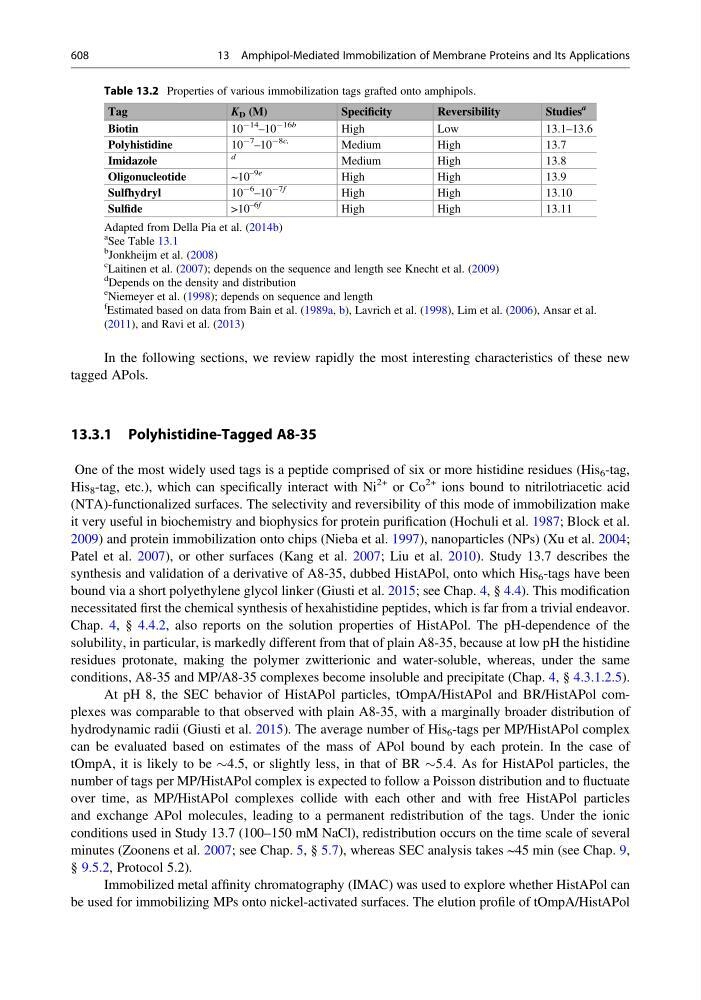
Table 13.2 Properties of various immobilization tags grafted onto amphipols.
Tag
K D (M)
Specificity
Reversibility
Studies
a
Biotin
10
À14
–10
À16b
High
Low
13.1–13.6
Polyhistidine
10
À7
–10
À8c,
Medium
High
13.7
Imidazole
d
Medium
High
13.8
Oligonucleotide
~10
–9e
High
High
13.9
Sulfhydryl
10
À6
–10
À7f
High
High
13.10
Sulfide
>10
–6f
High
High
13.11
Adapted from Della Pia et al. (2014b)
a See Table 13.1
b
Jonkheijm et al. (2008)
c Laitinen et al. (2007); depends on the sequence and length see Knecht et al. (2009)
d
Depends on the density and distribution
e Niemeyer et al. (1998); depends on sequence and length
f
Estimated based on data from Bain et al. (1989a, b), Lavrich et al. (1998), Lim et al. (2006), Ansar et al.
(2011), and Ravi et al. (2013)
608
13 Amphipol-Mediated Immobilization of Membrane Proteins and Its Applications