

their surface in a given round of selection, whereas they may do so during a subsequent screening step.
Hence, a significant proportion of phages coding for APol binders might escape the negative selection
step if it is not repeated. Once a specific library pruned of APol binders has been established by several
rounds of depletion, selection of protein-specific binders using MP/APol complexes ought to become
easier. Another option perhaps worth investigating could be, as has been done for DARPins (Seeger
et al. 2013), to engineer a library of αReps poorer in hydrophobic residues. In the meanwhile, the use of
tagged APols in the phage display process should probably be limited to MPs that have too limited a
stability in detergent solutions to survive a detergent-based procedure or that cannot be easily tagged.
13.3 Alternative Tags
The biotin/avidin couple presents the advantage of a very high affinity, leading to the formation of
non-covalent but essentially irreversible complexes. When biotin is chemically bound to the protein,
the latter cannot be eluted. In the case of MPs trapped with a biotinylated APol, on the contrary, one
has the option of washing it away with an excess of either detergent or a non-biotinylated APol: the
chip or beads will retain the biotinylated APol and will not be regenerated, but the protein will elute.
Similarly, an APol grafted with desthiobiotin (nonextant yet) could be displaced from avidin-coated
surfaces by biotin. It is nevertheless worth examining the feasibility and applications of using other
tag/binder combinations. In Studies 13.7–13.10 (see Table 13.1), the synthesis of four alternative
tagged variants of A8-35 has been developed and their validation undertaken. The tags explored are
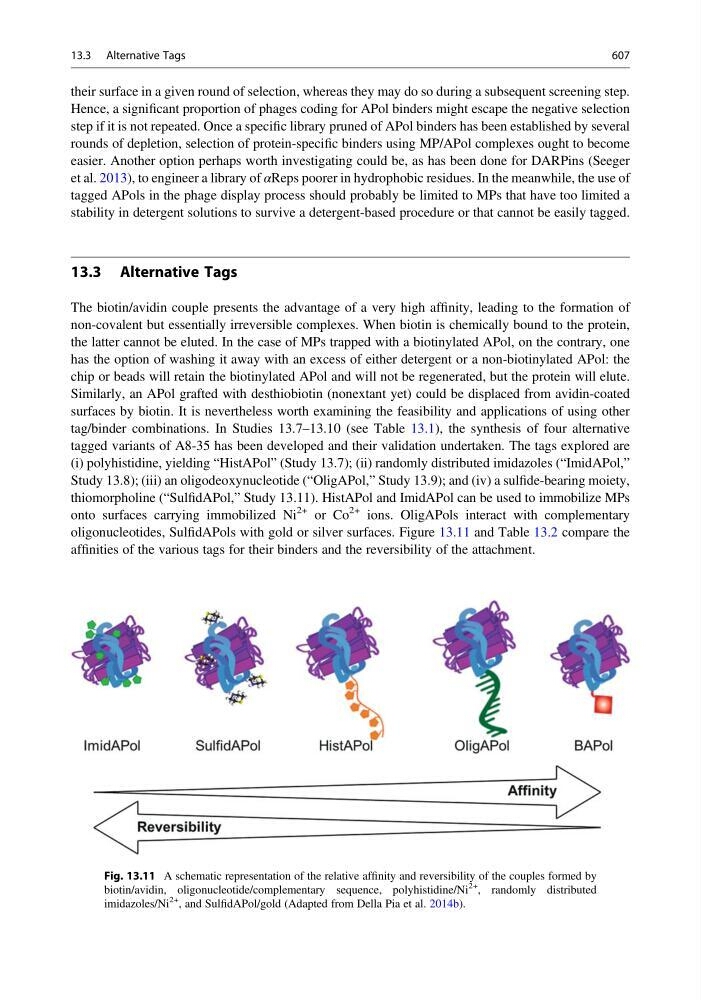
(i) polyhistidine, yielding “HistAPol” (Study 13.7); (ii) randomly distributed imidazoles (“ImidAPol,”
Study 13.8); (iii) an oligodeoxynucleotide (“OligAPol,” Study 13.9); and (iv) a sulfide-bearing moiety,
thiomorpholine (“SulfidAPol,” Study 13.11). HistAPol and ImidAPol can be used to immobilize MPs
onto surfaces carrying immobilized Ni
2+ or Co
2+ ions. OligAPols interact with complementary
oligonucleotides, SulfidAPols with gold or silver surfaces. Figure 13.11 and Table 13.2 compare the
affinities of the various tags for their binders and the reversibility of the attachment.
Fig. 13.11 A schematic representation of the relative affinity and reversibility of the couples formed by
biotin/avidin, oligonucleotide/complementary sequence, polyhistidine/Ni
2+ , randomly distributed
imidazoles/Ni
2+ , and SulfidAPol/gold (Adapted from Della Pia et al. 2014b).
13.3 Alternative Tags
607