

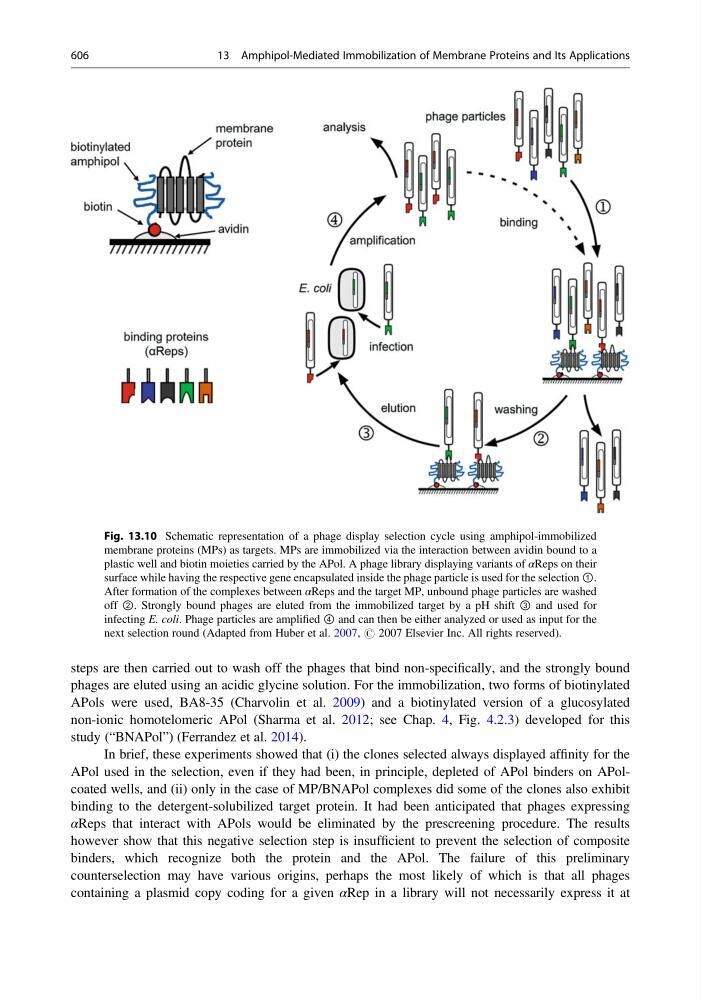
steps are then carried out to wash off the phages that bind non-specifically, and the strongly bound
phages are eluted using an acidic glycine solution. For the immobilization, two forms of biotinylated
APols were used, BA8-35 (Charvolin et al. 2009) and a biotinylated version of a glucosylated
non-ionic homotelomeric APol (Sharma et al. 2012; see Chap. 4, Fig. 4.2.3) developed for this
study (“BNAPol”) (Ferrandez et al. 2014).
In brief, these experiments showed that (i) the clones selected always displayed affinity for the
APol used in the selection, even if they had been, in principle, depleted of APol binders on APolcoated wells, and (ii) only in the case of MP/BNAPol complexes did some of the clones also exhibit
binding to the detergent-solubilized target protein. It had been anticipated that phages expressing
αReps that interact with APols would be eliminated by the prescreening procedure. The results
however show that this negative selection step is insufficient to prevent the selection of composite
binders, which recognize both the protein and the APol. The failure of this preliminary
counterselection may have various origins, perhaps the most likely of which is that all phages
containing a plasmid copy coding for a given αRep in a library will not necessarily express it at
Fig. 13.10 Schematic representation of a phage display selection cycle using amphipol-immobilized
membrane proteins (MPs) as targets. MPs are immobilized via the interaction between avidin bound to a
plastic well and biotin moieties carried by the APol. A phage library displaying variants of αReps on their
surface while having the respective gene encapsulated inside the phage particle is used for the selection ①.
After formation of the complexes between αReps and the target MP, unbound phage particles are washed
off ②. Strongly bound phages are eluted from the immobilized target by a pH shift ③ and used for
infecting E. coli. Phage particles are amplified ④ and can then be either analyzed or used as input for the
next selection round (Adapted from Huber et al. 2007, # 2007 Elsevier Inc. All rights reserved).
606
13 Amphipol-Mediated Immobilization of Membrane Proteins and Its Applications