

become linear, which is compatible with perfect monodispersity and neutral interactions. It cannot be
excluded, however, that the onset of association masks lingering repulsive interactions. These
observations suggest, nevertheless, that conditions can be found where the charged character of
A8-35 ceases to prevent bc 1 complexes from interacting one with another. The shape of the bc 1
complex facilitates the formation of crystals in which the dimers interact exclusively via their
extramembrane domains, without bringing TM regions into close proximity. Such is indeed the case
of the crystals (P6 5 22) that are usually obtained under the conditions used in Study 11.3 (Zhang et al.
1998) (Fig. 11.12B). It seemed therefore reasonable to hope that crystallization of bc 1 /A8-35
complexes might occur.
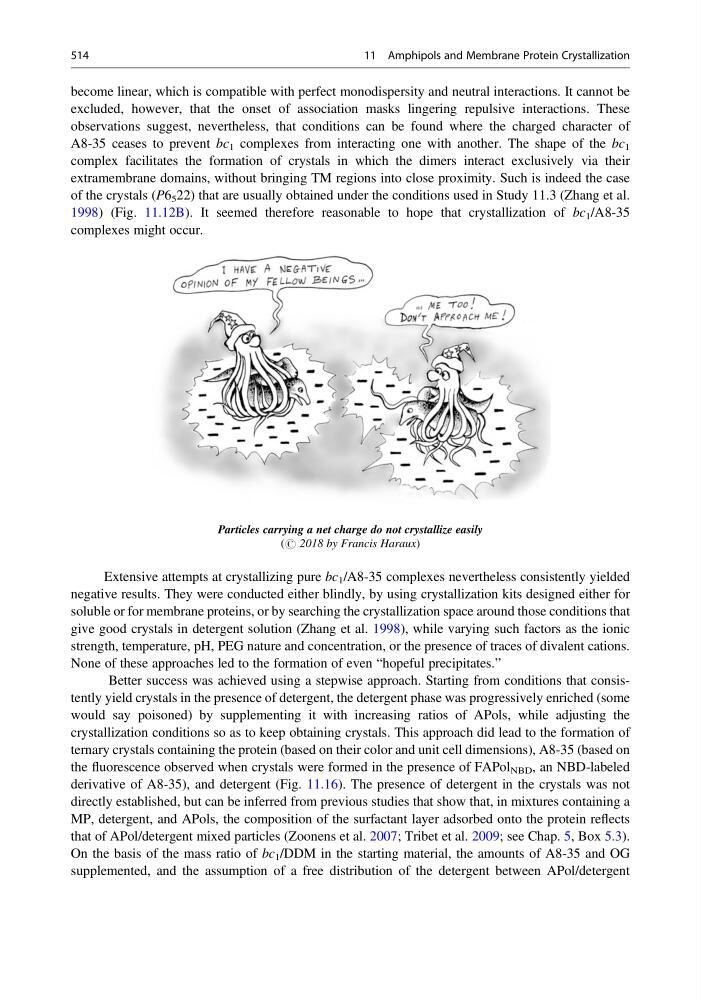
Particles carrying a net charge do not crystallize easily
(# 2018 by Francis Haraux)
Extensive attempts at crystallizing pure bc 1 /A8-35 complexes nevertheless consistently yielded
negative results. They were conducted either blindly, by using crystallization kits designed either for
soluble or for membrane proteins, or by searching the crystallization space around those conditions that
give good crystals in detergent solution (Zhang et al. 1998), while varying such factors as the ionic
strength, temperature, pH, PEG nature and concentration, or the presence of traces of divalent cations.
None of these approaches led to the formation of even “hopeful precipitates.”
Better success was achieved using a stepwise approach. Starting from conditions that consistently yield crystals in the presence of detergent, the detergent phase was progressively enriched (some
would say poisoned) by supplementing it with increasing ratios of APols, while adjusting the
crystallization conditions so as to keep obtaining crystals. This approach did lead to the formation of
ternary crystals containing the protein (based on their color and unit cell dimensions), A8-35 (based on
the fluorescence observed when crystals were formed in the presence of FAPol NBD , an NBD-labeled
derivative of A8-35), and detergent (Fig. 11.16). The presence of detergent in the crystals was not
directly established, but can be inferred from previous studies that show that, in mixtures containing a
MP, detergent, and APols, the composition of the surfactant layer adsorbed onto the protein reflects
that of APol/detergent mixed particles (Zoonens et al. 2007; Tribet et al. 2009; see Chap. 5, Box 5.3).
On the basis of the mass ratio of bc 1 /DDM in the starting material, the amounts of A8-35 and OG
supplemented, and the assumption of a free distribution of the detergent between APol/detergent
514
11 Amphipols and Membrane Protein Crystallization
excluded, however, that the onset of association masks lingering repulsive interactions. These
observations suggest, nevertheless, that conditions can be found where the charged character of
A8-35 ceases to prevent bc 1 complexes from interacting one with another. The shape of the bc 1
complex facilitates the formation of crystals in which the dimers interact exclusively via their
extramembrane domains, without bringing TM regions into close proximity. Such is indeed the case
of the crystals (P6 5 22) that are usually obtained under the conditions used in Study 11.3 (Zhang et al.
1998) (Fig. 11.12B). It seemed therefore reasonable to hope that crystallization of bc 1 /A8-35
complexes might occur.
Particles carrying a net charge do not crystallize easily
(# 2018 by Francis Haraux)
Extensive attempts at crystallizing pure bc 1 /A8-35 complexes nevertheless consistently yielded
negative results. They were conducted either blindly, by using crystallization kits designed either for
soluble or for membrane proteins, or by searching the crystallization space around those conditions that
give good crystals in detergent solution (Zhang et al. 1998), while varying such factors as the ionic
strength, temperature, pH, PEG nature and concentration, or the presence of traces of divalent cations.
None of these approaches led to the formation of even “hopeful precipitates.”
Better success was achieved using a stepwise approach. Starting from conditions that consistently yield crystals in the presence of detergent, the detergent phase was progressively enriched (some
would say poisoned) by supplementing it with increasing ratios of APols, while adjusting the
crystallization conditions so as to keep obtaining crystals. This approach did lead to the formation of
ternary crystals containing the protein (based on their color and unit cell dimensions), A8-35 (based on
the fluorescence observed when crystals were formed in the presence of FAPol NBD , an NBD-labeled
derivative of A8-35), and detergent (Fig. 11.16). The presence of detergent in the crystals was not
directly established, but can be inferred from previous studies that show that, in mixtures containing a
MP, detergent, and APols, the composition of the surfactant layer adsorbed onto the protein reflects
that of APol/detergent mixed particles (Zoonens et al. 2007; Tribet et al. 2009; see Chap. 5, Box 5.3).
On the basis of the mass ratio of bc 1 /DDM in the starting material, the amounts of A8-35 and OG
supplemented, and the assumption of a free distribution of the detergent between APol/detergent
514
11 Amphipols and Membrane Protein Crystallization