

mixed particles, soluble bc 1 /A8-35/detergent complexes, and crystals, it can be estimated that the mass
ratio of APol to detergent in the crystals most enriched in APols reached about 1:1 w/w (Charvolin
et al. 2014). A protocol for the crystallization of bc i /A8-35/detergent ternary complexes is described in
§ 11.4 (Protocol 11.1).
Why ternary complexes crystallized whereas pure bc 1 /APol complexes did not can have several
causes:
• First, diluting A8-35 with a neutral detergent effectively lowers the charge density of the
surface of the surfactant layer, diminishing global electrostatic repulsion.
• Second, it offers a way for the system to locally avoid close approach between carboxylate
groups of APol molecules adsorbed onto neighboring bc 1 dimers, since charged groups can
move away from each other and be replaced by neutral detergent polar heads, much in the
same way as small surfactants are thought to facilitate the formation of Type II crystals by
substituting for bulkier detergent molecules to avoid steric clashes (§ 11.2.2.1).
• Third, ternary tOmpA/A8-35/detergent complexes, as already mentioned, appear more homogeneous, upon gel filtration, than binary tOmpA/A8-35 ones (Zoonens et al. 2007; see
Chap. 9, § 9.3.2). This effect is probably due to the fact that MPs bind only a limited number
of APol molecules and that the latter are relatively large and heterogeneous. This may prevent
the mixture from relaxing to a state where each MP is surrounded by exactly the same amount
of surfactant. Detergents may provide the “small change” that helps adjusting the surfactant
layer to about the same size from one particle to another, obviously a favorable factor for
crystallization.
• Fourth, it is worth noting that some EM (Althoff et al. 2011) and MD (Perlmutter et al. 2014)
studies suggest that MP-bound A8-35 layers are not smooth, but bumpy (see Chaps. 5, § 5.3.3
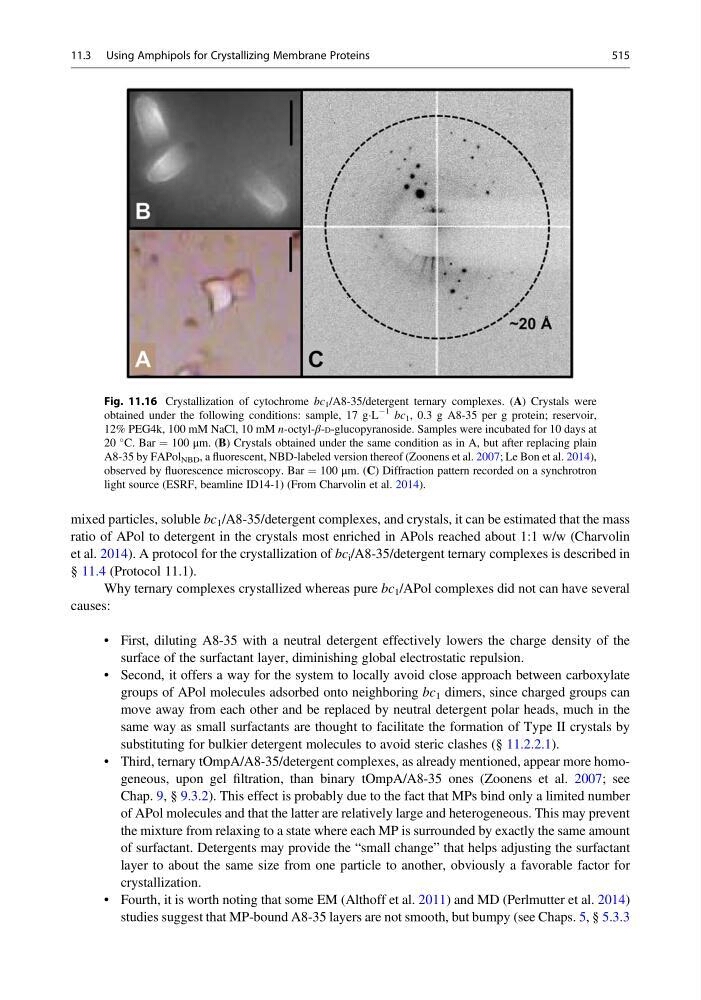
Fig. 11.16 Crystallization of cytochrome bc 1 /A8-35/detergent ternary complexes. (A) Crystals were
obtained under the following conditions: sample, 17 gÁL
À1 bc 1 , 0.3 g A8-35 per g protein; reservoir,
12% PEG4k, 100 mM NaCl, 10 mM n-octyl-β-D-glucopyranoside. Samples were incubated for 10 days at
20
C. Bar ¼ 100 μm. (B) Crystals obtained under the same condition as in A, but after replacing plain
A8-35 by FAPol NBD , a fluorescent, NBD-labeled version thereof (Zoonens et al. 2007; Le Bon et al. 2014),
observed by fluorescence microscopy. Bar ¼ 100 μm. (C) Diffraction pattern recorded on a synchrotron
light source (ESRF, beamline ID14-1) (From Charvolin et al. 2014).
11.3 Using Amphipols for Crystallizing Membrane Proteins
515
ratio of APol to detergent in the crystals most enriched in APols reached about 1:1 w/w (Charvolin
et al. 2014). A protocol for the crystallization of bc i /A8-35/detergent ternary complexes is described in
§ 11.4 (Protocol 11.1).
Why ternary complexes crystallized whereas pure bc 1 /APol complexes did not can have several
causes:
• First, diluting A8-35 with a neutral detergent effectively lowers the charge density of the
surface of the surfactant layer, diminishing global electrostatic repulsion.
• Second, it offers a way for the system to locally avoid close approach between carboxylate
groups of APol molecules adsorbed onto neighboring bc 1 dimers, since charged groups can
move away from each other and be replaced by neutral detergent polar heads, much in the
same way as small surfactants are thought to facilitate the formation of Type II crystals by
substituting for bulkier detergent molecules to avoid steric clashes (§ 11.2.2.1).
• Third, ternary tOmpA/A8-35/detergent complexes, as already mentioned, appear more homogeneous, upon gel filtration, than binary tOmpA/A8-35 ones (Zoonens et al. 2007; see
Chap. 9, § 9.3.2). This effect is probably due to the fact that MPs bind only a limited number
of APol molecules and that the latter are relatively large and heterogeneous. This may prevent
the mixture from relaxing to a state where each MP is surrounded by exactly the same amount
of surfactant. Detergents may provide the “small change” that helps adjusting the surfactant
layer to about the same size from one particle to another, obviously a favorable factor for
crystallization.
• Fourth, it is worth noting that some EM (Althoff et al. 2011) and MD (Perlmutter et al. 2014)
studies suggest that MP-bound A8-35 layers are not smooth, but bumpy (see Chaps. 5, § 5.3.3
Fig. 11.16 Crystallization of cytochrome bc 1 /A8-35/detergent ternary complexes. (A) Crystals were
obtained under the following conditions: sample, 17 gÁL
À1 bc 1 , 0.3 g A8-35 per g protein; reservoir,
12% PEG4k, 100 mM NaCl, 10 mM n-octyl-β-D-glucopyranoside. Samples were incubated for 10 days at
20
C. Bar ¼ 100 μm. (B) Crystals obtained under the same condition as in A, but after replacing plain
A8-35 by FAPol NBD , a fluorescent, NBD-labeled version thereof (Zoonens et al. 2007; Le Bon et al. 2014),
observed by fluorescence microscopy. Bar ¼ 100 μm. (C) Diffraction pattern recorded on a synchrotron
light source (ESRF, beamline ID14-1) (From Charvolin et al. 2014).
11.3 Using Amphipols for Crystallizing Membrane Proteins
515