

fraction of the surface of tOmpA is covered with surfactant and the protein has only small
extramembrane loops, differences in the amount of bound APol from particle to particle can be
expected to significantly affect the R S distribution. With cytochrome bc 1 , on the contrary, most of
the bulk of which is extramembrane, slight variations of the amount of APol surrounding the TM
region of the protein are unlikely to strongly affect its apparent R S , which is more sensitive to its overall
length.
The homogeneity of bc 1 /A8-35 particles, an essential factor in crystallization attempts, can be
affected by two further factors: on the one hand, the biochemical stability of the complexes, and, in
particular, the absence of monomerization; on the other, the propensity of bc 1 dimers to form higherorder oligomers. As regards the first point, substituting DDM with A8-35 drastically improved the
biochemical stability of cytochrome bc 1 (Charvolin et al. 2014). Over the course of several weeks at
4
C, however, a small degree of monomerization did develop. If previous experience with the
homologous b 6 f complex (Breyton et al. 1997, and unpublished observations) and with GPCRs
(Dahmane et al. 2009) is any guide, trapping some lipids along with the protein might be expected
to improve stability. As regards oligomerization, observations with the bc 1 complex are reminiscent of
those made with tOmpA (Zoonens et al. 2007), BR (Gohon et al. 2008), and OmpF (Arunmanee et al.
2014) (see Chaps. 5, § 5.2.1, and 12, § 12.3.1): namely the presence of a small excess of APol is
needed to prevent bc 1 dimers from forming higher-order oligomers (Fig. 11.14). This effect has been
attributed to the poorly dissociating character of APols (Chap. 5, § 5.2.1): upon removal of free APol,
APol-complexed MPs tend to form small aggregates, which, in the case of tOmpA, redisperse upon
adding back some free APol (Zoonens et al. 2007). The observations with the bc 1 complex, added to
those with OmpF (Arunmanee et al. 2014), further support the view that this may be a general
phenomenon. Experiments that benefit from monodispersity or require it, such as radiation scattering
or crystallization in aqueous solutions, should therefore be carried out in the presence of a slight excess
of APols. In the case of cytochrome bc 1 , the required amount of free APol is much lower (~0.1 g free
A8-35 per g of bound one) than in those of tOmpA (Zoonens et al. 2007) and BR (Gohon et al. 2008)
(~1:1). Since the propensity to aggregate is determined by the competition between protein/protein and
protein/APol interactions, the optimal ratio of free to bound APol that ensures monodispersity can be
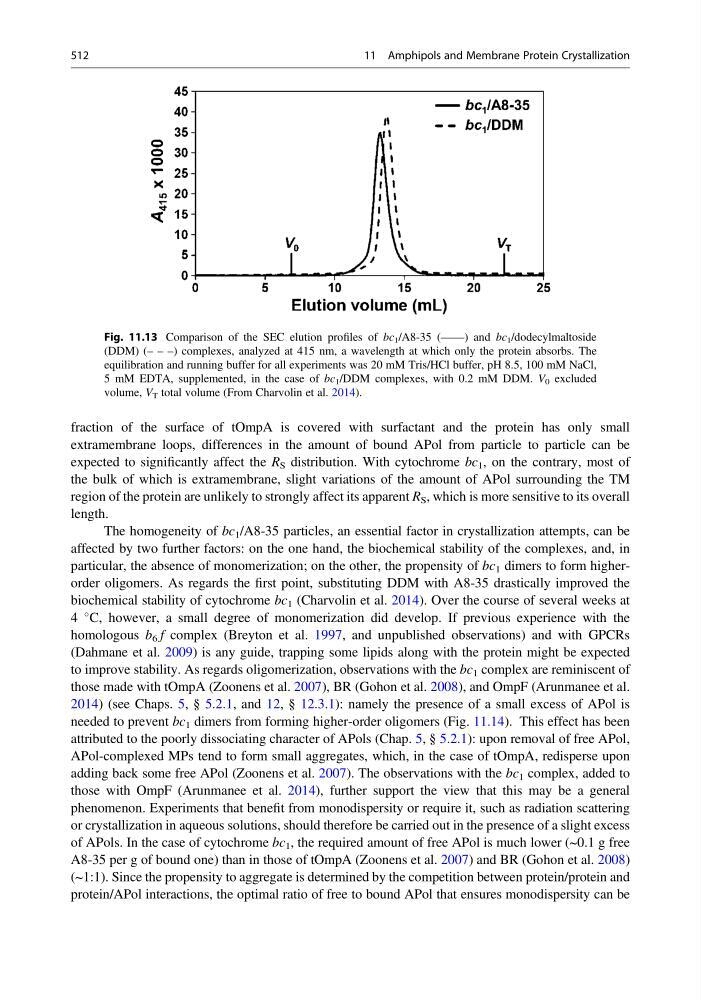
Fig. 11.13 Comparison of the SEC elution profiles of bc 1 /A8-35 (——) and bc 1 /dodecylmaltoside
(DDM) (– – –) complexes, analyzed at 415 nm, a wavelength at which only the protein absorbs. The
equilibration and running buffer for all experiments was 20 mM Tris/HCl buffer, pH 8.5, 100 mM NaCl,
5 mM EDTA, supplemented, in the case of bc 1 /DDM complexes, with 0.2 mM DDM. V 0 excluded
volume, V T total volume (From Charvolin et al. 2014).
512
11 Amphipols and Membrane Protein Crystallization
extramembrane loops, differences in the amount of bound APol from particle to particle can be
expected to significantly affect the R S distribution. With cytochrome bc 1 , on the contrary, most of
the bulk of which is extramembrane, slight variations of the amount of APol surrounding the TM
region of the protein are unlikely to strongly affect its apparent R S , which is more sensitive to its overall
length.
The homogeneity of bc 1 /A8-35 particles, an essential factor in crystallization attempts, can be
affected by two further factors: on the one hand, the biochemical stability of the complexes, and, in
particular, the absence of monomerization; on the other, the propensity of bc 1 dimers to form higherorder oligomers. As regards the first point, substituting DDM with A8-35 drastically improved the
biochemical stability of cytochrome bc 1 (Charvolin et al. 2014). Over the course of several weeks at
4
C, however, a small degree of monomerization did develop. If previous experience with the
homologous b 6 f complex (Breyton et al. 1997, and unpublished observations) and with GPCRs
(Dahmane et al. 2009) is any guide, trapping some lipids along with the protein might be expected
to improve stability. As regards oligomerization, observations with the bc 1 complex are reminiscent of
those made with tOmpA (Zoonens et al. 2007), BR (Gohon et al. 2008), and OmpF (Arunmanee et al.
2014) (see Chaps. 5, § 5.2.1, and 12, § 12.3.1): namely the presence of a small excess of APol is
needed to prevent bc 1 dimers from forming higher-order oligomers (Fig. 11.14). This effect has been
attributed to the poorly dissociating character of APols (Chap. 5, § 5.2.1): upon removal of free APol,
APol-complexed MPs tend to form small aggregates, which, in the case of tOmpA, redisperse upon
adding back some free APol (Zoonens et al. 2007). The observations with the bc 1 complex, added to
those with OmpF (Arunmanee et al. 2014), further support the view that this may be a general
phenomenon. Experiments that benefit from monodispersity or require it, such as radiation scattering
or crystallization in aqueous solutions, should therefore be carried out in the presence of a slight excess
of APols. In the case of cytochrome bc 1 , the required amount of free APol is much lower (~0.1 g free
A8-35 per g of bound one) than in those of tOmpA (Zoonens et al. 2007) and BR (Gohon et al. 2008)
(~1:1). Since the propensity to aggregate is determined by the competition between protein/protein and
protein/APol interactions, the optimal ratio of free to bound APol that ensures monodispersity can be
Fig. 11.13 Comparison of the SEC elution profiles of bc 1 /A8-35 (——) and bc 1 /dodecylmaltoside
(DDM) (– – –) complexes, analyzed at 415 nm, a wavelength at which only the protein absorbs. The
equilibration and running buffer for all experiments was 20 mM Tris/HCl buffer, pH 8.5, 100 mM NaCl,
5 mM EDTA, supplemented, in the case of bc 1 /DDM complexes, with 0.2 mM DDM. V 0 excluded
volume, V T total volume (From Charvolin et al. 2014).
512
11 Amphipols and Membrane Protein Crystallization