

Box 11.1 (continued)
When a MP in detergent solution is mixed with a lipidic cubic phase, it inserts into the walls of
the tubes, where it experiences a membrane-like environment. It can diffuse freely throughout the
whole volume of the phase. Addition of precipitants causes, under appropriate conditions, the
formation of nucleation sites and then of microcrystals, which are fed by the 3D network, grow to
crystallographically useful sizes, and can diffract to high resolution (Fig. 11.10). The water channels in
the MO cubic phase are only ~50 Å in diameter, which is a limitation to the diffusion of MPs with large
extramembrane regions. Some compounds, like PEG or butanediol, cause the cubic phase to pick up
more water, moving in the direction of a “sponge” phase. The water-filled channels swell, and the
whole phase becomes more flexible and less ordered, but it retains its 3D continuity and can be used, in
particular, to crystallize MPs with extended extramembrane domains (see Wadsten et al. 2006; Wöhri
et al. 2008; Caffrey 2015). The term in meso, which is frequently used to refer to MP crystallization in
mesophases, is therefore more generally applicable than the more restrictive alternative in cubo.
It is noteworthy that all 3D crystals grown in meso to date are of Type I (Fig. 11.2), which is
formed from stacks of 2D crystals. A proposed mechanism for their growth from the 3D cubic or
sponge phases is shown in Fig. 11.10 and discussed in its legend (Li et al. 2013).
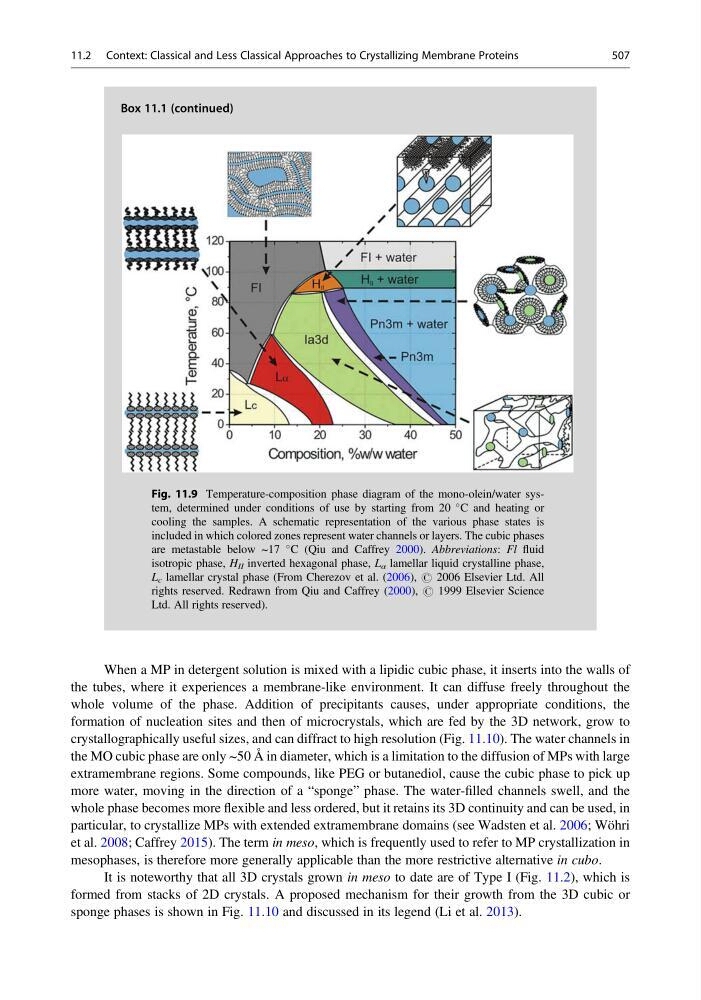
Fig. 11.9 Temperature-composition phase diagram of the mono-olein/water system, determined under conditions of use by starting from 20
C and heating or
cooling the samples. A schematic representation of the various phase states is
included in which colored zones represent water channels or layers. The cubic phases
are metastable below ~17
C (Qiu and Caffrey 2000). Abbreviations: Fl fluid
isotropic phase, H II inverted hexagonal phase, L α lamellar liquid crystalline phase,
L c lamellar crystal phase (From Cherezov et al. (2006), # 2006 Elsevier Ltd. All
rights reserved. Redrawn from Qiu and Caffrey (2000), # 1999 Elsevier Science
Ltd. All rights reserved).
11.2 Context: Classical and Less Classical Approaches to Crystallizing Membrane Proteins
507
When a MP in detergent solution is mixed with a lipidic cubic phase, it inserts into the walls of
the tubes, where it experiences a membrane-like environment. It can diffuse freely throughout the
whole volume of the phase. Addition of precipitants causes, under appropriate conditions, the
formation of nucleation sites and then of microcrystals, which are fed by the 3D network, grow to
crystallographically useful sizes, and can diffract to high resolution (Fig. 11.10). The water channels in
the MO cubic phase are only ~50 Å in diameter, which is a limitation to the diffusion of MPs with large
extramembrane regions. Some compounds, like PEG or butanediol, cause the cubic phase to pick up
more water, moving in the direction of a “sponge” phase. The water-filled channels swell, and the
whole phase becomes more flexible and less ordered, but it retains its 3D continuity and can be used, in
particular, to crystallize MPs with extended extramembrane domains (see Wadsten et al. 2006; Wöhri
et al. 2008; Caffrey 2015). The term in meso, which is frequently used to refer to MP crystallization in
mesophases, is therefore more generally applicable than the more restrictive alternative in cubo.
It is noteworthy that all 3D crystals grown in meso to date are of Type I (Fig. 11.2), which is
formed from stacks of 2D crystals. A proposed mechanism for their growth from the 3D cubic or
sponge phases is shown in Fig. 11.10 and discussed in its legend (Li et al. 2013).
Fig. 11.9 Temperature-composition phase diagram of the mono-olein/water system, determined under conditions of use by starting from 20
C and heating or
cooling the samples. A schematic representation of the various phase states is
included in which colored zones represent water channels or layers. The cubic phases
are metastable below ~17
C (Qiu and Caffrey 2000). Abbreviations: Fl fluid
isotropic phase, H II inverted hexagonal phase, L α lamellar liquid crystalline phase,
L c lamellar crystal phase (From Cherezov et al. (2006), # 2006 Elsevier Ltd. All
rights reserved. Redrawn from Qiu and Caffrey (2000), # 1999 Elsevier Science
Ltd. All rights reserved).
11.2 Context: Classical and Less Classical Approaches to Crystallizing Membrane Proteins
507