

crystallization screens and will keep for a long while yielding more structures even if they are no better
than more recent detergents with a more limited track record.
11.2.2.2 Forming Crystals in Lipid Three-Dimensional Phases
Twenty years ago, Ehud M. Landau and Jürg P. Rosenbusch introduced what they rightly called “a
novel concept for the crystallization of membrane proteins” and demonstrated its validity using BR as a
model (Landau and Rosenbusch 1996). Their proposal was to use as a medium for MP crystallization,
rather than a detergent solution, some of the organized 3D phases that specific lipids can form under
specific conditions and, in particular, the so-called cubic phases. As described in Box 11.1, these
“mesophases” are comprised of a 3D network of interconnected tubes. The wall of the tubes has a
bilayer structure, while two distinct networks of aqueous channels pervade the whole sample. A
macroscopic sample of lipidic cubic phase appears as a transparent, highly viscous blob, which can
nevertheless be handled using syringes, as well as overlaid with solutions. The walls of the tubes allow
the diffusion of membrane-inserted molecules throughout the sample, and so do the two networks of
aqueous channels for water-soluble molecules. Cubic phases are resistant to low concentrations of
detergent, as well as to most precipitants, and they tolerate the insertion, up to a certain concentration,
of biological lipids (see Caffrey 2015, and refs. therein). Below ~17
C, the cubic phase formed by
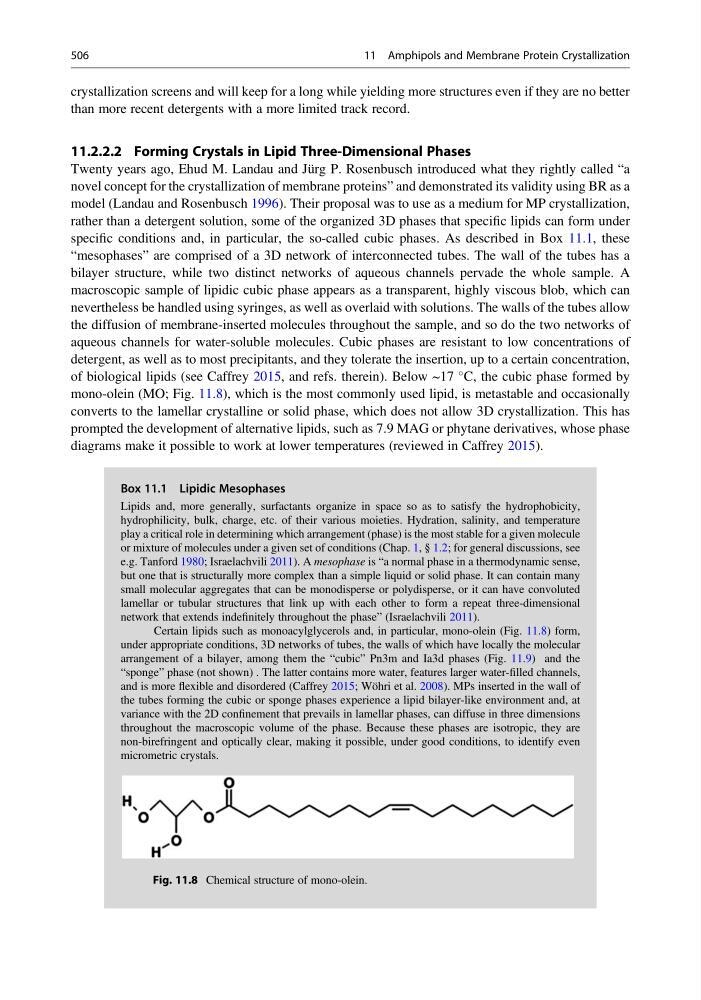
mono-olein (MO; Fig. 11.8), which is the most commonly used lipid, is metastable and occasionally
converts to the lamellar crystalline or solid phase, which does not allow 3D crystallization. This has
prompted the development of alternative lipids, such as 7.9 MAG or phytane derivatives, whose phase
diagrams make it possible to work at lower temperatures (reviewed in Caffrey 2015).
Box 11.1 Lipidic Mesophases
Lipids and, more generally, surfactants organize in space so as to satisfy the hydrophobicity,
hydrophilicity, bulk, charge, etc. of their various moieties. Hydration, salinity, and temperature
play a critical role in determining which arrangement (phase) is the most stable for a given molecule
or mixture of molecules under a given set of conditions (Chap. 1, § 1.2; for general discussions, see
e.g. Tanford 1980; Israelachvili 2011). A mesophase is “a normal phase in a thermodynamic sense,
but one that is structurally more complex than a simple liquid or solid phase. It can contain many
small molecular aggregates that can be monodisperse or polydisperse, or it can have convoluted
lamellar or tubular structures that link up with each other to form a repeat three-dimensional
network that extends indefinitely throughout the phase” (Israelachvili 2011).
Certain lipids such as monoacylglycerols and, in particular, mono-olein (Fig. 11.8) form,
under appropriate conditions, 3D networks of tubes, the walls of which have locally the molecular
arrangement of a bilayer, among them the “cubic” Pn3m and Ia3d phases (Fig. 11.9) and the
“sponge” phase (not shown) . The latter contains more water, features larger water-filled channels,
and is more flexible and disordered (Caffrey 2015; Wöhri et al. 2008). MPs inserted in the wall of
the tubes forming the cubic or sponge phases experience a lipid bilayer-like environment and, at
variance with the 2D confinement that prevails in lamellar phases, can diffuse in three dimensions
throughout the macroscopic volume of the phase. Because these phases are isotropic, they are
non-birefringent and optically clear, making it possible, under good conditions, to identify even
micrometric crystals.
Fig. 11.8 Chemical structure of mono-olein.
506
11 Amphipols and Membrane Protein Crystallization
than more recent detergents with a more limited track record.
11.2.2.2 Forming Crystals in Lipid Three-Dimensional Phases
Twenty years ago, Ehud M. Landau and Jürg P. Rosenbusch introduced what they rightly called “a
novel concept for the crystallization of membrane proteins” and demonstrated its validity using BR as a
model (Landau and Rosenbusch 1996). Their proposal was to use as a medium for MP crystallization,
rather than a detergent solution, some of the organized 3D phases that specific lipids can form under
specific conditions and, in particular, the so-called cubic phases. As described in Box 11.1, these
“mesophases” are comprised of a 3D network of interconnected tubes. The wall of the tubes has a
bilayer structure, while two distinct networks of aqueous channels pervade the whole sample. A
macroscopic sample of lipidic cubic phase appears as a transparent, highly viscous blob, which can
nevertheless be handled using syringes, as well as overlaid with solutions. The walls of the tubes allow
the diffusion of membrane-inserted molecules throughout the sample, and so do the two networks of
aqueous channels for water-soluble molecules. Cubic phases are resistant to low concentrations of
detergent, as well as to most precipitants, and they tolerate the insertion, up to a certain concentration,
of biological lipids (see Caffrey 2015, and refs. therein). Below ~17
C, the cubic phase formed by
mono-olein (MO; Fig. 11.8), which is the most commonly used lipid, is metastable and occasionally
converts to the lamellar crystalline or solid phase, which does not allow 3D crystallization. This has
prompted the development of alternative lipids, such as 7.9 MAG or phytane derivatives, whose phase
diagrams make it possible to work at lower temperatures (reviewed in Caffrey 2015).
Box 11.1 Lipidic Mesophases
Lipids and, more generally, surfactants organize in space so as to satisfy the hydrophobicity,
hydrophilicity, bulk, charge, etc. of their various moieties. Hydration, salinity, and temperature
play a critical role in determining which arrangement (phase) is the most stable for a given molecule
or mixture of molecules under a given set of conditions (Chap. 1, § 1.2; for general discussions, see
e.g. Tanford 1980; Israelachvili 2011). A mesophase is “a normal phase in a thermodynamic sense,
but one that is structurally more complex than a simple liquid or solid phase. It can contain many
small molecular aggregates that can be monodisperse or polydisperse, or it can have convoluted
lamellar or tubular structures that link up with each other to form a repeat three-dimensional
network that extends indefinitely throughout the phase” (Israelachvili 2011).
Certain lipids such as monoacylglycerols and, in particular, mono-olein (Fig. 11.8) form,
under appropriate conditions, 3D networks of tubes, the walls of which have locally the molecular
arrangement of a bilayer, among them the “cubic” Pn3m and Ia3d phases (Fig. 11.9) and the
“sponge” phase (not shown) . The latter contains more water, features larger water-filled channels,
and is more flexible and disordered (Caffrey 2015; Wöhri et al. 2008). MPs inserted in the wall of
the tubes forming the cubic or sponge phases experience a lipid bilayer-like environment and, at
variance with the 2D confinement that prevails in lamellar phases, can diffuse in three dimensions
throughout the macroscopic volume of the phase. Because these phases are isotropic, they are
non-birefringent and optically clear, making it possible, under good conditions, to identify even
micrometric crystals.
Fig. 11.8 Chemical structure of mono-olein.
506
11 Amphipols and Membrane Protein Crystallization