

• Detergents, as discussed in Chap. 2, tend to destabilize MPs and to do so the more rapidly
when they are more concentrated. In typical crystallization experiments by vapor diffusion,
the initial solution is already quite concentrated in MP and detergent, and the evaporation of
water will increase both concentrations.
• Detergents have their own phase diagrams: when concentrating a micellar solution of
detergent – or warming it or cooling it – separation can occur between a detergent-poor and
a detergent-rich phase, in which micelles interact with one another (Chap. 2). Phase separation is generally to be avoided (see however Garavito et al. 1983, 1996), but coming close to it
can help, because slightly attractive interactions between the detergent belts surrounding the
proteins can favor the formation of the crystal (cf. Fig. 11.5). Interactions between detergent
micelles indeed are a good predictor of crystallization conditions (Hitscherich et al. 2000).
• The bulk of the detergent belt is also a source of problems, as it may interfere with the
formation of the crystal and make the formation of contacts between the hydrophilic surfaces
of the protein more difficult. Indeed, when crystals do form, they tend to be more water-rich
and less well ordered in the presence of detergents that form large micelles, and there is
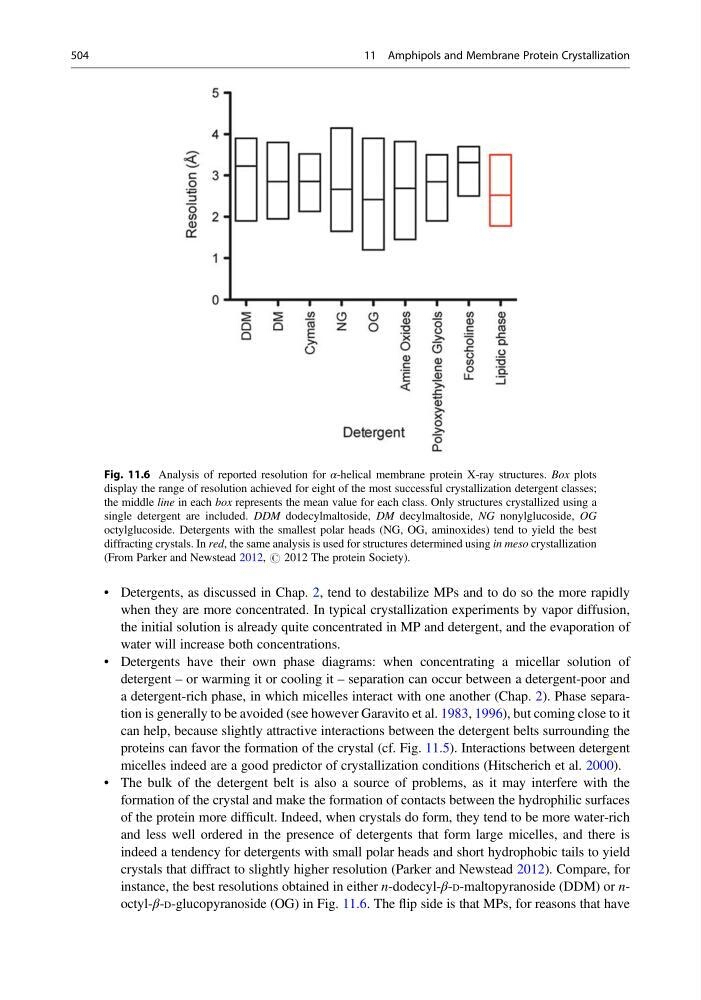
indeed a tendency for detergents with small polar heads and short hydrophobic tails to yield
crystals that diffract to slightly higher resolution (Parker and Newstead 2012). Compare, for
instance, the best resolutions obtained in either n-dodecyl-β-D-maltopyranoside (DDM) or noctyl-β-D-glucopyranoside (OG) in Fig. 11.6. The flip side is that MPs, for reasons that have
Fig. 11.6 Analysis of reported resolution for α-helical membrane protein X-ray structures. Box plots
display the range of resolution achieved for eight of the most successful crystallization detergent classes;
the middle line in each box represents the mean value for each class. Only structures crystallized using a
single detergent are included. DDM dodecylmaltoside, DM decylmaltoside, NG nonylglucoside, OG
octylglucoside. Detergents with the smallest polar heads (NG, OG, aminoxides) tend to yield the best
diffracting crystals. In red, the same analysis is used for structures determined using in meso crystallization
(From Parker and Newstead 2012, # 2012 The protein Society).
504
11 Amphipols and Membrane Protein Crystallization
when they are more concentrated. In typical crystallization experiments by vapor diffusion,
the initial solution is already quite concentrated in MP and detergent, and the evaporation of
water will increase both concentrations.
• Detergents have their own phase diagrams: when concentrating a micellar solution of
detergent – or warming it or cooling it – separation can occur between a detergent-poor and
a detergent-rich phase, in which micelles interact with one another (Chap. 2). Phase separation is generally to be avoided (see however Garavito et al. 1983, 1996), but coming close to it
can help, because slightly attractive interactions between the detergent belts surrounding the
proteins can favor the formation of the crystal (cf. Fig. 11.5). Interactions between detergent
micelles indeed are a good predictor of crystallization conditions (Hitscherich et al. 2000).
• The bulk of the detergent belt is also a source of problems, as it may interfere with the
formation of the crystal and make the formation of contacts between the hydrophilic surfaces
of the protein more difficult. Indeed, when crystals do form, they tend to be more water-rich
and less well ordered in the presence of detergents that form large micelles, and there is
indeed a tendency for detergents with small polar heads and short hydrophobic tails to yield
crystals that diffract to slightly higher resolution (Parker and Newstead 2012). Compare, for
instance, the best resolutions obtained in either n-dodecyl-β-D-maltopyranoside (DDM) or noctyl-β-D-glucopyranoside (OG) in Fig. 11.6. The flip side is that MPs, for reasons that have
Fig. 11.6 Analysis of reported resolution for α-helical membrane protein X-ray structures. Box plots
display the range of resolution achieved for eight of the most successful crystallization detergent classes;
the middle line in each box represents the mean value for each class. Only structures crystallized using a
single detergent are included. DDM dodecylmaltoside, DM decylmaltoside, NG nonylglucoside, OG
octylglucoside. Detergents with the smallest polar heads (NG, OG, aminoxides) tend to yield the best
diffracting crystals. In red, the same analysis is used for structures determined using in meso crystallization
(From Parker and Newstead 2012, # 2012 The protein Society).
504
11 Amphipols and Membrane Protein Crystallization