

membrane 2D crystals (Grigorieff et al. 1996). This is schematically shown in the cartoon of Fig. 11.2
(left). Between planes, contacts would be established between the hydrophilic, extramembrane
surfaces of the proteins, as in soluble protein crystals. H. Michel deemed the prospect of growing
such crystals to a size useful for X-ray crystallography as dim, because the crystallization procedure
would have to simultaneously optimize both hydrophobic and hydrophilic contacts. Indeed, they are
seldom observed when MP crystals are grown from detergent solutions.
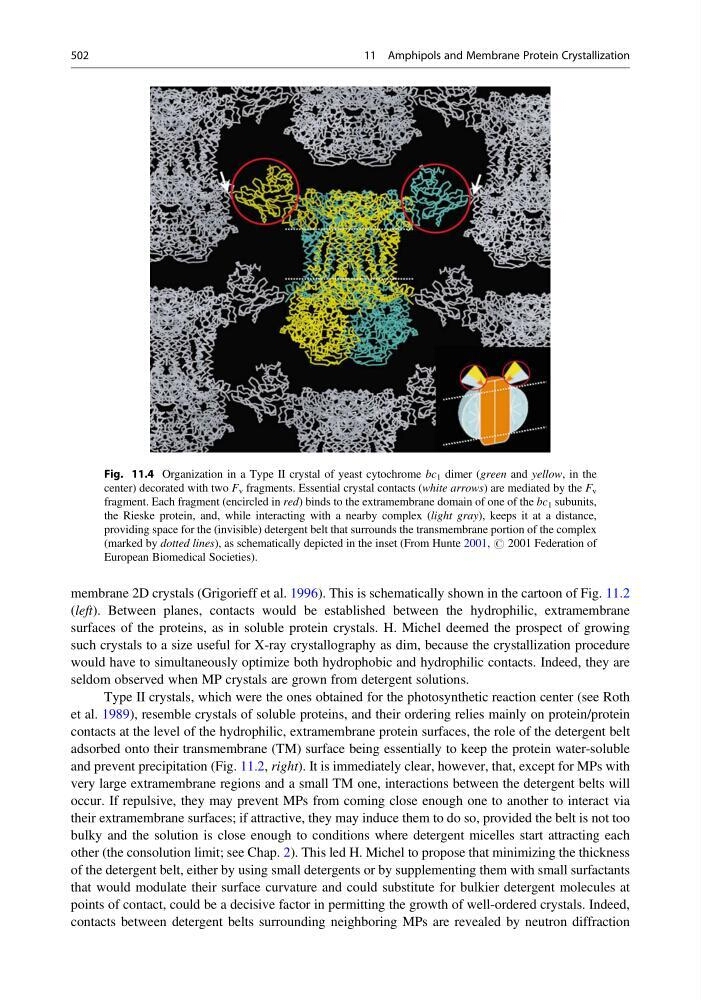
Type II crystals, which were the ones obtained for the photosynthetic reaction center (see Roth
et al. 1989), resemble crystals of soluble proteins, and their ordering relies mainly on protein/protein
contacts at the level of the hydrophilic, extramembrane protein surfaces, the role of the detergent belt
adsorbed onto their transmembrane (TM) surface being essentially to keep the protein water-soluble
and prevent precipitation (Fig. 11.2, right). It is immediately clear, however, that, except for MPs with
very large extramembrane regions and a small TM one, interactions between the detergent belts will
occur. If repulsive, they may prevent MPs from coming close enough one to another to interact via
their extramembrane surfaces; if attractive, they may induce them to do so, provided the belt is not too
bulky and the solution is close enough to conditions where detergent micelles start attracting each
other (the consolution limit; see Chap. 2). This led H. Michel to propose that minimizing the thickness
of the detergent belt, either by using small detergents or by supplementing them with small surfactants
that would modulate their surface curvature and could substitute for bulkier detergent molecules at
points of contact, could be a decisive factor in permitting the growth of well-ordered crystals. Indeed,
contacts between detergent belts surrounding neighboring MPs are revealed by neutron diffraction
Fig. 11.4 Organization in a Type II crystal of yeast cytochrome bc 1 dimer (green and yellow, in the
center) decorated with two F v fragments. Essential crystal contacts (white arrows) are mediated by the F v
fragment. Each fragment (encircled in red) binds to the extramembrane domain of one of the bc 1 subunits,
the Rieske protein, and, while interacting with a nearby complex (light gray), keeps it at a distance,
providing space for the (invisible) detergent belt that surrounds the transmembrane portion of the complex
(marked by dotted lines), as schematically depicted in the inset (From Hunte 2001, # 2001 Federation of
European Biomedical Societies).
502
11 Amphipols and Membrane Protein Crystallization
(left). Between planes, contacts would be established between the hydrophilic, extramembrane
surfaces of the proteins, as in soluble protein crystals. H. Michel deemed the prospect of growing
such crystals to a size useful for X-ray crystallography as dim, because the crystallization procedure
would have to simultaneously optimize both hydrophobic and hydrophilic contacts. Indeed, they are
seldom observed when MP crystals are grown from detergent solutions.
Type II crystals, which were the ones obtained for the photosynthetic reaction center (see Roth
et al. 1989), resemble crystals of soluble proteins, and their ordering relies mainly on protein/protein
contacts at the level of the hydrophilic, extramembrane protein surfaces, the role of the detergent belt
adsorbed onto their transmembrane (TM) surface being essentially to keep the protein water-soluble
and prevent precipitation (Fig. 11.2, right). It is immediately clear, however, that, except for MPs with
very large extramembrane regions and a small TM one, interactions between the detergent belts will
occur. If repulsive, they may prevent MPs from coming close enough one to another to interact via
their extramembrane surfaces; if attractive, they may induce them to do so, provided the belt is not too
bulky and the solution is close enough to conditions where detergent micelles start attracting each
other (the consolution limit; see Chap. 2). This led H. Michel to propose that minimizing the thickness
of the detergent belt, either by using small detergents or by supplementing them with small surfactants
that would modulate their surface curvature and could substitute for bulkier detergent molecules at
points of contact, could be a decisive factor in permitting the growth of well-ordered crystals. Indeed,
contacts between detergent belts surrounding neighboring MPs are revealed by neutron diffraction
Fig. 11.4 Organization in a Type II crystal of yeast cytochrome bc 1 dimer (green and yellow, in the
center) decorated with two F v fragments. Essential crystal contacts (white arrows) are mediated by the F v
fragment. Each fragment (encircled in red) binds to the extramembrane domain of one of the bc 1 subunits,
the Rieske protein, and, while interacting with a nearby complex (light gray), keeps it at a distance,
providing space for the (invisible) detergent belt that surrounds the transmembrane portion of the complex
(marked by dotted lines), as schematically depicted in the inset (From Hunte 2001, # 2001 Federation of
European Biomedical Societies).
502
11 Amphipols and Membrane Protein Crystallization