

milder than SAPols (see Chap. 5, § 5.5) and may permit to collect data for longer periods and/or at
higher temperature. However, their current synthesis protocol makes them difficult to market in large
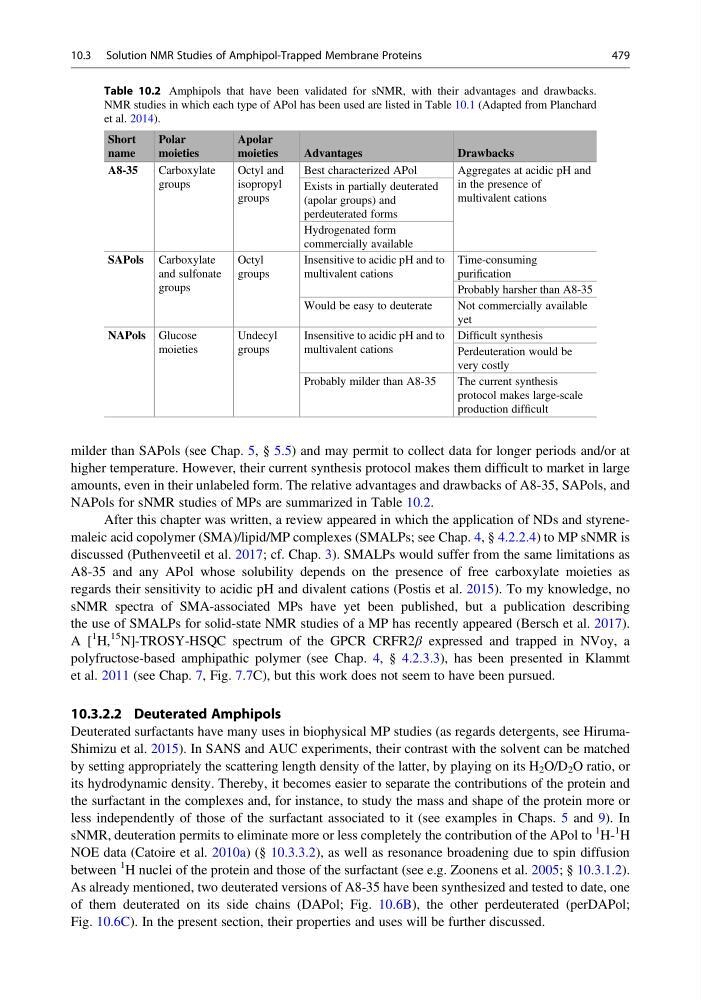
amounts, even in their unlabeled form. The relative advantages and drawbacks of A8-35, SAPols, and
NAPols for sNMR studies of MPs are summarized in Table 10.2.
After this chapter was written, a review appeared in which the application of NDs and styrenemaleic acid copolymer (SMA)/lipid/MP complexes (SMALPs; see Chap. 4, § 4.2.2.4) to MP sNMR is
discussed (Puthenveetil et al. 2017; cf. Chap. 3). SMALPs would suffer from the same limitations as
A8-35 and any APol whose solubility depends on the presence of free carboxylate moieties as
regards their sensitivity to acidic pH and divalent cations (Postis et al. 2015). To my knowledge, no
sNMR spectra of SMA-associated MPs have yet been published, but a publication describing
the use of SMALPs for solid-state NMR studies of a MP has recently appeared (Bersch et al. 2017).
A [
1 H,
15 N]-TROSY-HSQC spectrum of the GPCR CRFR2β expressed and trapped in NVoy, a
polyfructose-based amphipathic polymer (see Chap. 4, § 4.2.3.3), has been presented in Klammt
et al. 2011 (see Chap. 7, Fig. 7.7C), but this work does not seem to have been pursued.
10.3.2.2 Deuterated Amphipols
Deuterated surfactants have many uses in biophysical MP studies (as regards detergents, see HirumaShimizu et al. 2015). In SANS and AUC experiments, their contrast with the solvent can be matched
by setting appropriately the scattering length density of the latter, by playing on its H 2 O/D 2 O ratio, or
its hydrodynamic density. Thereby, it becomes easier to separate the contributions of the protein and
the surfactant in the complexes and, for instance, to study the mass and shape of the protein more or
less independently of those of the surfactant associated to it (see examples in Chaps. 5 and 9). In
sNMR, deuteration permits to eliminate more or less completely the contribution of the APol to
1 H1
H
NOE data (Catoire et al. 2010a) (§ 10.3.3.2), as well as resonance broadening due to spin diffusion
between
1 H nuclei of the protein and those of the surfactant (see e.g. Zoonens et al. 2005; § 10.3.1.2).
As already mentioned, two deuterated versions of A8-35 have been synthesized and tested to date, one
of them deuterated on its side chains (DAPol; Fig. 10.6B), the other perdeuterated (perDAPol;
Fig. 10.6C). In the present section, their properties and uses will be further discussed.
Table 10.2 Amphipols that have been validated for sNMR, with their advantages and drawbacks.
NMR studies in which each type of APol has been used are listed in Table 10.1 (Adapted from Planchard
et al. 2014).
Short
name
Polar
moieties
Apolar
moieties
Advantages
Drawbacks
A8-35
Carboxylate
groups
Octyl and
isopropyl
groups
Best characterized APol
Aggregates at acidic pH and
in the presence of
multivalent cations
Exists in partially deuterated
(apolar groups) and
perdeuterated forms
Hydrogenated form
commercially available
SAPols Carboxylate
and sulfonate
groups
Octyl
groups
Insensitive to acidic pH and to
multivalent cations
Time-consuming
purification
Probably harsher than A8-35
Would be easy to deuterate
Not commercially available
yet
NAPols Glucose
moieties
Undecyl
groups
Insensitive to acidic pH and to
multivalent cations
Difficult synthesis
Perdeuteration would be
very costly
Probably milder than A8-35
The current synthesis
protocol makes large-scale
production difficult
10.3 Solution NMR Studies of Amphipol-Trapped Membrane Proteins
479
higher temperature. However, their current synthesis protocol makes them difficult to market in large
amounts, even in their unlabeled form. The relative advantages and drawbacks of A8-35, SAPols, and
NAPols for sNMR studies of MPs are summarized in Table 10.2.
After this chapter was written, a review appeared in which the application of NDs and styrenemaleic acid copolymer (SMA)/lipid/MP complexes (SMALPs; see Chap. 4, § 4.2.2.4) to MP sNMR is
discussed (Puthenveetil et al. 2017; cf. Chap. 3). SMALPs would suffer from the same limitations as
A8-35 and any APol whose solubility depends on the presence of free carboxylate moieties as
regards their sensitivity to acidic pH and divalent cations (Postis et al. 2015). To my knowledge, no
sNMR spectra of SMA-associated MPs have yet been published, but a publication describing
the use of SMALPs for solid-state NMR studies of a MP has recently appeared (Bersch et al. 2017).
A [
1 H,
15 N]-TROSY-HSQC spectrum of the GPCR CRFR2β expressed and trapped in NVoy, a
polyfructose-based amphipathic polymer (see Chap. 4, § 4.2.3.3), has been presented in Klammt
et al. 2011 (see Chap. 7, Fig. 7.7C), but this work does not seem to have been pursued.
10.3.2.2 Deuterated Amphipols
Deuterated surfactants have many uses in biophysical MP studies (as regards detergents, see HirumaShimizu et al. 2015). In SANS and AUC experiments, their contrast with the solvent can be matched
by setting appropriately the scattering length density of the latter, by playing on its H 2 O/D 2 O ratio, or
its hydrodynamic density. Thereby, it becomes easier to separate the contributions of the protein and
the surfactant in the complexes and, for instance, to study the mass and shape of the protein more or
less independently of those of the surfactant associated to it (see examples in Chaps. 5 and 9). In
sNMR, deuteration permits to eliminate more or less completely the contribution of the APol to
1 H1
H
NOE data (Catoire et al. 2010a) (§ 10.3.3.2), as well as resonance broadening due to spin diffusion
between
1 H nuclei of the protein and those of the surfactant (see e.g. Zoonens et al. 2005; § 10.3.1.2).
As already mentioned, two deuterated versions of A8-35 have been synthesized and tested to date, one
of them deuterated on its side chains (DAPol; Fig. 10.6B), the other perdeuterated (perDAPol;
Fig. 10.6C). In the present section, their properties and uses will be further discussed.
Table 10.2 Amphipols that have been validated for sNMR, with their advantages and drawbacks.
NMR studies in which each type of APol has been used are listed in Table 10.1 (Adapted from Planchard
et al. 2014).
Short
name
Polar
moieties
Apolar
moieties
Advantages
Drawbacks
A8-35
Carboxylate
groups
Octyl and
isopropyl
groups
Best characterized APol
Aggregates at acidic pH and
in the presence of
multivalent cations
Exists in partially deuterated
(apolar groups) and
perdeuterated forms
Hydrogenated form
commercially available
SAPols Carboxylate
and sulfonate
groups
Octyl
groups
Insensitive to acidic pH and to
multivalent cations
Time-consuming
purification
Probably harsher than A8-35
Would be easy to deuterate
Not commercially available
yet
NAPols Glucose
moieties
Undecyl
groups
Insensitive to acidic pH and to
multivalent cations
Difficult synthesis
Perdeuteration would be
very costly
Probably milder than A8-35
The current synthesis
protocol makes large-scale
production difficult
10.3 Solution NMR Studies of Amphipol-Trapped Membrane Proteins
479