

especially if one aims to capture a single MP per ND, and some purification work is required to obtain
monodisperse preparations (see e.g. Ritchie et al. 2009, and Chap. 3, § 3.3).
From a practical point of view, a marked advantage of A8-35 or SAPols over NAPols is that they
are relatively easy to deuterate, which is a great asset for certain NMR studies (see § 10.3.3). They
would have to be preferred to NAPols should it be necessary to work with unprotonated APols,
because perdeuteration of glucosylated NAPols would be difficult and costly. NAPols are likely to be
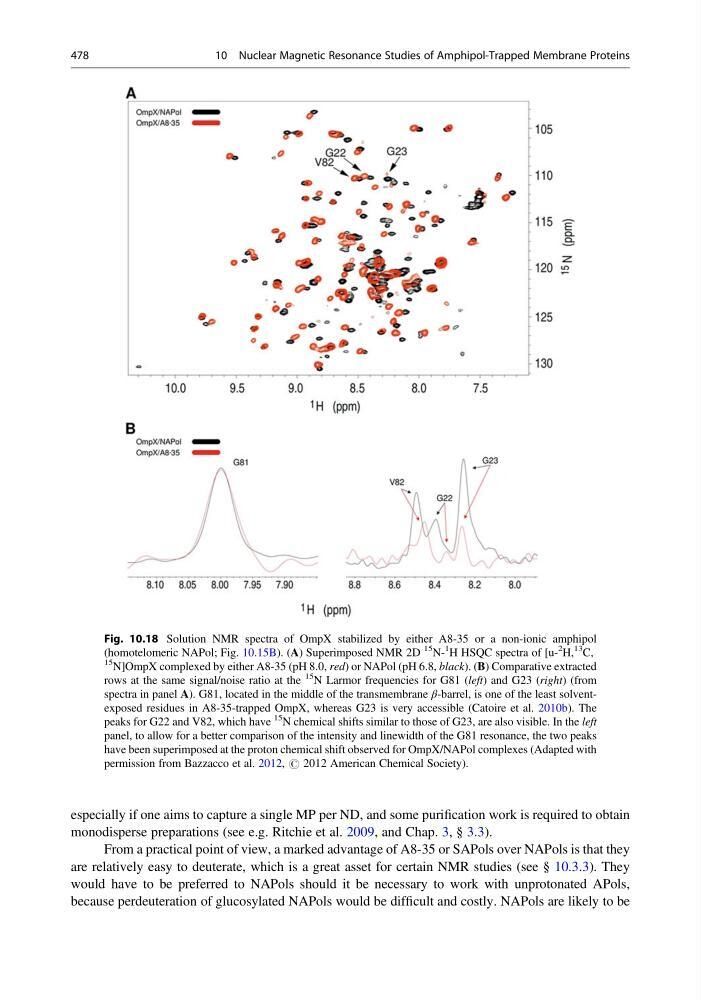
Fig. 10.18 Solution NMR spectra of OmpX stabilized by either A8-35 or a non-ionic amphipol
(homotelomeric NAPol; Fig. 10.15B). (A) Superimposed NMR 2D
15
N1
H HSQC spectra of [u2
H,
13
C,
15
N]OmpX complexed by either A8-35 (pH 8.0, red) or NAPol (pH 6.8, black). (B) Comparative extracted
rows at the same signal/noise ratio at the
15
N Larmor frequencies for G81 (left) and G23 (right) (from
spectra in panel A). G81, located in the middle of the transmembrane β-barrel, is one of the least solventexposed residues in A8-35-trapped OmpX, whereas G23 is very accessible (Catoire et al. 2010b). The
peaks for G22 and V82, which have
15
N chemical shifts similar to those of G23, are also visible. In the left
panel, to allow for a better comparison of the intensity and linewidth of the G81 resonance, the two peaks
have been superimposed at the proton chemical shift observed for OmpX/NAPol complexes (Adapted with
permission from Bazzacco et al. 2012, # 2012 American Chemical Society).
478
10 Nuclear Magnetic Resonance Studies of Amphipol-Trapped Membrane Proteins
monodisperse preparations (see e.g. Ritchie et al. 2009, and Chap. 3, § 3.3).
From a practical point of view, a marked advantage of A8-35 or SAPols over NAPols is that they
are relatively easy to deuterate, which is a great asset for certain NMR studies (see § 10.3.3). They
would have to be preferred to NAPols should it be necessary to work with unprotonated APols,
because perdeuteration of glucosylated NAPols would be difficult and costly. NAPols are likely to be
Fig. 10.18 Solution NMR spectra of OmpX stabilized by either A8-35 or a non-ionic amphipol
(homotelomeric NAPol; Fig. 10.15B). (A) Superimposed NMR 2D
15
N1
H HSQC spectra of [u2
H,
13
C,
15
N]OmpX complexed by either A8-35 (pH 8.0, red) or NAPol (pH 6.8, black). (B) Comparative extracted
rows at the same signal/noise ratio at the
15
N Larmor frequencies for G81 (left) and G23 (right) (from
spectra in panel A). G81, located in the middle of the transmembrane β-barrel, is one of the least solventexposed residues in A8-35-trapped OmpX, whereas G23 is very accessible (Catoire et al. 2010b). The
peaks for G22 and V82, which have
15
N chemical shifts similar to those of G23, are also visible. In the left
panel, to allow for a better comparison of the intensity and linewidth of the G81 resonance, the two peaks
have been superimposed at the proton chemical shift observed for OmpX/NAPol complexes (Adapted with
permission from Bazzacco et al. 2012, # 2012 American Chemical Society).
478
10 Nuclear Magnetic Resonance Studies of Amphipol-Trapped Membrane Proteins