

The stability of tOmpA/SAPol complexes was tested by recording 2D
15 N1 H TROSY spectra at
30, 50, and 70
C (Fig. 10.17). The very similar and well-dispersed correlation peaks indicate that
SAPol-trapped tOmpA retains its native 3D structure for days even at 70
C. As expected, the line
shape and intensity of signals originating from loop residues change more with temperature than those
from β-barrel residues, due to faster conformational exchange in the loops. Similarly, it has been
observed that transferring the insulin-responsive facilitative glucose transporter GLUT4 from the
highly stabilizing detergent lauryl maltose neopentyl glycol (LMNG) to APol A8-35 increased the
accessible NMR acquisition time at 35
C from 2 to 36 h without inducing any detectable protein
aggregation (Kraft et al. 2015). Having access to a broad range of temperatures is of interest not only
for speeding up the tumbling rate, thereby increasing the resolution, but also for modulating the rate of
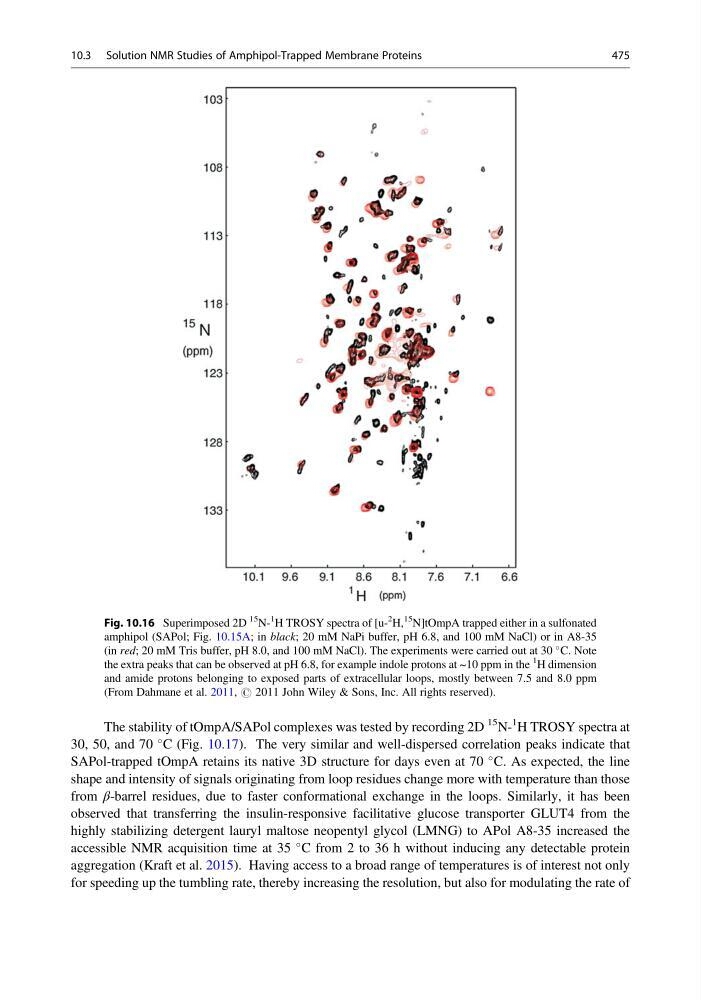
Fig. 10.16 Superimposed 2D
15
N1
H TROSY spectra of [u2
H,
15
N]tOmpA trapped either in a sulfonated
amphipol (SAPol; Fig. 10.15A; in black; 20 mM NaPi buffer, pH 6.8, and 100 mM NaCl) or in A8-35
(in red; 20 mM Tris buffer, pH 8.0, and 100 mM NaCl). The experiments were carried out at 30
C. Note
the extra peaks that can be observed at pH 6.8, for example indole protons at ~10 ppm in the
1
H dimension
and amide protons belonging to exposed parts of extracellular loops, mostly between 7.5 and 8.0 ppm
(From Dahmane et al. 2011, # 2011 John Wiley & Sons, Inc. All rights reserved).
10.3 Solution NMR Studies of Amphipol-Trapped Membrane Proteins
475
15 N1 H TROSY spectra at
30, 50, and 70
C (Fig. 10.17). The very similar and well-dispersed correlation peaks indicate that
SAPol-trapped tOmpA retains its native 3D structure for days even at 70
C. As expected, the line
shape and intensity of signals originating from loop residues change more with temperature than those
from β-barrel residues, due to faster conformational exchange in the loops. Similarly, it has been
observed that transferring the insulin-responsive facilitative glucose transporter GLUT4 from the
highly stabilizing detergent lauryl maltose neopentyl glycol (LMNG) to APol A8-35 increased the
accessible NMR acquisition time at 35
C from 2 to 36 h without inducing any detectable protein
aggregation (Kraft et al. 2015). Having access to a broad range of temperatures is of interest not only
for speeding up the tumbling rate, thereby increasing the resolution, but also for modulating the rate of
Fig. 10.16 Superimposed 2D
15
N1
H TROSY spectra of [u2
H,
15
N]tOmpA trapped either in a sulfonated
amphipol (SAPol; Fig. 10.15A; in black; 20 mM NaPi buffer, pH 6.8, and 100 mM NaCl) or in A8-35
(in red; 20 mM Tris buffer, pH 8.0, and 100 mM NaCl). The experiments were carried out at 30
C. Note
the extra peaks that can be observed at pH 6.8, for example indole protons at ~10 ppm in the
1
H dimension
and amide protons belonging to exposed parts of extracellular loops, mostly between 7.5 and 8.0 ppm
(From Dahmane et al. 2011, # 2011 John Wiley & Sons, Inc. All rights reserved).
10.3 Solution NMR Studies of Amphipol-Trapped Membrane Proteins
475