

exchange between interconverting conformations, which can create line broadening and make detection impossible in multidimensional experiments (Sanders and Sönnichsen 2006).
tOmpA is a very stable MP, whose NMR structure has been studied in detergent solution at
50
C (Arora et al. 2001). In comparative studies of MP stability in SAPols vs. A8-35, SAPols
appeared to be less stabilizing than A8-35 (Picard et al. 2006; Dahmane et al. 2011), presumably due to
their higher charge density (see Chap. 5). This drawback could probably be alleviated by bringing the
charge density of SAPols in line with that of A8-35. The synthesis of an APol that would comprise
35% of sulfonate groups, 25% of octyl chains, and 40% of isopropylamine ones would achieve this
goal, but it would require the development of a different synthesis protocol, because it is impossible to
derivatize the totality of the carboxylate groups carried by a polyacrylate.
The deuteration or perdeuteration of SAPols, if needed, could be carried out following the same
routes as used for obtaining partially and totally deuterated forms of A8-35.
As described in Chap. 4, developing a totally non-ionic APol (NAPol) has been a protracted
endeavor that went through a succession of chemical structures and synthesis protocols. The major
difficulty is to endow the molecules with enough non-ionic but polar groups to confer them a high
solubility in water despite the many alkyl chains they have to carry. The most satisfying structure
obtained to date, which was designed and developed in collaboration with the organic chemistry
laboratory of Bernard Pucci, is shown in Fig. 10.15B. Its solubility is due to the presence of two
glucose residues per undecyl chain, a sugar residue to alkyl chain ratio identical to that in
undecylmaltoside. This homotelomeric NAPol has been extensively validated for trapping, folding,
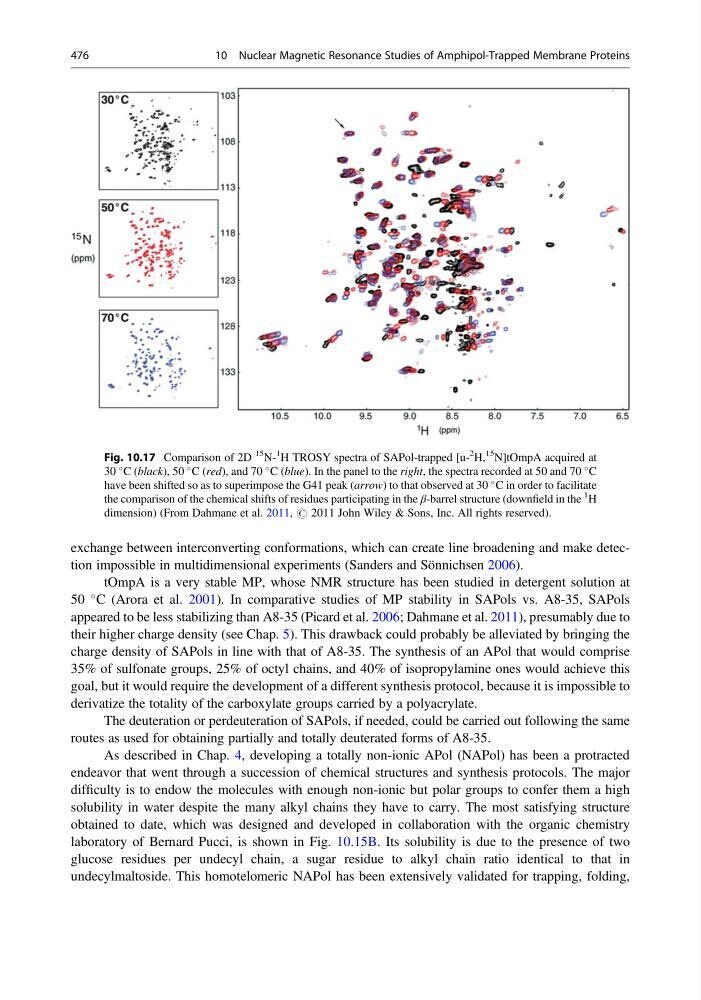
Fig. 10.17 Comparison of 2D
15
N1
H TROSY spectra of SAPol-trapped [u2
H,
15
N]tOmpA acquired at
30
C (black), 50
C (red), and 70
C (blue). In the panel to the right, the spectra recorded at 50 and 70
C
have been shifted so as to superimpose the G41 peak (arrow) to that observed at 30
C in order to facilitate
the comparison of the chemical shifts of residues participating in the β-barrel structure (downfield in the
1
H
dimension) (From Dahmane et al. 2011, # 2011 John Wiley & Sons, Inc. All rights reserved).
476
10 Nuclear Magnetic Resonance Studies of Amphipol-Trapped Membrane Proteins
tOmpA is a very stable MP, whose NMR structure has been studied in detergent solution at
50
C (Arora et al. 2001). In comparative studies of MP stability in SAPols vs. A8-35, SAPols
appeared to be less stabilizing than A8-35 (Picard et al. 2006; Dahmane et al. 2011), presumably due to
their higher charge density (see Chap. 5). This drawback could probably be alleviated by bringing the
charge density of SAPols in line with that of A8-35. The synthesis of an APol that would comprise
35% of sulfonate groups, 25% of octyl chains, and 40% of isopropylamine ones would achieve this
goal, but it would require the development of a different synthesis protocol, because it is impossible to
derivatize the totality of the carboxylate groups carried by a polyacrylate.
The deuteration or perdeuteration of SAPols, if needed, could be carried out following the same
routes as used for obtaining partially and totally deuterated forms of A8-35.
As described in Chap. 4, developing a totally non-ionic APol (NAPol) has been a protracted
endeavor that went through a succession of chemical structures and synthesis protocols. The major
difficulty is to endow the molecules with enough non-ionic but polar groups to confer them a high
solubility in water despite the many alkyl chains they have to carry. The most satisfying structure
obtained to date, which was designed and developed in collaboration with the organic chemistry
laboratory of Bernard Pucci, is shown in Fig. 10.15B. Its solubility is due to the presence of two
glucose residues per undecyl chain, a sugar residue to alkyl chain ratio identical to that in
undecylmaltoside. This homotelomeric NAPol has been extensively validated for trapping, folding,
Fig. 10.17 Comparison of 2D
15
N1
H TROSY spectra of SAPol-trapped [u2
H,
15
N]tOmpA acquired at
30
C (black), 50
C (red), and 70
C (blue). In the panel to the right, the spectra recorded at 50 and 70
C
have been shifted so as to superimpose the G41 peak (arrow) to that observed at 30
C in order to facilitate
the comparison of the chemical shifts of residues participating in the β-barrel structure (downfield in the
1
H
dimension) (From Dahmane et al. 2011, # 2011 John Wiley & Sons, Inc. All rights reserved).
476
10 Nuclear Magnetic Resonance Studies of Amphipol-Trapped Membrane Proteins