

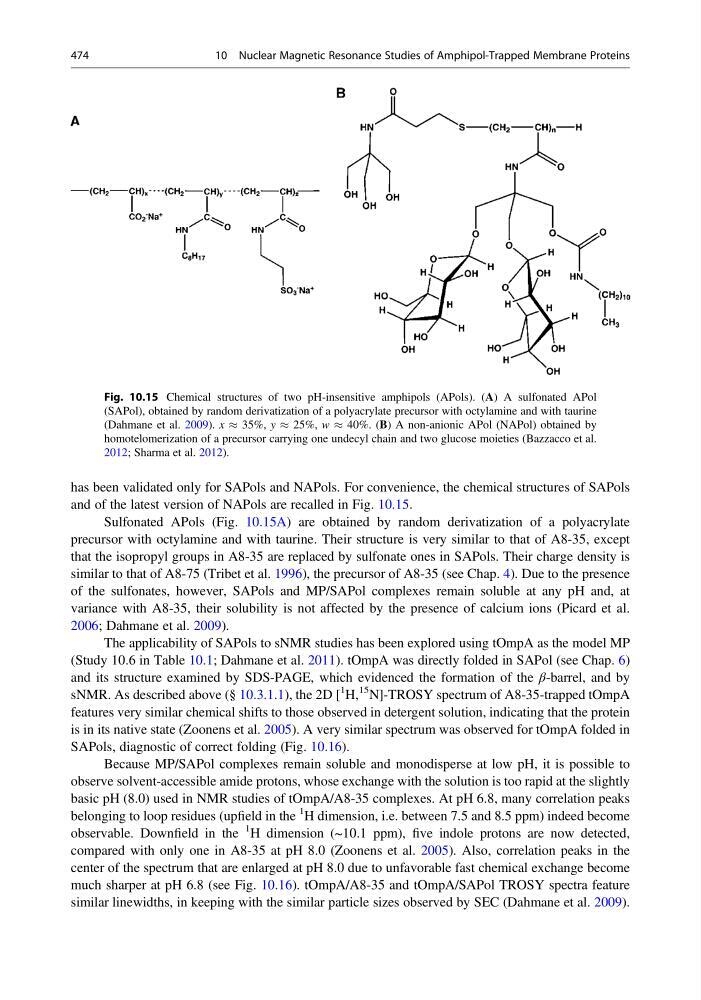
has been validated only for SAPols and NAPols. For convenience, the chemical structures of SAPols
and of the latest version of NAPols are recalled in Fig. 10.15.
Sulfonated APols (Fig. 10.15A) are obtained by random derivatization of a polyacrylate
precursor with octylamine and with taurine. Their structure is very similar to that of A8-35, except
that the isopropyl groups in A8-35 are replaced by sulfonate ones in SAPols. Their charge density is
similar to that of A8-75 (Tribet et al. 1996), the precursor of A8-35 (see Chap. 4). Due to the presence
of the sulfonates, however, SAPols and MP/SAPol complexes remain soluble at any pH and, at
variance with A8-35, their solubility is not affected by the presence of calcium ions (Picard et al.
2006; Dahmane et al. 2009).
The applicability of SAPols to sNMR studies has been explored using tOmpA as the model MP
(Study 10.6 in Table 10.1; Dahmane et al. 2011). tOmpA was directly folded in SAPol (see Chap. 6)
and its structure examined by SDS-PAGE, which evidenced the formation of the β-barrel, and by
sNMR. As described above (§ 10.3.1.1), the 2D [
1 H,
15 N]-TROSY spectrum of A8-35-trapped tOmpA
features very similar chemical shifts to those observed in detergent solution, indicating that the protein
is in its native state (Zoonens et al. 2005). A very similar spectrum was observed for tOmpA folded in
SAPols, diagnostic of correct folding (Fig. 10.16).
Because MP/SAPol complexes remain soluble and monodisperse at low pH, it is possible to
observe solvent-accessible amide protons, whose exchange with the solution is too rapid at the slightly
basic pH (8.0) used in NMR studies of tOmpA/A8-35 complexes. At pH 6.8, many correlation peaks
belonging to loop residues (upfield in the
1 H dimension, i.e. between 7.5 and 8.5 ppm) indeed become
observable. Downfield in the
1 H dimension (~10.1 ppm), five indole protons are now detected,
compared with only one in A8-35 at pH 8.0 (Zoonens et al. 2005). Also, correlation peaks in the
center of the spectrum that are enlarged at pH 8.0 due to unfavorable fast chemical exchange become
much sharper at pH 6.8 (see Fig. 10.16). tOmpA/A8-35 and tOmpA/SAPol TROSY spectra feature
similar linewidths, in keeping with the similar particle sizes observed by SEC (Dahmane et al. 2009).
Fig. 10.15 Chemical structures of two pH-insensitive amphipols (APols). (A) A sulfonated APol
(SAPol), obtained by random derivatization of a polyacrylate precursor with octylamine and with taurine
(Dahmane et al. 2009). x % 35%, y % 25%, w % 40%. (B) A non-anionic APol (NAPol) obtained by
homotelomerization of a precursor carrying one undecyl chain and two glucose moieties (Bazzacco et al.
2012; Sharma et al. 2012).
474
10 Nuclear Magnetic Resonance Studies of Amphipol-Trapped Membrane Proteins
and of the latest version of NAPols are recalled in Fig. 10.15.
Sulfonated APols (Fig. 10.15A) are obtained by random derivatization of a polyacrylate
precursor with octylamine and with taurine. Their structure is very similar to that of A8-35, except
that the isopropyl groups in A8-35 are replaced by sulfonate ones in SAPols. Their charge density is
similar to that of A8-75 (Tribet et al. 1996), the precursor of A8-35 (see Chap. 4). Due to the presence
of the sulfonates, however, SAPols and MP/SAPol complexes remain soluble at any pH and, at
variance with A8-35, their solubility is not affected by the presence of calcium ions (Picard et al.
2006; Dahmane et al. 2009).
The applicability of SAPols to sNMR studies has been explored using tOmpA as the model MP
(Study 10.6 in Table 10.1; Dahmane et al. 2011). tOmpA was directly folded in SAPol (see Chap. 6)
and its structure examined by SDS-PAGE, which evidenced the formation of the β-barrel, and by
sNMR. As described above (§ 10.3.1.1), the 2D [
1 H,
15 N]-TROSY spectrum of A8-35-trapped tOmpA
features very similar chemical shifts to those observed in detergent solution, indicating that the protein
is in its native state (Zoonens et al. 2005). A very similar spectrum was observed for tOmpA folded in
SAPols, diagnostic of correct folding (Fig. 10.16).
Because MP/SAPol complexes remain soluble and monodisperse at low pH, it is possible to
observe solvent-accessible amide protons, whose exchange with the solution is too rapid at the slightly
basic pH (8.0) used in NMR studies of tOmpA/A8-35 complexes. At pH 6.8, many correlation peaks
belonging to loop residues (upfield in the
1 H dimension, i.e. between 7.5 and 8.5 ppm) indeed become
observable. Downfield in the
1 H dimension (~10.1 ppm), five indole protons are now detected,
compared with only one in A8-35 at pH 8.0 (Zoonens et al. 2005). Also, correlation peaks in the
center of the spectrum that are enlarged at pH 8.0 due to unfavorable fast chemical exchange become
much sharper at pH 6.8 (see Fig. 10.16). tOmpA/A8-35 and tOmpA/SAPol TROSY spectra feature
similar linewidths, in keeping with the similar particle sizes observed by SEC (Dahmane et al. 2009).
Fig. 10.15 Chemical structures of two pH-insensitive amphipols (APols). (A) A sulfonated APol
(SAPol), obtained by random derivatization of a polyacrylate precursor with octylamine and with taurine
(Dahmane et al. 2009). x % 35%, y % 25%, w % 40%. (B) A non-anionic APol (NAPol) obtained by
homotelomerization of a precursor carrying one undecyl chain and two glucose moieties (Bazzacco et al.
2012; Sharma et al. 2012).
474
10 Nuclear Magnetic Resonance Studies of Amphipol-Trapped Membrane Proteins