

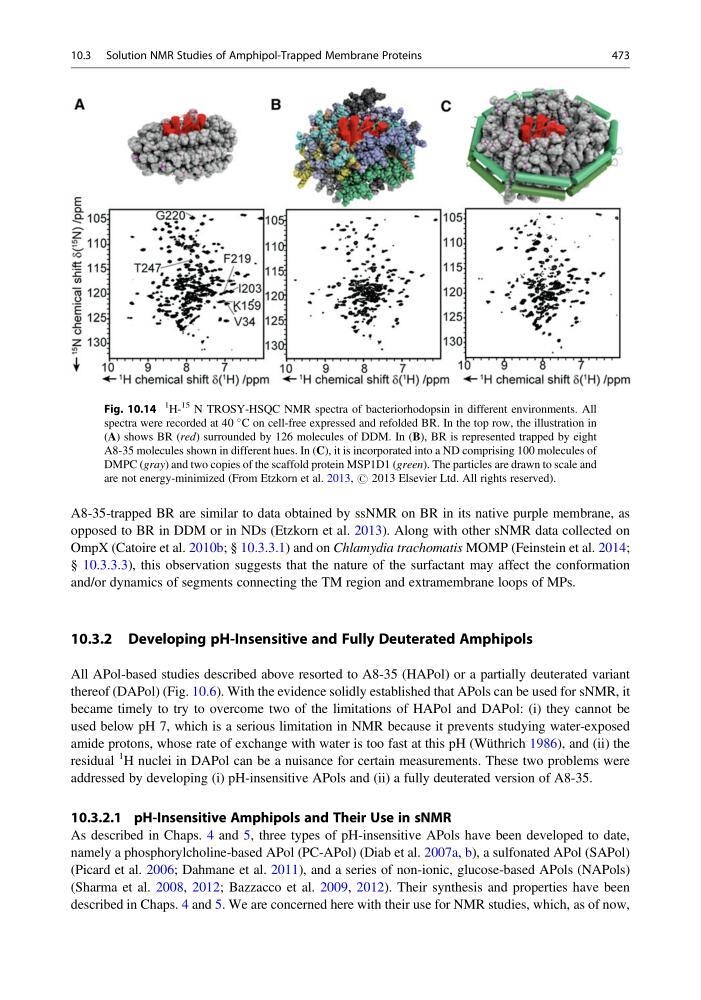
A8-35-trapped BR are similar to data obtained by ssNMR on BR in its native purple membrane, as
opposed to BR in DDM or in NDs (Etzkorn et al. 2013). Along with other sNMR data collected on
OmpX (Catoire et al. 2010b; § 10.3.3.1) and on Chlamydia trachomatis MOMP (Feinstein et al. 2014;
§ 10.3.3.3), this observation suggests that the nature of the surfactant may affect the conformation
and/or dynamics of segments connecting the TM region and extramembrane loops of MPs.
10.3.2 Developing pH-Insensitive and Fully Deuterated Amphipols
All APol-based studies described above resorted to A8-35 (HAPol) or a partially deuterated variant
thereof (DAPol) (Fig. 10.6). With the evidence solidly established that APols can be used for sNMR, it
became timely to try to overcome two of the limitations of HAPol and DAPol: (i) they cannot be
used below pH 7, which is a serious limitation in NMR because it prevents studying water-exposed
amide protons, whose rate of exchange with water is too fast at this pH (Wüthrich 1986), and (ii) the
residual
1 H nuclei in DAPol can be a nuisance for certain measurements. These two problems were
addressed by developing (i) pH-insensitive APols and (ii) a fully deuterated version of A8-35.
10.3.2.1 pH-Insensitive Amphipols and Their Use in sNMR
As described in Chaps. 4 and 5, three types of pH-insensitive APols have been developed to date,
namely a phosphorylcholine-based APol (PC-APol) (Diab et al. 2007a, b), a sulfonated APol (SAPol)
(Picard et al. 2006; Dahmane et al. 2011), and a series of non-ionic, glucose-based APols (NAPols)
(Sharma et al. 2008, 2012; Bazzacco et al. 2009, 2012). Their synthesis and properties have been
described in Chaps. 4 and 5. We are concerned here with their use for NMR studies, which, as of now,
Fig. 10.14
1
H15 N TROSY-HSQC NMR spectra of bacteriorhodopsin in different environments. All
spectra were recorded at 40
C on cell-free expressed and refolded BR. In the top row, the illustration in
(A) shows BR (red) surrounded by 126 molecules of DDM. In (B), BR is represented trapped by eight
A8-35 molecules shown in different hues. In (C), it is incorporated into a ND comprising 100 molecules of
DMPC (gray) and two copies of the scaffold protein MSP1D1 (green). The particles are drawn to scale and
are not energy-minimized (From Etzkorn et al. 2013, # 2013 Elsevier Ltd. All rights reserved).
10.3 Solution NMR Studies of Amphipol-Trapped Membrane Proteins
473
opposed to BR in DDM or in NDs (Etzkorn et al. 2013). Along with other sNMR data collected on
OmpX (Catoire et al. 2010b; § 10.3.3.1) and on Chlamydia trachomatis MOMP (Feinstein et al. 2014;
§ 10.3.3.3), this observation suggests that the nature of the surfactant may affect the conformation
and/or dynamics of segments connecting the TM region and extramembrane loops of MPs.
10.3.2 Developing pH-Insensitive and Fully Deuterated Amphipols
All APol-based studies described above resorted to A8-35 (HAPol) or a partially deuterated variant
thereof (DAPol) (Fig. 10.6). With the evidence solidly established that APols can be used for sNMR, it
became timely to try to overcome two of the limitations of HAPol and DAPol: (i) they cannot be
used below pH 7, which is a serious limitation in NMR because it prevents studying water-exposed
amide protons, whose rate of exchange with water is too fast at this pH (Wüthrich 1986), and (ii) the
residual
1 H nuclei in DAPol can be a nuisance for certain measurements. These two problems were
addressed by developing (i) pH-insensitive APols and (ii) a fully deuterated version of A8-35.
10.3.2.1 pH-Insensitive Amphipols and Their Use in sNMR
As described in Chaps. 4 and 5, three types of pH-insensitive APols have been developed to date,
namely a phosphorylcholine-based APol (PC-APol) (Diab et al. 2007a, b), a sulfonated APol (SAPol)
(Picard et al. 2006; Dahmane et al. 2011), and a series of non-ionic, glucose-based APols (NAPols)
(Sharma et al. 2008, 2012; Bazzacco et al. 2009, 2012). Their synthesis and properties have been
described in Chaps. 4 and 5. We are concerned here with their use for NMR studies, which, as of now,
Fig. 10.14
1
H15 N TROSY-HSQC NMR spectra of bacteriorhodopsin in different environments. All
spectra were recorded at 40
C on cell-free expressed and refolded BR. In the top row, the illustration in
(A) shows BR (red) surrounded by 126 molecules of DDM. In (B), BR is represented trapped by eight
A8-35 molecules shown in different hues. In (C), it is incorporated into a ND comprising 100 molecules of
DMPC (gray) and two copies of the scaffold protein MSP1D1 (green). The particles are drawn to scale and
are not energy-minimized (From Etzkorn et al. 2013, # 2013 Elsevier Ltd. All rights reserved).
10.3 Solution NMR Studies of Amphipol-Trapped Membrane Proteins
473