

A8-35 and two types of APols with different chemical structures have also been validated for use in
sNMR and will be discussed below (§ 10.3.2).
10.3.1.1 Validating the Use of Amphipols for sNMR and Resolution of the Spectra
as Compared with Those Obtained in Detergent Solutions
The princeps demonstration that APols can be used for sNMR studies of MPs (Study 10.1 in
Table 10.1) was achieved by Laurent J. Catoire and Manuela Zoonens using as a model the TM
domain of E. coli OmpA (tOmpA) trapped either in unlabeled A8-35 (HAPol) or in DAPol
(Zoonens 2004; Zoonens et al. 2005). It was followed by a couple of studies (Studies 10.2 and 10.3
in Table 10.1) using E. coli OmpX trapped in the same APols (Catoire et al. 2009, 2010b). Known to
be highly stable in vitro, these two proteins, which express very well, were chosen because of the
extensive sNMR data available from studies conducted in detergent solutions (Arora et al. 2001;
Fernández et al. 2001a, b), which had led to 3D structures very similar to those obtained by X-ray
diffraction (Vogt and Schulz 1999; Pautsch and Schulz 2000). As no activity tests are available for
these two proteins in solution, the fact that they had maintained their conformation after transfer to
APols was established by (i) examining their migration during SDS-PAGE, which indicates whether
the β-barrel is present or not (Schweizer et al. 1978; Pautsch et al. 1999), and (ii) comparing their
1
H
and
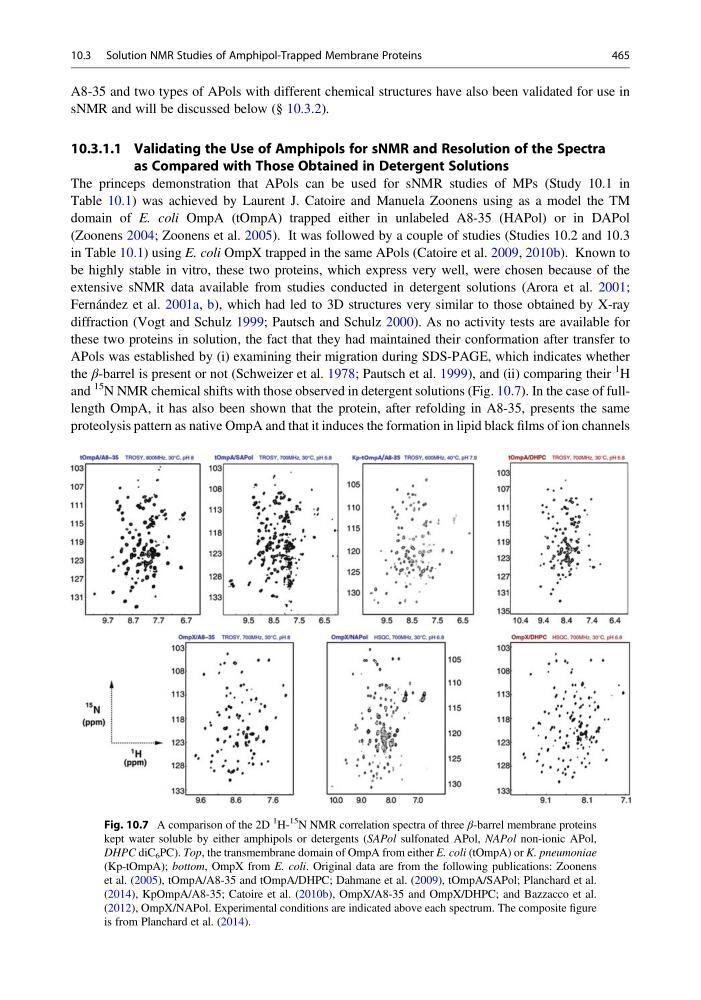
15 N NMR chemical shifts with those observed in detergent solutions (Fig. 10.7). In the case of fulllength OmpA, it has also been shown that the protein, after refolding in A8-35, presents the same
proteolysis pattern as native OmpA and that it induces the formation in lipid black films of ion channels
Fig. 10.7 A comparison of the 2D
1
H15
N NMR correlation spectra of three β-barrel membrane proteins
kept water soluble by either amphipols or detergents (SAPol sulfonated APol, NAPol non-ionic APol,
DHPC diC 6 PC). Top, the transmembrane domain of OmpA from either E. coli (tOmpA) or K. pneumoniae
(Kp-tOmpA); bottom, OmpX from E. coli. Original data are from the following publications: Zoonens
et al. (2005), tOmpA/A8-35 and tOmpA/DHPC; Dahmane et al. (2009), tOmpA/SAPol; Planchard et al.
(2014), KpOmpA/A8-35; Catoire et al. (2010b), OmpX/A8-35 and OmpX/DHPC; and Bazzacco et al.
(2012), OmpX/NAPol. Experimental conditions are indicated above each spectrum. The composite figure
is from Planchard et al. (2014).
10.3 Solution NMR Studies of Amphipol-Trapped Membrane Proteins
465
sNMR and will be discussed below (§ 10.3.2).
10.3.1.1 Validating the Use of Amphipols for sNMR and Resolution of the Spectra
as Compared with Those Obtained in Detergent Solutions
The princeps demonstration that APols can be used for sNMR studies of MPs (Study 10.1 in
Table 10.1) was achieved by Laurent J. Catoire and Manuela Zoonens using as a model the TM
domain of E. coli OmpA (tOmpA) trapped either in unlabeled A8-35 (HAPol) or in DAPol
(Zoonens 2004; Zoonens et al. 2005). It was followed by a couple of studies (Studies 10.2 and 10.3
in Table 10.1) using E. coli OmpX trapped in the same APols (Catoire et al. 2009, 2010b). Known to
be highly stable in vitro, these two proteins, which express very well, were chosen because of the
extensive sNMR data available from studies conducted in detergent solutions (Arora et al. 2001;
Fernández et al. 2001a, b), which had led to 3D structures very similar to those obtained by X-ray
diffraction (Vogt and Schulz 1999; Pautsch and Schulz 2000). As no activity tests are available for
these two proteins in solution, the fact that they had maintained their conformation after transfer to
APols was established by (i) examining their migration during SDS-PAGE, which indicates whether
the β-barrel is present or not (Schweizer et al. 1978; Pautsch et al. 1999), and (ii) comparing their
1
H
and
15 N NMR chemical shifts with those observed in detergent solutions (Fig. 10.7). In the case of fulllength OmpA, it has also been shown that the protein, after refolding in A8-35, presents the same
proteolysis pattern as native OmpA and that it induces the formation in lipid black films of ion channels
Fig. 10.7 A comparison of the 2D
1
H15
N NMR correlation spectra of three β-barrel membrane proteins
kept water soluble by either amphipols or detergents (SAPol sulfonated APol, NAPol non-ionic APol,
DHPC diC 6 PC). Top, the transmembrane domain of OmpA from either E. coli (tOmpA) or K. pneumoniae
(Kp-tOmpA); bottom, OmpX from E. coli. Original data are from the following publications: Zoonens
et al. (2005), tOmpA/A8-35 and tOmpA/DHPC; Dahmane et al. (2009), tOmpA/SAPol; Planchard et al.
(2014), KpOmpA/A8-35; Catoire et al. (2010b), OmpX/A8-35 and OmpX/DHPC; and Bazzacco et al.
(2012), OmpX/NAPol. Experimental conditions are indicated above each spectrum. The composite figure
is from Planchard et al. (2014).
10.3 Solution NMR Studies of Amphipol-Trapped Membrane Proteins
465