

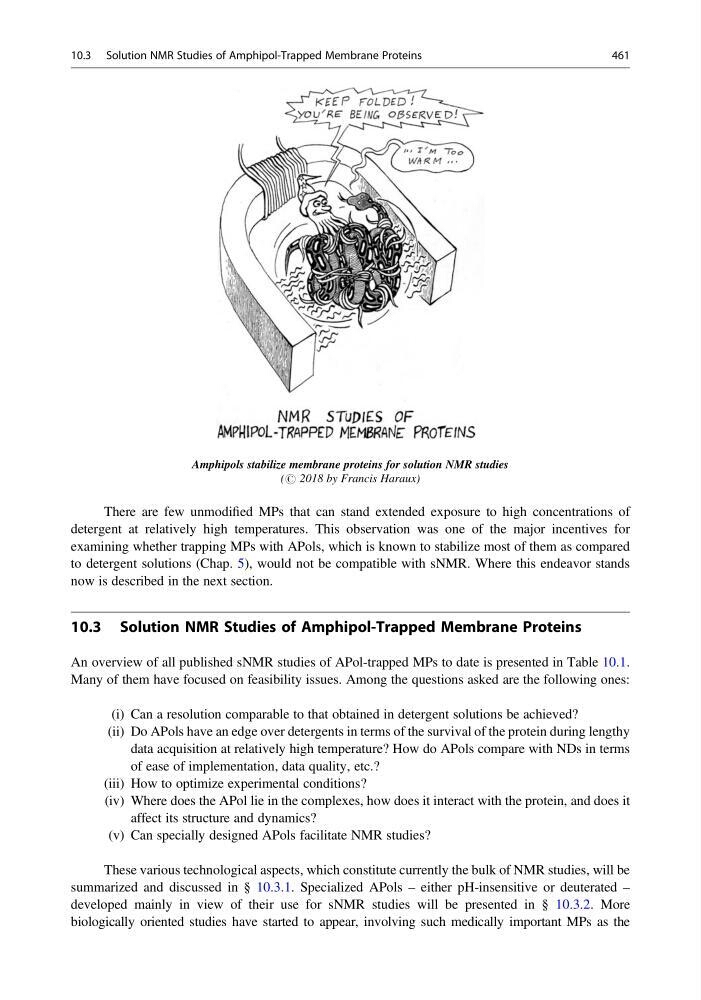
Amphipols stabilize membrane proteins for solution NMR studies
(# 2018 by Francis Haraux)
There are few unmodified MPs that can stand extended exposure to high concentrations of
detergent at relatively high temperatures. This observation was one of the major incentives for
examining whether trapping MPs with APols, which is known to stabilize most of them as compared
to detergent solutions (Chap. 5), would not be compatible with sNMR. Where this endeavor stands
now is described in the next section.
10.3 Solution NMR Studies of Amphipol-Trapped Membrane Proteins
An overview of all published sNMR studies of APol-trapped MPs to date is presented in Table 10.1.
Many of them have focused on feasibility issues. Among the questions asked are the following ones:
(i) Can a resolution comparable to that obtained in detergent solutions be achieved?
(ii) Do APols have an edge over detergents in terms of the survival of the protein during lengthy
data acquisition at relatively high temperature? How do APols compare with NDs in terms
of ease of implementation, data quality, etc.?
(iii) How to optimize experimental conditions?
(iv) Where does the APol lie in the complexes, how does it interact with the protein, and does it
affect its structure and dynamics?
(v) Can specially designed APols facilitate NMR studies?
These various technological aspects, which constitute currently the bulk of NMR studies, will be
summarized and discussed in § 10.3.1. Specialized APols – either pH-insensitive or deuterated –
developed mainly in view of their use for sNMR studies will be presented in § 10.3.2. More
biologically oriented studies have started to appear, involving such medically important MPs as the
10.3 Solution NMR Studies of Amphipol-Trapped Membrane Proteins
461
(# 2018 by Francis Haraux)
There are few unmodified MPs that can stand extended exposure to high concentrations of
detergent at relatively high temperatures. This observation was one of the major incentives for
examining whether trapping MPs with APols, which is known to stabilize most of them as compared
to detergent solutions (Chap. 5), would not be compatible with sNMR. Where this endeavor stands
now is described in the next section.
10.3 Solution NMR Studies of Amphipol-Trapped Membrane Proteins
An overview of all published sNMR studies of APol-trapped MPs to date is presented in Table 10.1.
Many of them have focused on feasibility issues. Among the questions asked are the following ones:
(i) Can a resolution comparable to that obtained in detergent solutions be achieved?
(ii) Do APols have an edge over detergents in terms of the survival of the protein during lengthy
data acquisition at relatively high temperature? How do APols compare with NDs in terms
of ease of implementation, data quality, etc.?
(iii) How to optimize experimental conditions?
(iv) Where does the APol lie in the complexes, how does it interact with the protein, and does it
affect its structure and dynamics?
(v) Can specially designed APols facilitate NMR studies?
These various technological aspects, which constitute currently the bulk of NMR studies, will be
summarized and discussed in § 10.3.1. Specialized APols – either pH-insensitive or deuterated –
developed mainly in view of their use for sNMR studies will be presented in § 10.3.2. More
biologically oriented studies have started to appear, involving such medically important MPs as the
10.3 Solution NMR Studies of Amphipol-Trapped Membrane Proteins
461