

that contains several disulfide bridges; and family C (glutamate receptor-like) features a long amino
terminus and a unique short and highly conserved third intracellular loop. Using E. coli lysates, three
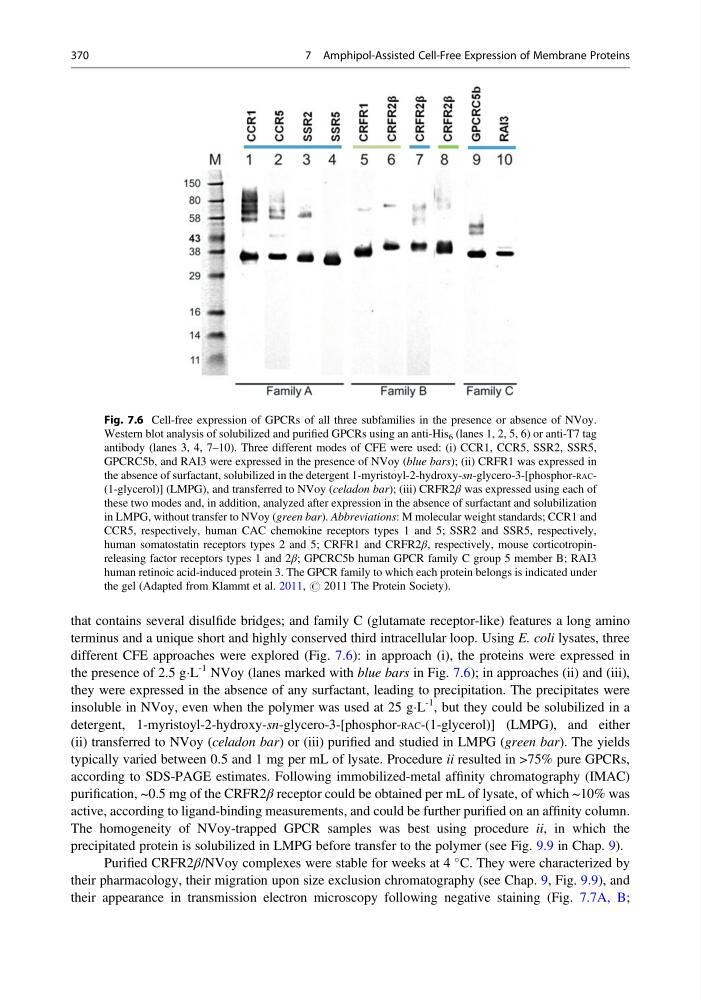
different CFE approaches were explored (Fig. 7.6): in approach (i), the proteins were expressed in
the presence of 2.5 gÁL
-1 NVoy (lanes marked with blue bars in Fig. 7.6); in approaches (ii) and (iii),
they were expressed in the absence of any surfactant, leading to precipitation. The precipitates were
insoluble in NVoy, even when the polymer was used at 25 gÁL
-1 , but they could be solubilized in a
detergent, 1-myristoyl-2-hydroxy-sn-glycero-3-[phosphor-RAC-(1-glycerol)] (LMPG), and either
(ii) transferred to NVoy (celadon bar) or (iii) purified and studied in LMPG (green bar). The yields
typically varied between 0.5 and 1 mg per mL of lysate. Procedure ii resulted in >75% pure GPCRs,
according to SDS-PAGE estimates. Following immobilized-metal affinity chromatography (IMAC)
purification, ~0.5 mg of the CRFR2β receptor could be obtained per mL of lysate, of which ~10% was
active, according to ligand-binding measurements, and could be further purified on an affinity column.
The homogeneity of NVoy-trapped GPCR samples was best using procedure ii, in which the
precipitated protein is solubilized in LMPG before transfer to the polymer (see Fig. 9.9 in Chap. 9).
Purified CRFR2β/NVoy complexes were stable for weeks at 4
C. They were characterized by
their pharmacology, their migration upon size exclusion chromatography (see Chap. 9, Fig. 9.9), and
their appearance in transmission electron microscopy following negative staining (Fig. 7.7A, B;
Fig. 7.6 Cell-free expression of GPCRs of all three subfamilies in the presence or absence of NVoy.
Western blot analysis of solubilized and purified GPCRs using an anti-His 6 (lanes 1, 2, 5, 6) or anti-T7 tag
antibody (lanes 3, 4, 7–10). Three different modes of CFE were used: (i) CCR1, CCR5, SSR2, SSR5,
GPCRC5b, and RAI3 were expressed in the presence of NVoy (blue bars); (ii) CRFR1 was expressed in
the absence of surfactant, solubilized in the detergent 1-myristoyl-2-hydroxy-sn-glycero-3-[phosphor-RAC(1-glycerol)] (LMPG), and transferred to NVoy (celadon bar); (iii) CRFR2β was expressed using each of
these two modes and, in addition, analyzed after expression in the absence of surfactant and solubilization
in LMPG, without transfer to NVoy (green bar). Abbreviations: M molecular weight standards; CCR1 and
CCR5, respectively, human CAC chemokine receptors types 1 and 5; SSR2 and SSR5, respectively,
human somatostatin receptors types 2 and 5; CRFR1 and CRFR2β, respectively, mouse corticotropinreleasing factor receptors types 1 and 2β; GPCRC5b human GPCR family C group 5 member B; RAI3
human retinoic acid-induced protein 3. The GPCR family to which each protein belongs is indicated under
the gel (Adapted from Klammt et al. 2011, # 2011 The Protein Society).
370
7 Amphipol-Assisted Cell-Free Expression of Membrane Proteins
terminus and a unique short and highly conserved third intracellular loop. Using E. coli lysates, three
different CFE approaches were explored (Fig. 7.6): in approach (i), the proteins were expressed in
the presence of 2.5 gÁL
-1 NVoy (lanes marked with blue bars in Fig. 7.6); in approaches (ii) and (iii),
they were expressed in the absence of any surfactant, leading to precipitation. The precipitates were
insoluble in NVoy, even when the polymer was used at 25 gÁL
-1 , but they could be solubilized in a
detergent, 1-myristoyl-2-hydroxy-sn-glycero-3-[phosphor-RAC-(1-glycerol)] (LMPG), and either
(ii) transferred to NVoy (celadon bar) or (iii) purified and studied in LMPG (green bar). The yields
typically varied between 0.5 and 1 mg per mL of lysate. Procedure ii resulted in >75% pure GPCRs,
according to SDS-PAGE estimates. Following immobilized-metal affinity chromatography (IMAC)
purification, ~0.5 mg of the CRFR2β receptor could be obtained per mL of lysate, of which ~10% was
active, according to ligand-binding measurements, and could be further purified on an affinity column.
The homogeneity of NVoy-trapped GPCR samples was best using procedure ii, in which the
precipitated protein is solubilized in LMPG before transfer to the polymer (see Fig. 9.9 in Chap. 9).
Purified CRFR2β/NVoy complexes were stable for weeks at 4
C. They were characterized by
their pharmacology, their migration upon size exclusion chromatography (see Chap. 9, Fig. 9.9), and
their appearance in transmission electron microscopy following negative staining (Fig. 7.7A, B;
Fig. 7.6 Cell-free expression of GPCRs of all three subfamilies in the presence or absence of NVoy.
Western blot analysis of solubilized and purified GPCRs using an anti-His 6 (lanes 1, 2, 5, 6) or anti-T7 tag
antibody (lanes 3, 4, 7–10). Three different modes of CFE were used: (i) CCR1, CCR5, SSR2, SSR5,
GPCRC5b, and RAI3 were expressed in the presence of NVoy (blue bars); (ii) CRFR1 was expressed in
the absence of surfactant, solubilized in the detergent 1-myristoyl-2-hydroxy-sn-glycero-3-[phosphor-RAC(1-glycerol)] (LMPG), and transferred to NVoy (celadon bar); (iii) CRFR2β was expressed using each of
these two modes and, in addition, analyzed after expression in the absence of surfactant and solubilization
in LMPG, without transfer to NVoy (green bar). Abbreviations: M molecular weight standards; CCR1 and
CCR5, respectively, human CAC chemokine receptors types 1 and 5; SSR2 and SSR5, respectively,
human somatostatin receptors types 2 and 5; CRFR1 and CRFR2β, respectively, mouse corticotropinreleasing factor receptors types 1 and 2β; GPCRC5b human GPCR family C group 5 member B; RAI3
human retinoic acid-induced protein 3. The GPCR family to which each protein belongs is indicated under
the gel (Adapted from Klammt et al. 2011, # 2011 The Protein Society).
370
7 Amphipol-Assisted Cell-Free Expression of Membrane Proteins