

above pH 7 (see Chap. 4, § 4.2.2.3), is reported to inhibit CFE of GFP at concentrations above
0.011 mM (~0.13 gÁL
-1 ) and, at this concentration, to block GPCR synthesis (Klammt et al. 2011). This
effect cannot be attributed to a nonexistent polyanionic character.
On the contrary, MP CFE was found to proceed efficiently in the presence of non-ionic
amphipathic polymers, whether NVoy (Study 7.3 and, possibly, Study 7.2) or glucosylated non-ionic
APols (NAPols; Study 7.4).
In Study 7.2, a large number of proteins or protein fragments from pathogenic organisms that are
poorly expressed or poorly soluble upon overexpression in vivo in E. coli, a few of which only are MPs
or fragments thereof, were expressed by CFE in a wheat germ lysate either in the presence or absence
of NVoy, an uncharged polymer obtained by derivation with hydrophobic side chains of a carbohydrate (fructose) polymer (see Chap. 4, § 4.2.3.3). In most cases, NVoy was observed not to impede the
synthesis and to favor solubility. However, it is unclear from the data provided whether any of the
proteins or protein fragments tested comprised a TM domain. The bearing of these observations on
CFE of MPs is therefore quite uncertain, beyond the fact that NVoy does not systematically block CFE
and tends to improve the solubility of poorly soluble but not necessarily TM proteins.
In Study 7.3, an extensive investigation is reported on the production and characterization, using
NVoy, of eight different polyhistidine-tagged membrane receptors. The MPs chosen are representative
of the three GPCR families, each of which features seven TM α-helices: the largest subgroup, family A
(the rhodopsin-like family), comprises receptors for light, odorants, small molecules, and peptides and
glycoprotein hormones; family B (secretin-like) is characterized by a relatively long amino terminus
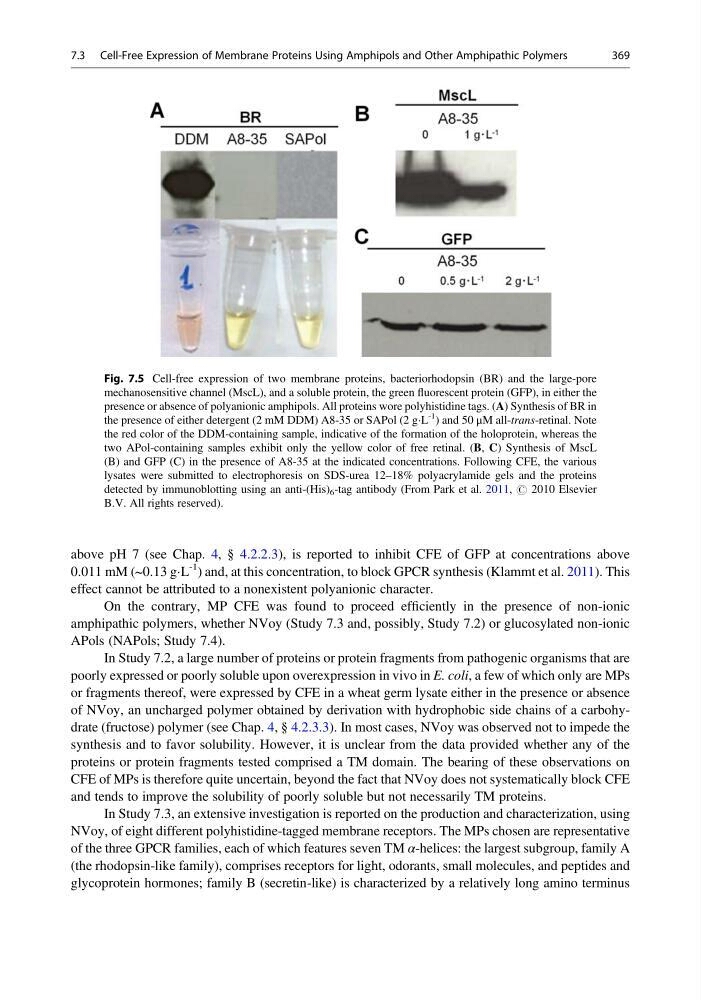
Fig. 7.5 Cell-free expression of two membrane proteins, bacteriorhodopsin (BR) and the large-pore
mechanosensitive channel (MscL), and a soluble protein, the green fluorescent protein (GFP), in either the
presence or absence of polyanionic amphipols. All proteins wore polyhistidine tags. (A) Synthesis of BR in
the presence of either detergent (2 mM DDM) A8-35 or SAPol (2 gÁL
-1 ) and 50 μM all-trans-retinal. Note
the red color of the DDM-containing sample, indicative of the formation of the holoprotein, whereas the
two APol-containing samples exhibit only the yellow color of free retinal. (B, C) Synthesis of MscL
(B) and GFP (C) in the presence of A8-35 at the indicated concentrations. Following CFE, the various
lysates were submitted to electrophoresis on SDS-urea 12–18% polyacrylamide gels and the proteins
detected by immunoblotting using an anti-(His) 6 -tag antibody (From Park et al. 2011, # 2010 Elsevier
B.V. All rights reserved).
7.3 Cell-Free Expression of Membrane Proteins Using Amphipols and Other Amphipathic Polymers
369
0.011 mM (~0.13 gÁL
-1 ) and, at this concentration, to block GPCR synthesis (Klammt et al. 2011). This
effect cannot be attributed to a nonexistent polyanionic character.
On the contrary, MP CFE was found to proceed efficiently in the presence of non-ionic
amphipathic polymers, whether NVoy (Study 7.3 and, possibly, Study 7.2) or glucosylated non-ionic
APols (NAPols; Study 7.4).
In Study 7.2, a large number of proteins or protein fragments from pathogenic organisms that are
poorly expressed or poorly soluble upon overexpression in vivo in E. coli, a few of which only are MPs
or fragments thereof, were expressed by CFE in a wheat germ lysate either in the presence or absence
of NVoy, an uncharged polymer obtained by derivation with hydrophobic side chains of a carbohydrate (fructose) polymer (see Chap. 4, § 4.2.3.3). In most cases, NVoy was observed not to impede the
synthesis and to favor solubility. However, it is unclear from the data provided whether any of the
proteins or protein fragments tested comprised a TM domain. The bearing of these observations on
CFE of MPs is therefore quite uncertain, beyond the fact that NVoy does not systematically block CFE
and tends to improve the solubility of poorly soluble but not necessarily TM proteins.
In Study 7.3, an extensive investigation is reported on the production and characterization, using
NVoy, of eight different polyhistidine-tagged membrane receptors. The MPs chosen are representative
of the three GPCR families, each of which features seven TM α-helices: the largest subgroup, family A
(the rhodopsin-like family), comprises receptors for light, odorants, small molecules, and peptides and
glycoprotein hormones; family B (secretin-like) is characterized by a relatively long amino terminus
Fig. 7.5 Cell-free expression of two membrane proteins, bacteriorhodopsin (BR) and the large-pore
mechanosensitive channel (MscL), and a soluble protein, the green fluorescent protein (GFP), in either the
presence or absence of polyanionic amphipols. All proteins wore polyhistidine tags. (A) Synthesis of BR in
the presence of either detergent (2 mM DDM) A8-35 or SAPol (2 gÁL
-1 ) and 50 μM all-trans-retinal. Note
the red color of the DDM-containing sample, indicative of the formation of the holoprotein, whereas the
two APol-containing samples exhibit only the yellow color of free retinal. (B, C) Synthesis of MscL
(B) and GFP (C) in the presence of A8-35 at the indicated concentrations. Following CFE, the various
lysates were submitted to electrophoresis on SDS-urea 12–18% polyacrylamide gels and the proteins
detected by immunoblotting using an anti-(His) 6 -tag antibody (From Park et al. 2011, # 2010 Elsevier
B.V. All rights reserved).
7.3 Cell-Free Expression of Membrane Proteins Using Amphipols and Other Amphipathic Polymers
369