

Box 6.1 Anfinsen’s Principle
Taking ribonuclease as a model, Christian Anfinsen and his colleagues, in the 1960s, showed that
this soluble enzyme, after its eight disulfide bridges had been reduced and the polypeptide unfolded
in urea, could recover full activity in vitro when the denaturant was removed and the bridges allowed
to reoxidize (Anfinsen et al. 1961; Anfinsen 1973; Anfinsen and Scheraga 1975). This established
that the native structure of the enzyme is not dictated by the biosynthetic apparatus, but by the
interaction of the amino acid sequence with itself and with its environment, and that it corresponds to
the (or a) free energy minimum of this ensemble. This has become known as Anfinsen’s principle.
Until Khorana’s work, however, it was totally uncertain whether the same principle could
apply to MPs, whose synthesis and membrane insertion take place in a highly anisotropic medium
and are catalyzed by a complex apparatus whose composition and role just started to be unraveled in
the 1970s. That MPs could be kinetically blocked, for instance, because some of their regions cannot
flip through the membrane, in a native conformation that does not correspond to the free energy
minimum was a real possibility. In such a case, refolding in vitro would have been extremely
complex, if not impossible. The work carried out at MIT in the early 1980s showed that it was not.
These two pioneering experiments were to have a rich posterity. Over the past 35 years, some
90 MPs have been successfully folded in vitro using a variety of unfolding and folding media and
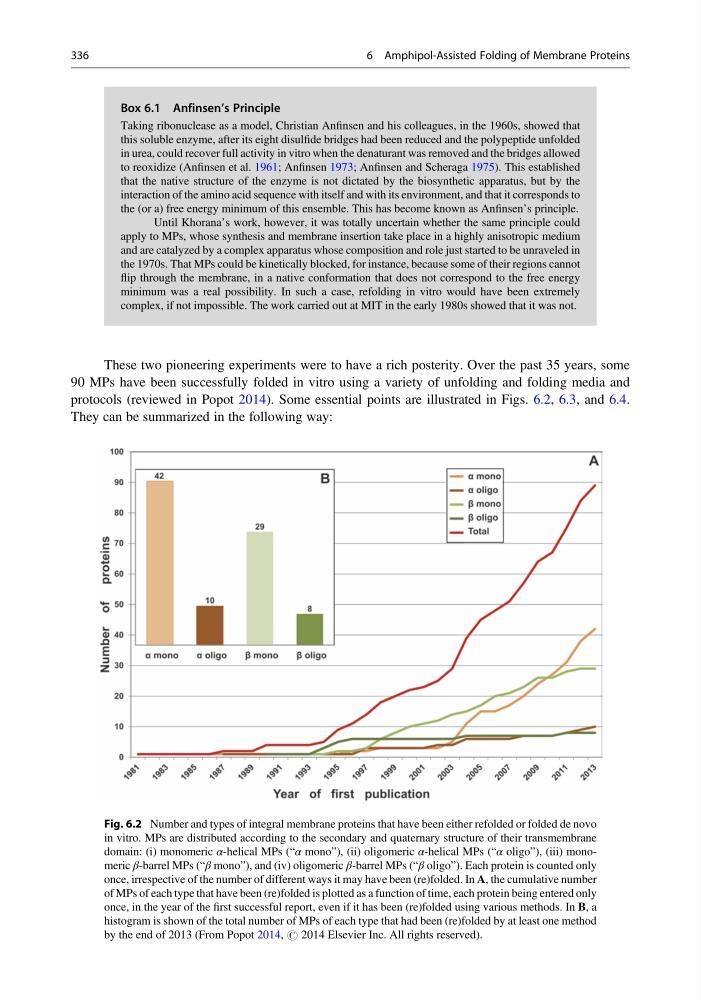
protocols (reviewed in Popot 2014). Some essential points are illustrated in Figs. 6.2, 6.3, and 6.4.
They can be summarized in the following way:
Fig. 6.2 Number and types of integral membrane proteins that have been either refolded or folded de novo
in vitro. MPs are distributed according to the secondary and quaternary structure of their transmembrane
domain: (i) monomeric α-helical MPs (“α mono”), (ii) oligomeric α-helical MPs (“α oligo”), (iii) monomeric β-barrel MPs (“β mono”), and (iv) oligomeric β-barrel MPs (“β oligo”). Each protein is counted only
once, irrespective of the number of different ways it may have been (re)folded. In A, the cumulative number
of MPs of each type that have been (re)folded is plotted as a function of time, each protein being entered only
once, in the year of the first successful report, even if it has been (re)folded using various methods. In B, a
histogram is shown of the total number of MPs of each type that had been (re)folded by at least one method
by the end of 2013 (From Popot 2014, # 2014 Elsevier Inc. All rights reserved).
336
6 Amphipol-Assisted Folding of Membrane Proteins
Taking ribonuclease as a model, Christian Anfinsen and his colleagues, in the 1960s, showed that
this soluble enzyme, after its eight disulfide bridges had been reduced and the polypeptide unfolded
in urea, could recover full activity in vitro when the denaturant was removed and the bridges allowed
to reoxidize (Anfinsen et al. 1961; Anfinsen 1973; Anfinsen and Scheraga 1975). This established
that the native structure of the enzyme is not dictated by the biosynthetic apparatus, but by the
interaction of the amino acid sequence with itself and with its environment, and that it corresponds to
the (or a) free energy minimum of this ensemble. This has become known as Anfinsen’s principle.
Until Khorana’s work, however, it was totally uncertain whether the same principle could
apply to MPs, whose synthesis and membrane insertion take place in a highly anisotropic medium
and are catalyzed by a complex apparatus whose composition and role just started to be unraveled in
the 1970s. That MPs could be kinetically blocked, for instance, because some of their regions cannot
flip through the membrane, in a native conformation that does not correspond to the free energy
minimum was a real possibility. In such a case, refolding in vitro would have been extremely
complex, if not impossible. The work carried out at MIT in the early 1980s showed that it was not.
These two pioneering experiments were to have a rich posterity. Over the past 35 years, some
90 MPs have been successfully folded in vitro using a variety of unfolding and folding media and
protocols (reviewed in Popot 2014). Some essential points are illustrated in Figs. 6.2, 6.3, and 6.4.
They can be summarized in the following way:
Fig. 6.2 Number and types of integral membrane proteins that have been either refolded or folded de novo
in vitro. MPs are distributed according to the secondary and quaternary structure of their transmembrane
domain: (i) monomeric α-helical MPs (“α mono”), (ii) oligomeric α-helical MPs (“α oligo”), (iii) monomeric β-barrel MPs (“β mono”), and (iv) oligomeric β-barrel MPs (“β oligo”). Each protein is counted only
once, irrespective of the number of different ways it may have been (re)folded. In A, the cumulative number
of MPs of each type that have been (re)folded is plotted as a function of time, each protein being entered only
once, in the year of the first successful report, even if it has been (re)folded using various methods. In B, a
histogram is shown of the total number of MPs of each type that had been (re)folded by at least one method
by the end of 2013 (From Popot 2014, # 2014 Elsevier Inc. All rights reserved).
336
6 Amphipol-Assisted Folding of Membrane Proteins