

5.6.2
Molecular Dynamics Simulations
The effects of APols on the dynamics of MPs have been examined by MD simulations, taking as a
model a complex between OmpX and A8-35 (Perlmutter et al. 2014). The choice of this system was
guided by the fact that a host of experimental data are available, particularly NMR data on the OmpX/
A8-35 complex (Catoire et al. 2009, 2010b; Etzkorn et al. 2014; cf. § 5.3.3 and Chap. 10), as well as
MD data on pure A8-35 (Perlmutter et al. 2011; Chap. 4, § 4.3.1.2.4). Experimental data can thus be
confronted to the results of MD simulations, which helped validating the methodology adopted. Once a
satisfying model had been built (§ 5.3.3), the dynamics of APol-trapped OmpX were studied and
compared to those of the same protein either embedded in a DOPC bilayer or complexed by the
detergent diC 6 PC.
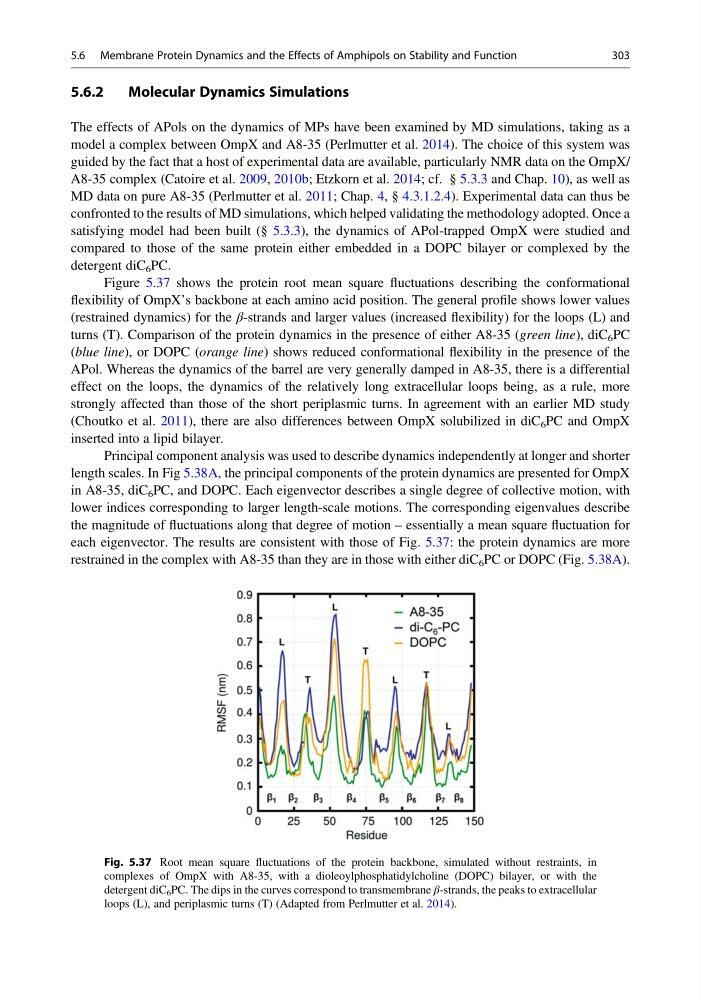
Figure 5.37 shows the protein root mean square fluctuations describing the conformational
flexibility of OmpX’s backbone at each amino acid position. The general profile shows lower values
(restrained dynamics) for the β-strands and larger values (increased flexibility) for the loops (L) and
turns (T). Comparison of the protein dynamics in the presence of either A8-35 (green line), diC 6 PC
(blue line), or DOPC (orange line) shows reduced conformational flexibility in the presence of the
APol. Whereas the dynamics of the barrel are very generally damped in A8-35, there is a differential
effect on the loops, the dynamics of the relatively long extracellular loops being, as a rule, more
strongly affected than those of the short periplasmic turns. In agreement with an earlier MD study
(Choutko et al. 2011), there are also differences between OmpX solubilized in diC 6 PC and OmpX
inserted into a lipid bilayer.
Principal component analysis was used to describe dynamics independently at longer and shorter
length scales. In Fig 5.38A, the principal components of the protein dynamics are presented for OmpX
in A8-35, diC 6 PC, and DOPC. Each eigenvector describes a single degree of collective motion, with
lower indices corresponding to larger length-scale motions. The corresponding eigenvalues describe
the magnitude of fluctuations along that degree of motion – essentially a mean square fluctuation for
each eigenvector. The results are consistent with those of Fig. 5.37: the protein dynamics are more
restrained in the complex with A8-35 than they are in those with either diC 6 PC or DOPC (Fig. 5.38A).
Fig. 5.37 Root mean square fluctuations of the protein backbone, simulated without restraints, in
complexes of OmpX with A8-35, with a dioleoylphosphatidylcholine (DOPC) bilayer, or with the
detergent diC 6 PC. The dips in the curves correspond to transmembrane β-strands, the peaks to extracellular
loops (L), and periplasmic turns (T) (Adapted from Perlmutter et al. 2014).
5.6 Membrane Protein Dynamics and the Effects of Amphipols on Stability and Function
303
Molecular Dynamics Simulations
The effects of APols on the dynamics of MPs have been examined by MD simulations, taking as a
model a complex between OmpX and A8-35 (Perlmutter et al. 2014). The choice of this system was
guided by the fact that a host of experimental data are available, particularly NMR data on the OmpX/
A8-35 complex (Catoire et al. 2009, 2010b; Etzkorn et al. 2014; cf. § 5.3.3 and Chap. 10), as well as
MD data on pure A8-35 (Perlmutter et al. 2011; Chap. 4, § 4.3.1.2.4). Experimental data can thus be
confronted to the results of MD simulations, which helped validating the methodology adopted. Once a
satisfying model had been built (§ 5.3.3), the dynamics of APol-trapped OmpX were studied and
compared to those of the same protein either embedded in a DOPC bilayer or complexed by the
detergent diC 6 PC.
Figure 5.37 shows the protein root mean square fluctuations describing the conformational
flexibility of OmpX’s backbone at each amino acid position. The general profile shows lower values
(restrained dynamics) for the β-strands and larger values (increased flexibility) for the loops (L) and
turns (T). Comparison of the protein dynamics in the presence of either A8-35 (green line), diC 6 PC
(blue line), or DOPC (orange line) shows reduced conformational flexibility in the presence of the
APol. Whereas the dynamics of the barrel are very generally damped in A8-35, there is a differential
effect on the loops, the dynamics of the relatively long extracellular loops being, as a rule, more
strongly affected than those of the short periplasmic turns. In agreement with an earlier MD study
(Choutko et al. 2011), there are also differences between OmpX solubilized in diC 6 PC and OmpX
inserted into a lipid bilayer.
Principal component analysis was used to describe dynamics independently at longer and shorter
length scales. In Fig 5.38A, the principal components of the protein dynamics are presented for OmpX
in A8-35, diC 6 PC, and DOPC. Each eigenvector describes a single degree of collective motion, with
lower indices corresponding to larger length-scale motions. The corresponding eigenvalues describe
the magnitude of fluctuations along that degree of motion – essentially a mean square fluctuation for
each eigenvector. The results are consistent with those of Fig. 5.37: the protein dynamics are more
restrained in the complex with A8-35 than they are in those with either diC 6 PC or DOPC (Fig. 5.38A).
Fig. 5.37 Root mean square fluctuations of the protein backbone, simulated without restraints, in
complexes of OmpX with A8-35, with a dioleoylphosphatidylcholine (DOPC) bilayer, or with the
detergent diC 6 PC. The dips in the curves correspond to transmembrane β-strands, the peaks to extracellular
loops (L), and periplasmic turns (T) (Adapted from Perlmutter et al. 2014).
5.6 Membrane Protein Dynamics and the Effects of Amphipols on Stability and Function
303