

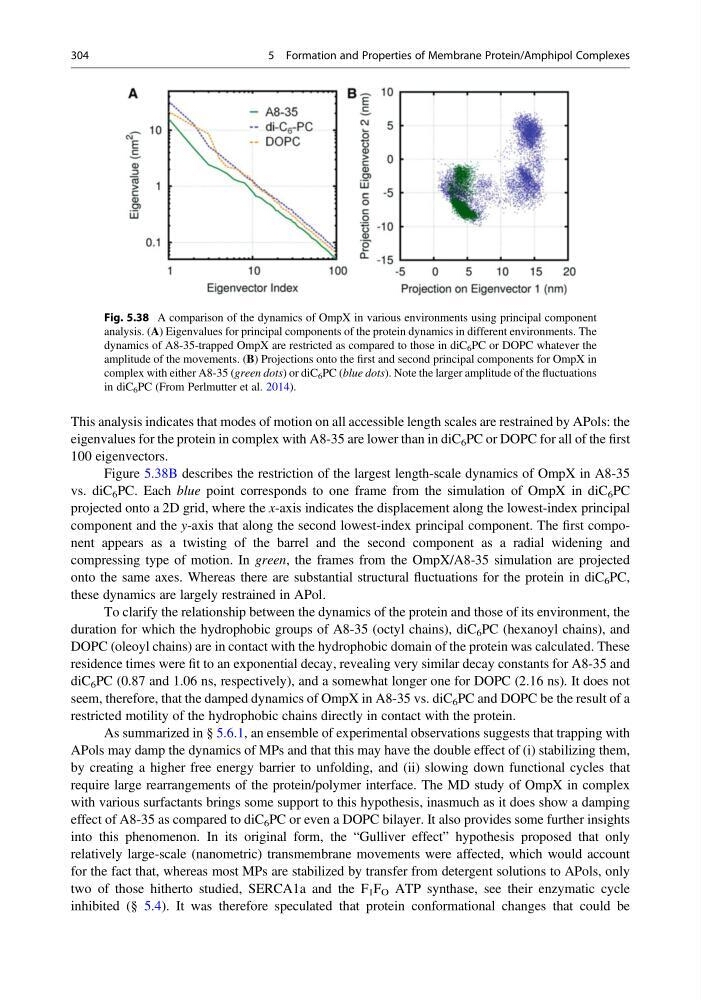
This analysis indicates that modes of motion on all accessible length scales are restrained by APols: the
eigenvalues for the protein in complex with A8-35 are lower than in diC 6 PC or DOPC for all of the first
100 eigenvectors.
Figure 5.38B describes the restriction of the largest length-scale dynamics of OmpX in A8-35
vs. diC 6 PC. Each blue point corresponds to one frame from the simulation of OmpX in diC 6 PC
projected onto a 2D grid, where the x-axis indicates the displacement along the lowest-index principal
component and the y-axis that along the second lowest-index principal component. The first component appears as a twisting of the barrel and the second component as a radial widening and
compressing type of motion. In green, the frames from the OmpX/A8-35 simulation are projected
onto the same axes. Whereas there are substantial structural fluctuations for the protein in diC 6 PC,
these dynamics are largely restrained in APol.
To clarify the relationship between the dynamics of the protein and those of its environment, the
duration for which the hydrophobic groups of A8-35 (octyl chains), diC 6 PC (hexanoyl chains), and
DOPC (oleoyl chains) are in contact with the hydrophobic domain of the protein was calculated. These
residence times were fit to an exponential decay, revealing very similar decay constants for A8-35 and
diC 6 PC (0.87 and 1.06 ns, respectively), and a somewhat longer one for DOPC (2.16 ns). It does not
seem, therefore, that the damped dynamics of OmpX in A8-35 vs. diC 6 PC and DOPC be the result of a
restricted motility of the hydrophobic chains directly in contact with the protein.
As summarized in § 5.6.1, an ensemble of experimental observations suggests that trapping with
APols may damp the dynamics of MPs and that this may have the double effect of (i) stabilizing them,
by creating a higher free energy barrier to unfolding, and (ii) slowing down functional cycles that
require large rearrangements of the protein/polymer interface. The MD study of OmpX in complex
with various surfactants brings some support to this hypothesis, inasmuch as it does show a damping
effect of A8-35 as compared to diC 6 PC or even a DOPC bilayer. It also provides some further insights
into this phenomenon. In its original form, the “Gulliver effect” hypothesis proposed that only
relatively large-scale (nanometric) transmembrane movements were affected, which would account
for the fact that, whereas most MPs are stabilized by transfer from detergent solutions to APols, only
two of those hitherto studied, SERCA1a and the F 1 F O ATP synthase, see their enzymatic cycle
inhibited (§ 5.4). It was therefore speculated that protein conformational changes that could be
Fig. 5.38 A comparison of the dynamics of OmpX in various environments using principal component
analysis. (A) Eigenvalues for principal components of the protein dynamics in different environments. The
dynamics of A8-35-trapped OmpX are restricted as compared to those in diC 6 PC or DOPC whatever the
amplitude of the movements. (B) Projections onto the first and second principal components for OmpX in
complex with either A8-35 (green dots) or diC 6 PC (blue dots). Note the larger amplitude of the fluctuations
in diC 6 PC (From Perlmutter et al. 2014).
304
5 Formation and Properties of Membrane Protein/Amphipol Complexes
eigenvalues for the protein in complex with A8-35 are lower than in diC 6 PC or DOPC for all of the first
100 eigenvectors.
Figure 5.38B describes the restriction of the largest length-scale dynamics of OmpX in A8-35
vs. diC 6 PC. Each blue point corresponds to one frame from the simulation of OmpX in diC 6 PC
projected onto a 2D grid, where the x-axis indicates the displacement along the lowest-index principal
component and the y-axis that along the second lowest-index principal component. The first component appears as a twisting of the barrel and the second component as a radial widening and
compressing type of motion. In green, the frames from the OmpX/A8-35 simulation are projected
onto the same axes. Whereas there are substantial structural fluctuations for the protein in diC 6 PC,
these dynamics are largely restrained in APol.
To clarify the relationship between the dynamics of the protein and those of its environment, the
duration for which the hydrophobic groups of A8-35 (octyl chains), diC 6 PC (hexanoyl chains), and
DOPC (oleoyl chains) are in contact with the hydrophobic domain of the protein was calculated. These
residence times were fit to an exponential decay, revealing very similar decay constants for A8-35 and
diC 6 PC (0.87 and 1.06 ns, respectively), and a somewhat longer one for DOPC (2.16 ns). It does not
seem, therefore, that the damped dynamics of OmpX in A8-35 vs. diC 6 PC and DOPC be the result of a
restricted motility of the hydrophobic chains directly in contact with the protein.
As summarized in § 5.6.1, an ensemble of experimental observations suggests that trapping with
APols may damp the dynamics of MPs and that this may have the double effect of (i) stabilizing them,
by creating a higher free energy barrier to unfolding, and (ii) slowing down functional cycles that
require large rearrangements of the protein/polymer interface. The MD study of OmpX in complex
with various surfactants brings some support to this hypothesis, inasmuch as it does show a damping
effect of A8-35 as compared to diC 6 PC or even a DOPC bilayer. It also provides some further insights
into this phenomenon. In its original form, the “Gulliver effect” hypothesis proposed that only
relatively large-scale (nanometric) transmembrane movements were affected, which would account
for the fact that, whereas most MPs are stabilized by transfer from detergent solutions to APols, only
two of those hitherto studied, SERCA1a and the F 1 F O ATP synthase, see their enzymatic cycle
inhibited (§ 5.4). It was therefore speculated that protein conformational changes that could be
Fig. 5.38 A comparison of the dynamics of OmpX in various environments using principal component
analysis. (A) Eigenvalues for principal components of the protein dynamics in different environments. The
dynamics of A8-35-trapped OmpX are restricted as compared to those in diC 6 PC or DOPC whatever the
amplitude of the movements. (B) Projections onto the first and second principal components for OmpX in
complex with either A8-35 (green dots) or diC 6 PC (blue dots). Note the larger amplitude of the fluctuations
in diC 6 PC (From Perlmutter et al. 2014).
304
5 Formation and Properties of Membrane Protein/Amphipol Complexes