

(Fig. 5.34A, B) and less protective (Fig. 5.34C) than the other APols tested. This raised again
the intriguing question of a possible common mechanism underlying the two types of effects (Picard
et al. 2006).
The P-type pumps to the family of which the SERCA1a belongs are remarkable by the extensive
rearrangement of the transmembrane helix bundle (and extramembrane domains) that takes place
during the enzymatic cycle (reviewed by Palmgren and Nissen 2011; see Norimatsu et al. 2017,
Sweadner 2017, and Chap. 1, § 1.6.3). This has led to the suggestion that the inhibition of SERCA1a
by APols could be due to an increase of the free energy of activation associated with SERCA1a
transconformations, which would result from the rearrangement of the polymer around the protein.
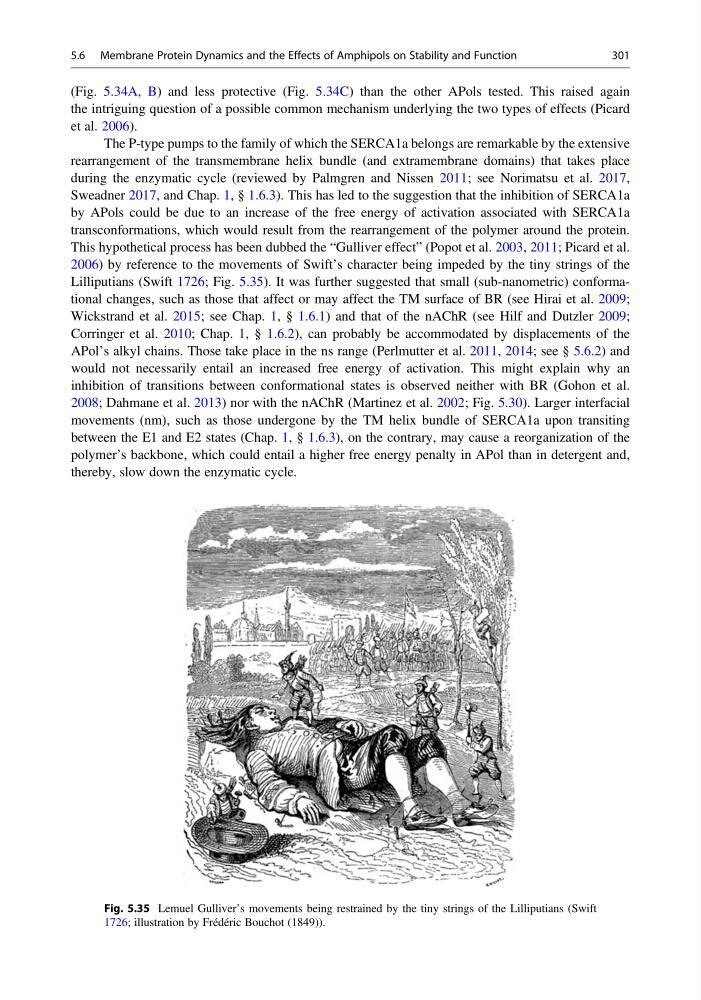
This hypothetical process has been dubbed the “Gulliver effect” (Popot et al. 2003, 2011; Picard et al.
2006) by reference to the movements of Swift’s character being impeded by the tiny strings of the
Lilliputians (Swift 1726; Fig. 5.35). It was further suggested that small (sub-nanometric) conformational changes, such as those that affect or may affect the TM surface of BR (see Hirai et al. 2009;
Wickstrand et al. 2015; see Chap. 1, § 1.6.1) and that of the nAChR (see Hilf and Dutzler 2009;
Corringer et al. 2010; Chap. 1, § 1.6.2), can probably be accommodated by displacements of the
APol’s alkyl chains. Those take place in the ns range (Perlmutter et al. 2011, 2014; see § 5.6.2) and
would not necessarily entail an increased free energy of activation. This might explain why an
inhibition of transitions between conformational states is observed neither with BR (Gohon et al.
2008; Dahmane et al. 2013) nor with the nAChR (Martinez et al. 2002; Fig. 5.30). Larger interfacial
movements (nm), such as those undergone by the TM helix bundle of SERCA1a upon transiting
between the E1 and E2 states (Chap. 1, § 1.6.3), on the contrary, may cause a reorganization of the
polymer’s backbone, which could entail a higher free energy penalty in APol than in detergent and,
thereby, slow down the enzymatic cycle.
Fig. 5.35 Lemuel Gulliver’s movements being restrained by the tiny strings of the Lilliputians (Swift
1726; illustration by Frédéric Bouchot (1849)).
5.6 Membrane Protein Dynamics and the Effects of Amphipols on Stability and Function
301
the intriguing question of a possible common mechanism underlying the two types of effects (Picard
et al. 2006).
The P-type pumps to the family of which the SERCA1a belongs are remarkable by the extensive
rearrangement of the transmembrane helix bundle (and extramembrane domains) that takes place
during the enzymatic cycle (reviewed by Palmgren and Nissen 2011; see Norimatsu et al. 2017,
Sweadner 2017, and Chap. 1, § 1.6.3). This has led to the suggestion that the inhibition of SERCA1a
by APols could be due to an increase of the free energy of activation associated with SERCA1a
transconformations, which would result from the rearrangement of the polymer around the protein.
This hypothetical process has been dubbed the “Gulliver effect” (Popot et al. 2003, 2011; Picard et al.
2006) by reference to the movements of Swift’s character being impeded by the tiny strings of the
Lilliputians (Swift 1726; Fig. 5.35). It was further suggested that small (sub-nanometric) conformational changes, such as those that affect or may affect the TM surface of BR (see Hirai et al. 2009;
Wickstrand et al. 2015; see Chap. 1, § 1.6.1) and that of the nAChR (see Hilf and Dutzler 2009;
Corringer et al. 2010; Chap. 1, § 1.6.2), can probably be accommodated by displacements of the
APol’s alkyl chains. Those take place in the ns range (Perlmutter et al. 2011, 2014; see § 5.6.2) and
would not necessarily entail an increased free energy of activation. This might explain why an
inhibition of transitions between conformational states is observed neither with BR (Gohon et al.
2008; Dahmane et al. 2013) nor with the nAChR (Martinez et al. 2002; Fig. 5.30). Larger interfacial
movements (nm), such as those undergone by the TM helix bundle of SERCA1a upon transiting
between the E1 and E2 states (Chap. 1, § 1.6.3), on the contrary, may cause a reorganization of the
polymer’s backbone, which could entail a higher free energy penalty in APol than in detergent and,
thereby, slow down the enzymatic cycle.
Fig. 5.35 Lemuel Gulliver’s movements being restrained by the tiny strings of the Lilliputians (Swift
1726; illustration by Frédéric Bouchot (1849)).
5.6 Membrane Protein Dynamics and the Effects of Amphipols on Stability and Function
301