

Fig. 5.34 Comparative effects of various amphipols on the activity and stability of the sarcoplasmic
reticulum (SR) calcium ATPase, SERCA1a. (A) Reversible inhibition by APols of the ATPase activity of
detergent-solubilized SR membranes. SR vesicles were diluted to 0.004 gÁL
À1 in a detergent-free assay
medium, and ATPase activity was monitored continuously with a coupled enzyme system. Following a
similar protocol to that in Fig. 5.31A, samples were successively supplemented with (i) 0.1 gÁL
À1 (i.e.
twice the CMC) C 12 E 8 , which solubilizes the SR membranes, thereby relieving the inhibition due to the
accumulation of Ca
2+ within SR vesicles; (ii) various APols, namely either A8-35, PMAL-C12, PMALAC12, or SAPol, at final concentrations first of 0.1 gÁL
À1 and then of 0.3 gÁL
À1
; finally (iii) a larger
concentration of C 12 E 8 added, partly relieving inhibition by APols (1 gÁL
À1 was added to the 0.1 gÁL
À1
already present). The ATPase activity measured during step ii is plotted as a function of APol concentration for each of the four APols tested. (B) Slowing down by APols of Ca
2+ dissociation from the detergentsolubilized ATPase. Summary of the rate constants found in parallel experiments with the four APols,
plotted as a function of APol concentration. (C) Protection conferred by various APols against the
irreversible inactivation of the ATPase upon calcium depletion in the presence of detergent. Experiments
were carried out as described in Fig. 5.33. Rate constants for irreversible inactivation are plotted vs. the
ratio of APol to C 12 E 8 in the samples. □, SAPol; ○, A8-35; ¨ , ~, PMAL-C12 and PMALA-C12
(Reprinted with permission from Picard et al. 2006, # 2006 American Chemical Society).
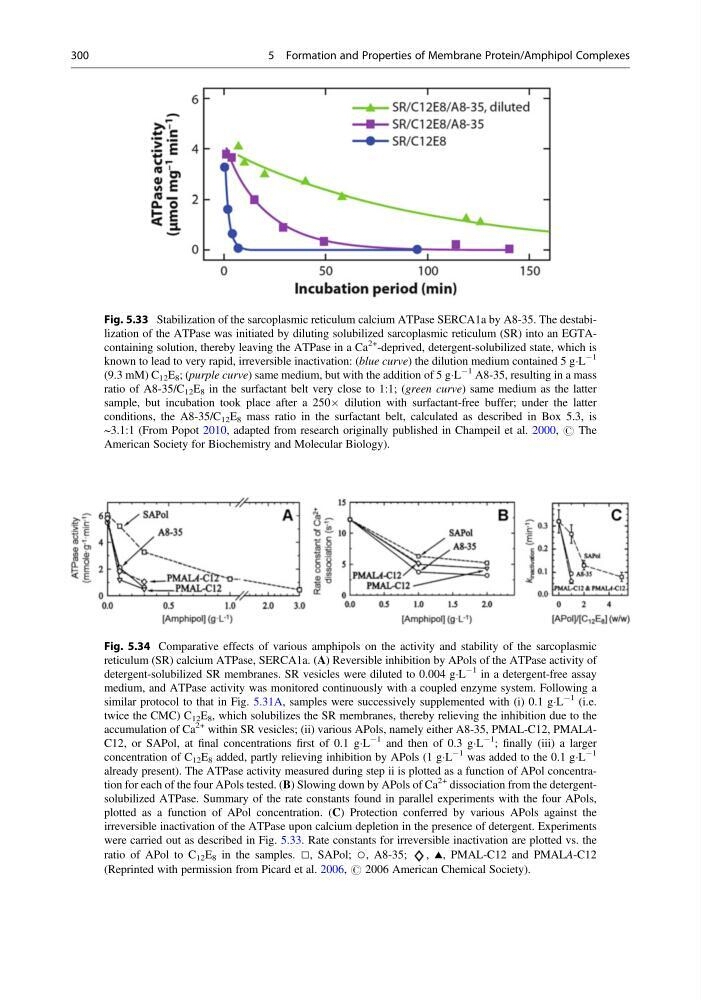
Fig. 5.33 Stabilization of the sarcoplasmic reticulum calcium ATPase SERCA1a by A8-35. The destabilization of the ATPase was initiated by diluting solubilized sarcoplasmic reticulum (SR) into an EGTAcontaining solution, thereby leaving the ATPase in a Ca
2+ -deprived, detergent-solubilized state, which is
known to lead to very rapid, irreversible inactivation: (blue curve) the dilution medium contained 5 gÁL
À1
(9.3 mM) C 12 E 8 ; (purple curve) same medium, but with the addition of 5 gÁL
À1 A8-35, resulting in a mass
ratio of A8-35/C 12 E 8 in the surfactant belt very close to 1:1; (green curve) same medium as the latter
sample, but incubation took place after a 250Â dilution with surfactant-free buffer; under the latter
conditions, the A8-35/C 12 E 8 mass ratio in the surfactant belt, calculated as described in Box 5.3, is
~3.1:1 (From Popot 2010, adapted from research originally published in Champeil et al. 2000, # The
American Society for Biochemistry and Molecular Biology).
300
5 Formation and Properties of Membrane Protein/Amphipol Complexes
reticulum (SR) calcium ATPase, SERCA1a. (A) Reversible inhibition by APols of the ATPase activity of
detergent-solubilized SR membranes. SR vesicles were diluted to 0.004 gÁL
À1 in a detergent-free assay
medium, and ATPase activity was monitored continuously with a coupled enzyme system. Following a
similar protocol to that in Fig. 5.31A, samples were successively supplemented with (i) 0.1 gÁL
À1 (i.e.
twice the CMC) C 12 E 8 , which solubilizes the SR membranes, thereby relieving the inhibition due to the
accumulation of Ca
2+ within SR vesicles; (ii) various APols, namely either A8-35, PMAL-C12, PMALAC12, or SAPol, at final concentrations first of 0.1 gÁL
À1 and then of 0.3 gÁL
À1
; finally (iii) a larger
concentration of C 12 E 8 added, partly relieving inhibition by APols (1 gÁL
À1 was added to the 0.1 gÁL
À1
already present). The ATPase activity measured during step ii is plotted as a function of APol concentration for each of the four APols tested. (B) Slowing down by APols of Ca
2+ dissociation from the detergentsolubilized ATPase. Summary of the rate constants found in parallel experiments with the four APols,
plotted as a function of APol concentration. (C) Protection conferred by various APols against the
irreversible inactivation of the ATPase upon calcium depletion in the presence of detergent. Experiments
were carried out as described in Fig. 5.33. Rate constants for irreversible inactivation are plotted vs. the
ratio of APol to C 12 E 8 in the samples. □, SAPol; ○, A8-35; ¨ , ~, PMAL-C12 and PMALA-C12
(Reprinted with permission from Picard et al. 2006, # 2006 American Chemical Society).
Fig. 5.33 Stabilization of the sarcoplasmic reticulum calcium ATPase SERCA1a by A8-35. The destabilization of the ATPase was initiated by diluting solubilized sarcoplasmic reticulum (SR) into an EGTAcontaining solution, thereby leaving the ATPase in a Ca
2+ -deprived, detergent-solubilized state, which is
known to lead to very rapid, irreversible inactivation: (blue curve) the dilution medium contained 5 gÁL
À1
(9.3 mM) C 12 E 8 ; (purple curve) same medium, but with the addition of 5 gÁL
À1 A8-35, resulting in a mass
ratio of A8-35/C 12 E 8 in the surfactant belt very close to 1:1; (green curve) same medium as the latter
sample, but incubation took place after a 250Â dilution with surfactant-free buffer; under the latter
conditions, the A8-35/C 12 E 8 mass ratio in the surfactant belt, calculated as described in Box 5.3, is
~3.1:1 (From Popot 2010, adapted from research originally published in Champeil et al. 2000, # The
American Society for Biochemistry and Molecular Biology).
300
5 Formation and Properties of Membrane Protein/Amphipol Complexes