

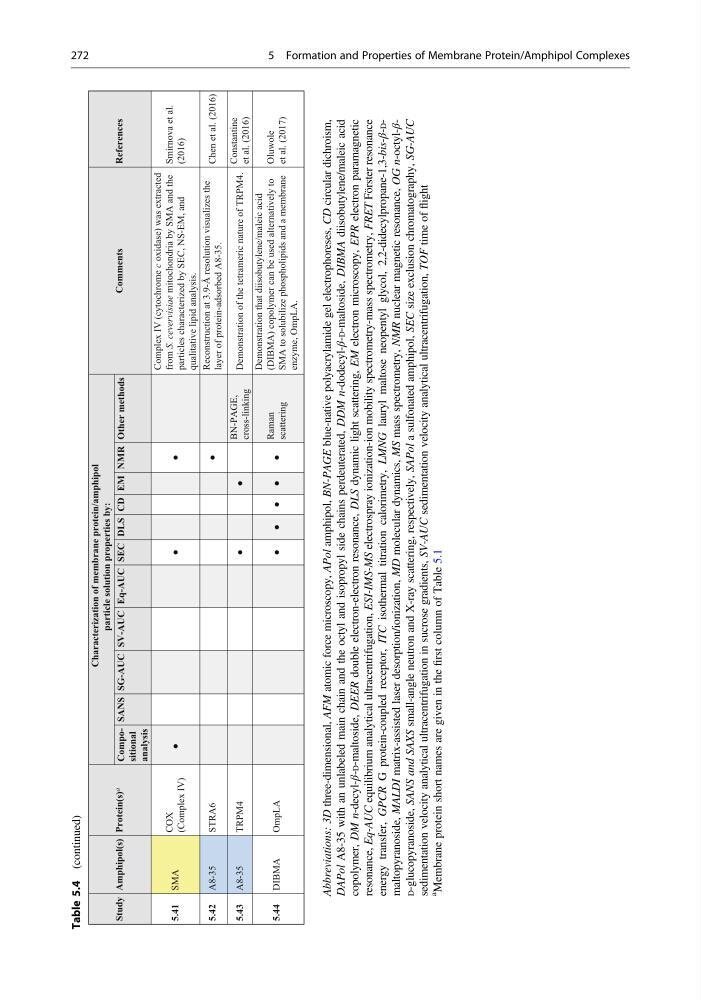
Table 5.4
(continued)
Study Amphipol(s) Protein(s) a
Characterization of membrane protein/amphipol
particle solution properties by:
Comments
References
Compositional
analysis
SANS SG-AUC SV-AUC Eq-AUC SEC DLS CD EM NMR Other methods
5.43 A8-35
TRPM4
●
●
BN-PAGE,
cross-linking
Demonstration of the tetrameric nature of TRPM4.
Constantine
et al. (2016)
5.44 DIBMA
OmpLA
●
●
●
●
●
Raman
scattering
Demonstration that diisobutylene/maleic acid
(DIBMA) copolymer can be used alternatively to
SMA to solubilize phospholipids and a membrane
enzyme, OmpLA.
Oluwole
et al. (2017)
5.42 A8-35
STRA6
●
Reconstruction at 3.9-Å resolution visualizes the
layer of protein-adsorbed A8-35.
Chen et al. (2016)
5.41 SMA
●
●
●
Complex IV (cytochrome c oxidase) was extracted
from S. cevervisiae mitochondria by SMA and the
particles characterized by SEC, NS-EM, and
qualitative lipid analysis.
Smirnova et al.
(2016)
COX
(Complex IV)
Abbreviations: 3D
three-dimensional, AFM
atomic force microscopy, APol
amphipol, BN-PAGE
blue-native polyacrylamide gel electrophoreses, CD
circular dichroism,
DAPol
A8-35 with an unlabeled main chain and the octyl and isopropyl side chains perdeuterated, DDM n-dodecyl-β-D-maltoside, DIBMA
diisobutylene/maleic acid
copolymer, DM n-decyl-β-D-maltoside, DEER
double electron-electron resonance, DLS
dynamic light scattering, EM
electron microscopy, EPR
electron paramagnetic
resonance, Eq-AUC
equilibrium analytical ultracentrifugation, ESI-IMS-MS
electrospray ionization-ion mobility spectrometry-mass spectrometry, FRET
Förster resonance
energy transfer, GPCR
G protein-coupled receptor, ITC
isothermal titration calorimetry, LMNG
lauryl maltose neopentyl glycol, 2,2-didecylpropane-1,3-bis-β-Dmaltopyranoside, MALDI
matrix-assisted laser desorption/ionization, MD
molecular dynamics, MS
mass spectrometry, NMR
nuclear magnetic resonance, OG n-octyl-βD-glucopyranoside,
SANS and SAXS
small-angle neutron and X-ray scattering, respectively, SAPol
a sulfonated amphipol, SEC
size exclusion chromatography, SG-AUC
sedimentation velocity analytical ultracentrifugation in sucrose gradients, SV-AUC
sedimentation velocity analytical ultracentrifugation, TOF
time of
flight
a
Membrane protein short names are given in the
first column of Table 5.1
272
5 Formation and Properties of Membrane Protein/Amphipol Complexes
(continued)
Study Amphipol(s) Protein(s) a
Characterization of membrane protein/amphipol
particle solution properties by:
Comments
References
Compositional
analysis
SANS SG-AUC SV-AUC Eq-AUC SEC DLS CD EM NMR Other methods
5.43 A8-35
TRPM4
●
●
BN-PAGE,
cross-linking
Demonstration of the tetrameric nature of TRPM4.
Constantine
et al. (2016)
5.44 DIBMA
OmpLA
●
●
●
●
●
Raman
scattering
Demonstration that diisobutylene/maleic acid
(DIBMA) copolymer can be used alternatively to
SMA to solubilize phospholipids and a membrane
enzyme, OmpLA.
Oluwole
et al. (2017)
5.42 A8-35
STRA6
●
Reconstruction at 3.9-Å resolution visualizes the
layer of protein-adsorbed A8-35.
Chen et al. (2016)
5.41 SMA
●
●
●
Complex IV (cytochrome c oxidase) was extracted
from S. cevervisiae mitochondria by SMA and the
particles characterized by SEC, NS-EM, and
qualitative lipid analysis.
Smirnova et al.
(2016)
COX
(Complex IV)
Abbreviations: 3D
three-dimensional, AFM
atomic force microscopy, APol
amphipol, BN-PAGE
blue-native polyacrylamide gel electrophoreses, CD
circular dichroism,
DAPol
A8-35 with an unlabeled main chain and the octyl and isopropyl side chains perdeuterated, DDM n-dodecyl-β-D-maltoside, DIBMA
diisobutylene/maleic acid
copolymer, DM n-decyl-β-D-maltoside, DEER
double electron-electron resonance, DLS
dynamic light scattering, EM
electron microscopy, EPR
electron paramagnetic
resonance, Eq-AUC
equilibrium analytical ultracentrifugation, ESI-IMS-MS
electrospray ionization-ion mobility spectrometry-mass spectrometry, FRET
Förster resonance
energy transfer, GPCR
G protein-coupled receptor, ITC
isothermal titration calorimetry, LMNG
lauryl maltose neopentyl glycol, 2,2-didecylpropane-1,3-bis-β-Dmaltopyranoside, MALDI
matrix-assisted laser desorption/ionization, MD
molecular dynamics, MS
mass spectrometry, NMR
nuclear magnetic resonance, OG n-octyl-βD-glucopyranoside,
SANS and SAXS
small-angle neutron and X-ray scattering, respectively, SAPol
a sulfonated amphipol, SEC
size exclusion chromatography, SG-AUC
sedimentation velocity analytical ultracentrifugation in sucrose gradients, SV-AUC
sedimentation velocity analytical ultracentrifugation, TOF
time of
flight
a
Membrane protein short names are given in the
first column of Table 5.1
272
5 Formation and Properties of Membrane Protein/Amphipol Complexes