

PC-APols
5.17 A8-35
OmpX
●
An NMR investigation of the accessibility to water
and dynamics of A8-35-trapped OmpX. EDTA is
shown to accelerate the tumbling time of the
particles and improve the resolution of the signals.
Catoire et al.
(2010b)
5.18 A8-35
Mitochondrial
supercomplex
I1III2IV1
(respirasome)
●
●
●
BN-PAGE
A cryo-EM study of A8-35-trapped supercomplex
I1III2IV1, the largest MP yet stabilized in APols,
showing the first direct visualization of a MP-bound
APol belt.
Althoff et al.
(2011)
5.19 SAPols
BR, tOmpA
●
●
SDS-PAGE
Solution NMR spectra of tOmpA trapped with
sulfonated APols have a resolution comparable to
that of A8-3-trapped tOmpA, indicating a similar
particle size. They can be recorded at low pH and
high temperature without denaturing the protein.
Dahmane et al.
(2009)
5.20 NVoy
CRFR1,
CRFR2β
●
●
●
Two GPCRs expressed in vitro in the presence of
NVoy were shown to be functional and form small
particles amenable to solution NMR investigations.
Klammt et al.
(2011)
5.13
Glucosylated
NAPols
BR, tOmpA,
GHS-R1a
●
●
●
●
●
Glucosylated NAPols were tested on three MPs,
BR, tOmpA, and the ghrelin receptor GHS-R1a.
The native state of the proteins was demonstrated
by functional (BR, GHS-R1a) or solution NMR
(tOmpA) measurements. The mass and dimensions
of the complexes were established by SEC,
SV-AUC, and SANS.
Bazzacco et al.
(2009, 2012) and
Sharma et al.
(2012)
5.14 A8-35
OmpX
●
MS
An NMR analysis of protein/APol contacts in
OmpX/A8-35 complexes.
Catoire et al.
(2009)
5.15 SMA
BR, PagP
●
●
●
The first demonstration that styrene-maleic acid
copolymers can be used to directly extract MPs
from membranes and keep them soluble in small
SMA-bounded lipid discs.
Knowles et al.
(2009)
5.16
A8-35
BR, tOmpA
ITC
A thermodynamic study of the exchange of
detergents and APols at the surface of MPs. The
enthalpy of APol/detergent exchange on the
hydrophobic surface of IMPs is negligibly small, an
indication of the similarity of the molecular
interactions of IMPs with the two types of
amphiphiles. The enhanced stability against dilution
of MP/APol complexes, compared to MP/detergent
ones, originates from the difference in entropy gain
achieved upon release in water the surfactant.
Tribet et al.
(2009)
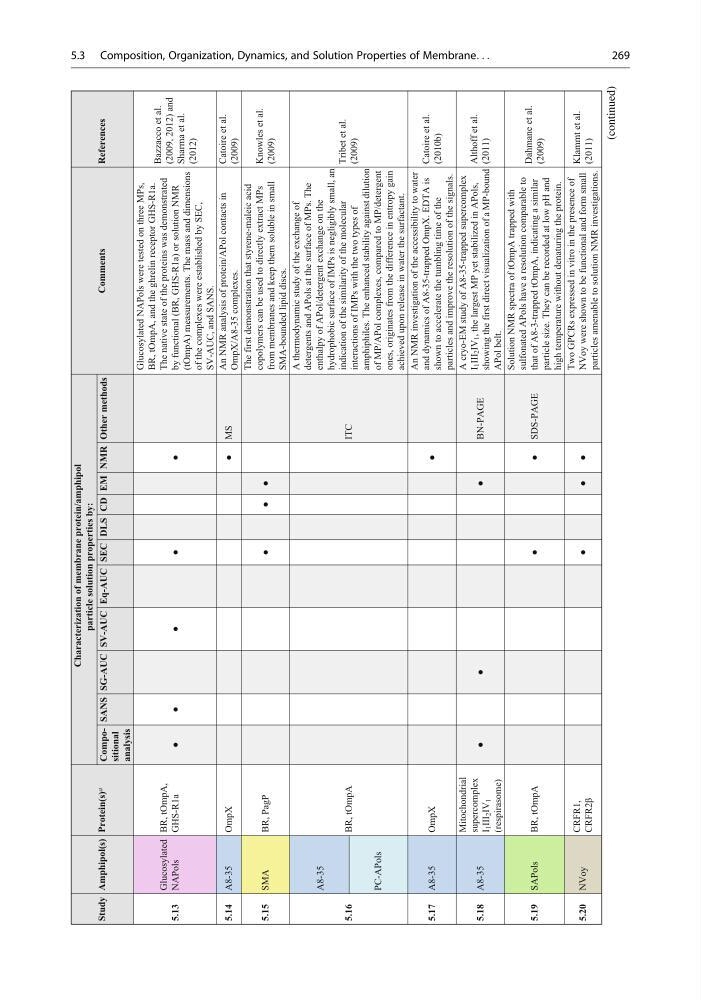
Study Amphipol(s) Protein(s) a
Characterization of membrane protein/amphipol
particle solution properties by:
Comments
References
Compositional
analysis
SANS
SG-AUC SV-AUC Eq-AUC SEC DLS CD EM NMR Other methods
(continued)
5.3 Composition, Organization, Dynamics, and Solution Properties of Membrane. . .
269
5.17 A8-35
OmpX
●
An NMR investigation of the accessibility to water
and dynamics of A8-35-trapped OmpX. EDTA is
shown to accelerate the tumbling time of the
particles and improve the resolution of the signals.
Catoire et al.
(2010b)
5.18 A8-35
Mitochondrial
supercomplex
I1III2IV1
(respirasome)
●
●
●
BN-PAGE
A cryo-EM study of A8-35-trapped supercomplex
I1III2IV1, the largest MP yet stabilized in APols,
showing the first direct visualization of a MP-bound
APol belt.
Althoff et al.
(2011)
5.19 SAPols
BR, tOmpA
●
●
SDS-PAGE
Solution NMR spectra of tOmpA trapped with
sulfonated APols have a resolution comparable to
that of A8-3-trapped tOmpA, indicating a similar
particle size. They can be recorded at low pH and
high temperature without denaturing the protein.
Dahmane et al.
(2009)
5.20 NVoy
CRFR1,
CRFR2β
●
●
●
Two GPCRs expressed in vitro in the presence of
NVoy were shown to be functional and form small
particles amenable to solution NMR investigations.
Klammt et al.
(2011)
5.13
Glucosylated
NAPols
BR, tOmpA,
GHS-R1a
●
●
●
●
●
Glucosylated NAPols were tested on three MPs,
BR, tOmpA, and the ghrelin receptor GHS-R1a.
The native state of the proteins was demonstrated
by functional (BR, GHS-R1a) or solution NMR
(tOmpA) measurements. The mass and dimensions
of the complexes were established by SEC,
SV-AUC, and SANS.
Bazzacco et al.
(2009, 2012) and
Sharma et al.
(2012)
5.14 A8-35
OmpX
●
MS
An NMR analysis of protein/APol contacts in
OmpX/A8-35 complexes.
Catoire et al.
(2009)
5.15 SMA
BR, PagP
●
●
●
The first demonstration that styrene-maleic acid
copolymers can be used to directly extract MPs
from membranes and keep them soluble in small
SMA-bounded lipid discs.
Knowles et al.
(2009)
5.16
A8-35
BR, tOmpA
ITC
A thermodynamic study of the exchange of
detergents and APols at the surface of MPs. The
enthalpy of APol/detergent exchange on the
hydrophobic surface of IMPs is negligibly small, an
indication of the similarity of the molecular
interactions of IMPs with the two types of
amphiphiles. The enhanced stability against dilution
of MP/APol complexes, compared to MP/detergent
ones, originates from the difference in entropy gain
achieved upon release in water the surfactant.
Tribet et al.
(2009)
Study Amphipol(s) Protein(s) a
Characterization of membrane protein/amphipol
particle solution properties by:
Comments
References
Compositional
analysis
SANS
SG-AUC SV-AUC Eq-AUC SEC DLS CD EM NMR Other methods
(continued)
5.3 Composition, Organization, Dynamics, and Solution Properties of Membrane. . .
269