

Box 5.1 (continued)
Whereas the protein content in the supernatants was identical (~11 mgÁL
À1 in both cases at
0.3% surfactant), the specific binding activity was higher in A8-35 (5700 cpm per μg protein)
compared to TX-100 (3900 cpm per μg protein). This effect is not due to a deleterious effect of
Triton X-100 on the binding activity (Leray et al. 1992). The increase of specific binding activity in
A8-35- vs. TX-100-extracted receptor is the same as observed when TX-100-solubilized receptor is
transferred to A8-35, which suggests a structural rearrangement of the receptor, such as could
result, for instance and hypothetically, from the preservation or recovery of some critical receptor/
lipid interactions.
In summary, these preliminary data strongly suggest that A8-35 is able to efficiently
solubilize the insulin receptor, improving insulin binding and preserving insulin-dependent
autophosphorylation.
B5.1.2. Direct extraction of the maltose transporter from E. coli plasma membrane
The maltose transporter belongs to the ABC transporter superfamily. It comprises two
different integral MPs, MalF and MalG, and two copies of a cytoplasmic protein, MalK, able to
hydrolyze ATP. The three subunits MalK, MalF, and MalG, the latter fused to the glutathione
S-transferase affinity tag (GST-MalG), were overexpressed in E. coli (NT169 strain). Direct
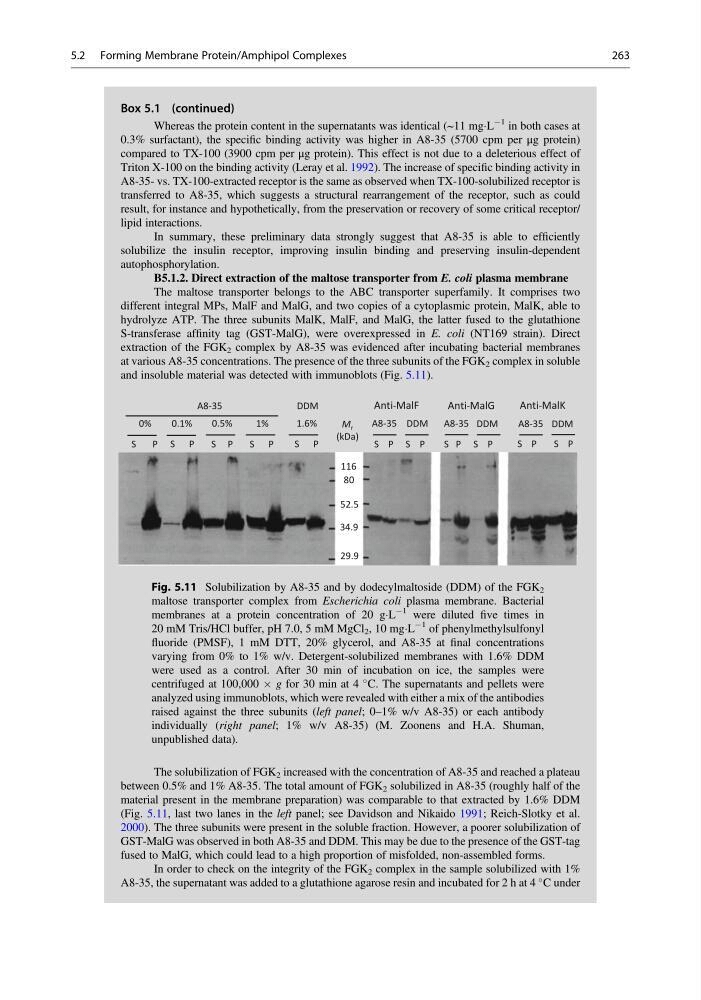
extraction of the FGK 2 complex by A8-35 was evidenced after incubating bacterial membranes
at various A8-35 concentrations. The presence of the three subunits of the FGK 2 complex in soluble
and insoluble material was detected with immunoblots (Fig. 5.11).
The solubilization of FGK 2 increased with the concentration of A8-35 and reached a plateau
between 0.5% and 1% A8-35. The total amount of FGK 2 solubilized in A8-35 (roughly half of the
material present in the membrane preparation) was comparable to that extracted by 1.6% DDM
(Fig. 5.11, last two lanes in the left panel; see Davidson and Nikaido 1991; Reich-Slotky et al.
2000). The three subunits were present in the soluble fraction. However, a poorer solubilization of
GST-MalG was observed in both A8-35 and DDM. This may be due to the presence of the GST-tag
fused to MalG, which could lead to a high proportion of misfolded, non-assembled forms.
In order to check on the integrity of the FGK 2 complex in the sample solubilized with 1%
A8-35, the supernatant was added to a glutathione agarose resin and incubated for 2 h at 4
C under
Anti-MalF
Anti-MalG
Anti-MalK
M r
(kDa)
0%
0.1%
0.5%
1%
A8-35
1.6%
DDM
A8-35 DDM
DDM
DDM
A8-35
A8-35
S
P S P
S P
S P
S P
S P S P
S P S P
S P
S P
116
80
52.5
34.9
29.9
Fig. 5.11 Solubilization by A8-35 and by dodecylmaltoside (DDM) of the FGK 2
maltose transporter complex from Escherichia coli plasma membrane. Bacterial
membranes at a protein concentration of 20 gÁL
À1 were diluted five times in
20 mM Tris/HCl buffer, pH 7.0, 5 mM MgCl 2 , 10 mgÁL
À1 of phenylmethylsulfonyl
fluoride (PMSF), 1 mM DTT, 20% glycerol, and A8-35 at final concentrations
varying from 0% to 1% w/v. Detergent-solubilized membranes with 1.6% DDM
were used as a control. After 30 min of incubation on ice, the samples were
centrifuged at 100,000 Â g for 30 min at 4
C. The supernatants and pellets were
analyzed using immunoblots, which were revealed with either a mix of the antibodies
raised against the three subunits (left panel; 0–1% w/v A8-35) or each antibody
individually (right panel; 1% w/v A8-35) (M. Zoonens and H.A. Shuman,
unpublished data).
5.2 Forming Membrane Protein/Amphipol Complexes
263
Whereas the protein content in the supernatants was identical (~11 mgÁL
À1 in both cases at
0.3% surfactant), the specific binding activity was higher in A8-35 (5700 cpm per μg protein)
compared to TX-100 (3900 cpm per μg protein). This effect is not due to a deleterious effect of
Triton X-100 on the binding activity (Leray et al. 1992). The increase of specific binding activity in
A8-35- vs. TX-100-extracted receptor is the same as observed when TX-100-solubilized receptor is
transferred to A8-35, which suggests a structural rearrangement of the receptor, such as could
result, for instance and hypothetically, from the preservation or recovery of some critical receptor/
lipid interactions.
In summary, these preliminary data strongly suggest that A8-35 is able to efficiently
solubilize the insulin receptor, improving insulin binding and preserving insulin-dependent
autophosphorylation.
B5.1.2. Direct extraction of the maltose transporter from E. coli plasma membrane
The maltose transporter belongs to the ABC transporter superfamily. It comprises two
different integral MPs, MalF and MalG, and two copies of a cytoplasmic protein, MalK, able to
hydrolyze ATP. The three subunits MalK, MalF, and MalG, the latter fused to the glutathione
S-transferase affinity tag (GST-MalG), were overexpressed in E. coli (NT169 strain). Direct
extraction of the FGK 2 complex by A8-35 was evidenced after incubating bacterial membranes
at various A8-35 concentrations. The presence of the three subunits of the FGK 2 complex in soluble
and insoluble material was detected with immunoblots (Fig. 5.11).
The solubilization of FGK 2 increased with the concentration of A8-35 and reached a plateau
between 0.5% and 1% A8-35. The total amount of FGK 2 solubilized in A8-35 (roughly half of the
material present in the membrane preparation) was comparable to that extracted by 1.6% DDM
(Fig. 5.11, last two lanes in the left panel; see Davidson and Nikaido 1991; Reich-Slotky et al.
2000). The three subunits were present in the soluble fraction. However, a poorer solubilization of
GST-MalG was observed in both A8-35 and DDM. This may be due to the presence of the GST-tag
fused to MalG, which could lead to a high proportion of misfolded, non-assembled forms.
In order to check on the integrity of the FGK 2 complex in the sample solubilized with 1%
A8-35, the supernatant was added to a glutathione agarose resin and incubated for 2 h at 4
C under
Anti-MalF
Anti-MalG
Anti-MalK
M r
(kDa)
0%
0.1%
0.5%
1%
A8-35
1.6%
DDM
A8-35 DDM
DDM
DDM
A8-35
A8-35
S
P S P
S P
S P
S P
S P S P
S P S P
S P
S P
116
80
52.5
34.9
29.9
Fig. 5.11 Solubilization by A8-35 and by dodecylmaltoside (DDM) of the FGK 2
maltose transporter complex from Escherichia coli plasma membrane. Bacterial
membranes at a protein concentration of 20 gÁL
À1 were diluted five times in
20 mM Tris/HCl buffer, pH 7.0, 5 mM MgCl 2 , 10 mgÁL
À1 of phenylmethylsulfonyl
fluoride (PMSF), 1 mM DTT, 20% glycerol, and A8-35 at final concentrations
varying from 0% to 1% w/v. Detergent-solubilized membranes with 1.6% DDM
were used as a control. After 30 min of incubation on ice, the samples were
centrifuged at 100,000 Â g for 30 min at 4
C. The supernatants and pellets were
analyzed using immunoblots, which were revealed with either a mix of the antibodies
raised against the three subunits (left panel; 0–1% w/v A8-35) or each antibody
individually (right panel; 1% w/v A8-35) (M. Zoonens and H.A. Shuman,
unpublished data).
5.2 Forming Membrane Protein/Amphipol Complexes
263