

Box 5.1 (continued)
higher in A8-35 than in CHAPS. Insulin-dependent autophosphorylation was evaluated by
SDS-polyacrylamide gel electrophoresis and blotting, followed by antiphosphotyrosine revelation.
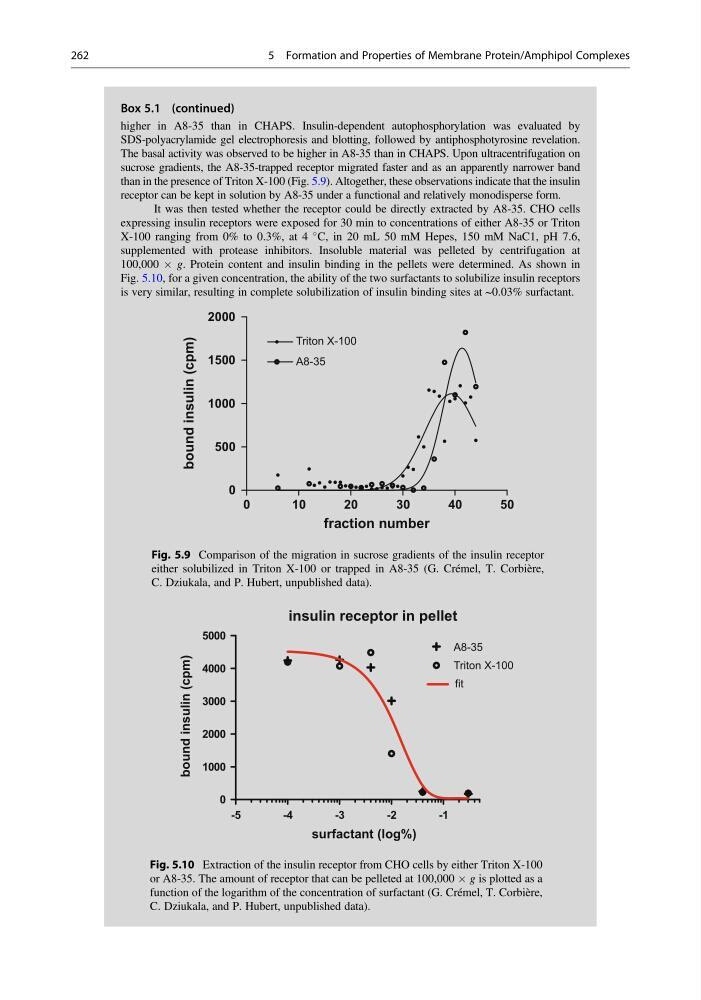
The basal activity was observed to be higher in A8-35 than in CHAPS. Upon ultracentrifugation on
sucrose gradients, the A8-35-trapped receptor migrated faster and as an apparently narrower band
than in the presence of Triton X-100 (Fig. 5.9). Altogether, these observations indicate that the insulin
receptor can be kept in solution by A8-35 under a functional and relatively monodisperse form.
It was then tested whether the receptor could be directly extracted by A8-35. CHO cells
expressing insulin receptors were exposed for 30 min to concentrations of either A8-35 or Triton
X-100 ranging from 0% to 0.3%, at 4
C, in 20 mL 50 mM Hepes, 150 mM NaC1, pH 7.6,
supplemented with protease inhibitors. Insoluble material was pelleted by centrifugation at
100,000 Â g. Protein content and insulin binding in the pellets were determined. As shown in
Fig. 5.10, for a given concentration, the ability of the two surfactants to solubilize insulin receptors
is very similar, resulting in complete solubilization of insulin binding sites at ~0.03% surfactant.
fraction number
bound insulin (cpm)
0
10
20
30
40
50
0
500
1000
1500
2000
Triton X-100
A8-35
Fig. 5.9 Comparison of the migration in sucrose gradients of the insulin receptor
either solubilized in Triton X-100 or trapped in A8-35 (G. Crémel, T. Corbière,
C. Dziukala, and P. Hubert, unpublished data).
-5
-4
-3
-2
-1
0
1000
2000
3000
4000
5000
insulin receptor in pellet
A8-35
Triton X-100
fit
surfactant (log%)
bound insulin (cpm)
Fig. 5.10 Extraction of the insulin receptor from CHO cells by either Triton X-100
or A8-35. The amount of receptor that can be pelleted at 100,000 Â g is plotted as a
function of the logarithm of the concentration of surfactant (G. Crémel, T. Corbière,
C. Dziukala, and P. Hubert, unpublished data).
262
5 Formation and Properties of Membrane Protein/Amphipol Complexes
higher in A8-35 than in CHAPS. Insulin-dependent autophosphorylation was evaluated by
SDS-polyacrylamide gel electrophoresis and blotting, followed by antiphosphotyrosine revelation.
The basal activity was observed to be higher in A8-35 than in CHAPS. Upon ultracentrifugation on
sucrose gradients, the A8-35-trapped receptor migrated faster and as an apparently narrower band
than in the presence of Triton X-100 (Fig. 5.9). Altogether, these observations indicate that the insulin
receptor can be kept in solution by A8-35 under a functional and relatively monodisperse form.
It was then tested whether the receptor could be directly extracted by A8-35. CHO cells
expressing insulin receptors were exposed for 30 min to concentrations of either A8-35 or Triton
X-100 ranging from 0% to 0.3%, at 4
C, in 20 mL 50 mM Hepes, 150 mM NaC1, pH 7.6,
supplemented with protease inhibitors. Insoluble material was pelleted by centrifugation at
100,000 Â g. Protein content and insulin binding in the pellets were determined. As shown in
Fig. 5.10, for a given concentration, the ability of the two surfactants to solubilize insulin receptors
is very similar, resulting in complete solubilization of insulin binding sites at ~0.03% surfactant.
fraction number
bound insulin (cpm)
0
10
20
30
40
50
0
500
1000
1500
2000
Triton X-100
A8-35
Fig. 5.9 Comparison of the migration in sucrose gradients of the insulin receptor
either solubilized in Triton X-100 or trapped in A8-35 (G. Crémel, T. Corbière,
C. Dziukala, and P. Hubert, unpublished data).
-5
-4
-3
-2
-1
0
1000
2000
3000
4000
5000
insulin receptor in pellet
A8-35
Triton X-100
fit
surfactant (log%)
bound insulin (cpm)
Fig. 5.10 Extraction of the insulin receptor from CHO cells by either Triton X-100
or A8-35. The amount of receptor that can be pelleted at 100,000 Â g is plotted as a
function of the logarithm of the concentration of surfactant (G. Crémel, T. Corbière,
C. Dziukala, and P. Hubert, unpublished data).
262
5 Formation and Properties of Membrane Protein/Amphipol Complexes